
book · collected works
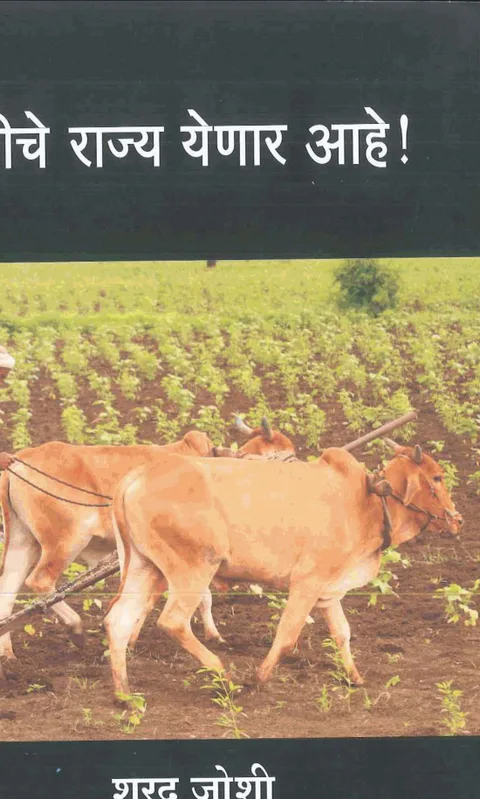
बळीचे राज्य येणार आहे
Baliche Rajey Yenar Aahe
By Sharad Joshi
जनशक्ती वाचक चळवळ · औरंगाबाद · 2010
206 pages
Summary
Baliche Rajya Yenar Aahe (बळीचे राज्य येणार आहे, ‘The Kingdom of Bali Is Coming’) is a collected-works volume of Marathi-language writings by Sharad Joshi (1935–2015), the founding leader of the Shetkari Sanghatana (Farmers’ Organisation), published by Janashakti Vachak Chalval, Aurangabad, in October 2010 to mark Joshi’s birth anniversary. The book gathers essays, speeches, and polemical pieces written across roughly three decades on Indian farm policy, the structural exploitation of agriculturalists, and the theory and practice of the shetkari movement. In the rendered pages, the volume opens with a section called ‘Chintan’ (Reflection) and launches immediately into three substantive essays.
In the rendered pages, the opening essay — ‘Annadata la purensa khau dya, to jagala potabhar khau ghailil’ (‘Let the food-giver eat his fill, and he will feed the world’) — is a long historical argument tracing how industrialisation in England and later Russia was built on the deliberate suppression of agricultural prices and the exploitation of farm labour. Joshi argues, in the rendered pages, that the Corn Laws controversy, Stalin’s collectivisation, and independent India’s Nehruvian planning framework all share a common logic: cheap food for the urban-industrial sector is extracted from the countryside at the cost of the peasant’s livelihood. He contests the Marxist framing of agriculture as a ‘primitive’ sector and insists that industrial capital accumulation everywhere has been premised on agricultural surplus extraction rather than on market exchange.
The second essay in the rendered pages, ‘Prashikshanача khara arth’ (‘The True Meaning of Training’), is an address to Shetkari Sanghatana organisers about the philosophical underpinnings of movement work. Joshi argues, in the rendered pages, that rote training programmes miss the movement’s true intellectual challenge; genuine training means instilling the capacity for independent economic analysis in farmers themselves. The third essay, ‘Bharat dashkatil chaturang sheti’ (‘Four-pronged farming in India’s decade’), begins in the rendered pages and frames the Shetkari Sanghatana’s programmatic shift toward comprehensive agricultural reform — covering crop markets, processing, exports, and input pricing — after its founding announcement. The bulk of the book (essays 4–48, covering fertiliser pricing, wheat imports, land policy, farmer suicides, sugar cooperatives, and more) falls outside the rendered pages.
Key points
-
In the rendered pages, Joshi frames global industrialisation — in England, Russia, and India — as historically dependent on the coercive suppression of farm-gate prices, a structural condition the Shetkari movement must dismantle.
-
In the rendered pages, Joshi explicitly rejects the Marxist characterisation of agriculture as a ‘primitive’ (आदिम) sector and argues that agrarian surplus extraction, not factory labour, was the true engine of capital accumulation.
-
In the rendered pages, he draws a pointed comparison between Stalin’s collectivisation (which destroyed the kulak class) and Nehru’s planning framework (which similarly subordinated farmers to an urban-industrial agenda), tracing a shared anti-peasant logic across ideological lines.
-
In the rendered pages, the essay on ‘true training’ argues that movement-building requires teaching farmers to analyse economic price mechanisms for themselves, not merely passing on organisational instructions.
-
In the rendered pages, Joshi’s tone is polemical and hortatory: the title ‘The Kingdom of Bali Is Coming’ invokes the Marathi folk-mythological figure of Bali Raja (the farmer-king) as a millennial promise of agrarian justice.
-
The publisher’s foreword (signed by Shrikant Anant Umarikar, 2 October 2010) confirms this is a collected edition and situates the volume as a tribute on Joshi’s birth anniversary.
-
The TOC lists 48 numbered chapters/essays organised under four thematic sections: Chintan (Reflection), Andolan (Movement), Sahkar (Cooperatives — cotton, milk, credit), and Karzabali (Debt-sacrifice, i.e. farmer suicides), plus an appendix.
Metadata and summary are AI-extracted from the source PDF and reviewed for editorial accuracy. The original work is available via the Read PDF tab above (where present); paragraph-level citation inside the PDF is deferred to a future engagement.