book · collected works
SATYAM EVA JAYATE
A Collection of Articles Contributed to Swarajya and Other Journals from 1956 to 1961
BHARATHAN PUBLICATIONS, KALKI BUILDINGS — KILPAUK, MADRAS-10 · Madras
570 pages

Summary
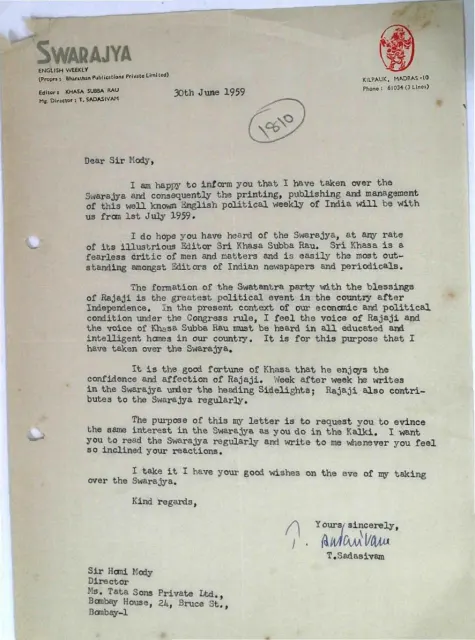
In the rendered pages, Satyam Eva Jayate (Volume I) presents itself as a collection of weekly journalistic pieces written by C. Rajagopalachari (Rajaji) for Swarajya and related journals between 1956 and 1961. The Preface makes clear that the articles are not a systematic treatise but ‘protests against errors — strongly felt protests against great errors,’ aimed squarely at the regimentation and statism of the Congress-ruled government. Rajaji dedicates the volumes to Khasa Subba Rau, the editor whose encouragement made the Swarajya venture possible, and names the collection after the Sanskrit phrase ‘Truth alone prevails’ as an act of faith against entrenched official power.
The first seven articles in the rendered pages span July–September 1956 and establish the recurring preoccupations of the collection. In ‘Value of Frank Criticism,’ Rajaji invokes Socrates’s self-description as a gadfly to argue that India’s post-Independence press has surrendered its critical function, leaving the Prime Minister cocooned in unqualified adulation and democracy itself at risk. ‘National and Official’ and ‘Commonsense vs. Pride’ mount a sustained, carefully reasoned case against making Hindi the official language of the Union, distinguishing ‘national’ (majority usage) from ‘official’ (state-enforced medium) and warning that imposing Hindi would constitute an ‘unconscionable waste’ destructive of the constitution’s linguistic guarantees. ‘Fifteenth of August’ reframes Independence Day not as a chauvinistic occasion but as a demonstration to all subject peoples that consent cannot be manufactured indefinitely. ‘Am I a Pessimist?’ catalogues contradictions in post-Independence policy — the destruction of cottage industries, the debarring of religion from schools while lamenting moral decline, the forced break-up of multi-lingual states. ‘Brinkmanship at Suez’ and ‘Physician, Heal Thyself’ turn to foreign affairs: Rajaji subjects John Foster Dulles’s doctrine of brinkmanship to biting analysis, arguing that nuclear deterrence compels peace-loving nations to concede unjust terms, and charges the Western Powers with hypocrisy in arraigning Egypt over Suez while continuing radioactive nuclear testing that poisons the world.
The physical copy scanned carries a scanner’s caveat that the book was water-damaged and pages are missing; this chunk covers only the opening front matter and the first seven of what are evidently many dozens of articles across two volumes.
Key points
-
In the rendered pages, Rajaji frames the entire collection as an act of ‘faith in truth’ against a powerful ruling party: the title Satyam Eva Jayate is explicitly explained in the Preface as a protest-slogan against government regimentation and statism.
-
In the rendered pages, the opening article uses Socrates’s gadfly metaphor to diagnose a crisis of press freedom: post-Independence India’s daily newspapers have become commercially dependent on advertisements and politically dependent on government approval, ceding the critical role once played by small, financially independent weeklies.
-
In the rendered pages, two articles on language policy (‘National and Official’ and ‘Commonsense vs. Pride’) develop the argument that Hindi may legitimately be the ‘national’ language in a cultural sense but must not become the coercive ‘official’ language of administration, because true democracy requires ‘even-handed justice to all’ communities, not imposition by numerical majority.
-
In the rendered pages, the ‘Brinkmanship at Suez’ article analyses Dulles’s brinkmanship doctrine and argues it has been deployed not only in Cold War confrontations but to bully a small nation (Egypt) into surrendering sovereign control of the Suez Canal — demonstrating that nuclear deterrence paradoxically strengthens aggressors against peace-seeking nations.
-
In the rendered pages, ‘Physician, Heal Thyself’ draws a direct parallel between the Anglo-French position on Suez and U.S. control of the Panama Canal, charging the Western Powers with applying a double standard and using propaganda machinery to justify expropriation under the guise of ‘internationalisation’.
-
In the rendered pages, ‘Am I a Pessimist?’ is a compressed inventory of policy contradictions — handloom weavers destroyed by mechanisation, religious culture denigrated in the name of anti-superstition, multi-lingual states broken up and then artificially re-stitched — that functions as an early statement of Rajaji’s disillusionment with Congress governance.
-
In the rendered pages, the Preface explicitly disavows party discipline on the language question, stating that Rajaji will not press his views through the Swatantra Party until public opinion comes round of its own accord.
Metadata and summary are AI-extracted from the source PDF and reviewed for editorial accuracy. The original work is available via the Read PDF tab above (where present); paragraph-level citation inside the PDF is deferred to a future engagement.