speech
SECOND FIVE YEAR PLAN IS THE REAL MISCHIEF-MAKER
Comments on 1957 Budget Proposals
FORUM OF FREE ENTERPRISE, "Sohrab House", 235, Dr. Dadabhai Naoroji Road, BOMBAY 1. · Bombay · 1957
6 pages
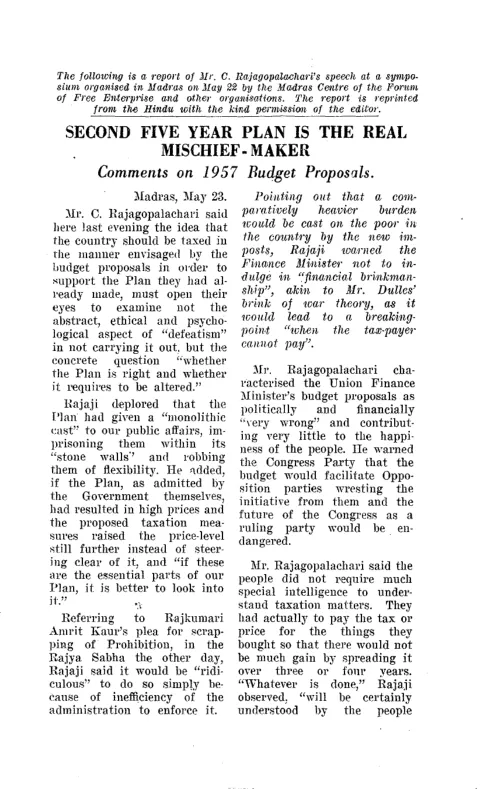
SECOND FIVE YEAR PLAN IS THE REAL MISCHIEF-MAKER
By C. Rajagopalachari
Summary
Reprinting a Hindu report of a speech delivered at a Madras symposium on May 22, 1957, organised by the Madras Centre of the Forum of Free Enterprise and other bodies, this pamphlet records C. Rajagopalachari’s frontal attack on the 1957 Budget proposals and, behind them, the Second Five Year Plan itself. Rajaji rejects the dominant frame in which critics debate only the abstract, ethical or psychological ‘defeatism’ of opposing the Plan; the concrete question, he insists, is whether the Plan is right and whether it requires alteration. He charges that the Plan has given a ‘monolithic cast’ to public affairs, imprisoning them within ‘stone walls’ and stripping them of flexibility, so that when the Plan generates high prices the Government’s only response is to pile on fresh taxes that fall on the poor.
Much of the speech is a close reading of Finance Minister T. T. Krishnamachari’s budget. Rajaji warns that the new imposts revive what he calls ‘financial brinkmanship’ and risk breaking the taxpayer’s back. He grants Krishnamachari’s intellectual stature and personal friendship, but turns this concession into the rhetorical pivot for sharper criticism: a true friend tells the truth. He defends the Opposition’s duty to wrest the political initiative from the Congress, lest the ruling party become endangered by its own monopoly. He also rejects the Government’s habit of dressing up taxation as a moral disapproval of consumption, arguing that India’s poor majority pays indirect taxes through every commodity, and that ‘looking into the Plan more carefully’ would force the Government to ‘cut their coat according to the cloth’ rather than rely on foreign aid that ‘will come back with compound interest’.
The later sections target specific measures: the wealth-tax and expenditure-tax, the kerosene price rise, increased railway fares and taxes on tea and coffee, and the constitutional novelty of an expenditure tax that Rajaji reads as a federal encroachment on the States’ sphere over sales and purchases. He defends Rajkumari Amrit Kaur’s Rajya Sabha plea for scrapping Prohibition and ridicules the converse logic — treating Government inefficiency as licence for fresh taxes. The closing paragraphs read the Government’s taxation of an agricultural article as a manufactured one, and the silent acquiescence of dole-dependent States, as further evidence that the Plan has eroded both federal balance and economic common sense. The pamphlet ends with the Forum of Free Enterprise’s Bombay imprint.
Key points
-
Rajagopalachari reframes opposition to the Plan: the question is not ‘defeatism’ but whether the Plan is correct and whether it needs alteration.
-
He accuses the Plan of imposing a ‘monolithic cast’ on public affairs, imprisoning policy within ‘stone walls’ and forcing high prices that are then patched over with new taxes.
-
He warns the Finance Minister T. T. Krishnamachari against ‘financial brinkmanship’ and argues a comparatively heavier burden of the new taxes falls on the poor.
-
He defends the constitutional role of the Opposition: the Congress itself is endangered when there is no real party wresting the political initiative.
-
He attacks the moralised rationale for indirect taxation, insisting India’s poor pay through every commodity and that ‘inefficiency of the Government’ is being used as an excuse to tax.
-
He prescribes fiscal restraint — cutting the coat to the cloth — over reliance on foreign aid that ‘will come back with compound interest’.
-
He treats the new expenditure tax as a constitutional encroachment by the Centre on the States’ sphere of taxation on sales and purchases, and reads agricultural articles being taxed as manufactured ones as a federal overreach.
-
He backs Rajkumari Amrit Kaur’s Rajya Sabha plea for scrapping Prohibition and rejects the symmetrical logic of taxing the rich to compensate for administrative failure.
Generated by the v1.5 extraction pipeline. Awaiting editorial review.
Metadata and summary are AI-extracted from the source PDF and reviewed for editorial accuracy. The original work is available via the Read PDF tab above (where present); paragraph-level citation inside the PDF is deferred to a future engagement.