pamphlet
REFORMS NEEDED IN INDIAN INCOME-TAX LAW
Published by M. R. PAI for the Forum of Free Enterprise, "Sohrab House", 235, Dr. Dadabhai Naoroji Road, Bombay-1. and printed by H. NARAYAN RAO at H. R. MOHAN & CO. (PRESS), 9-B, Cawasjee Patel Street, Bombay-1. · Bombay · 1966
13 pages
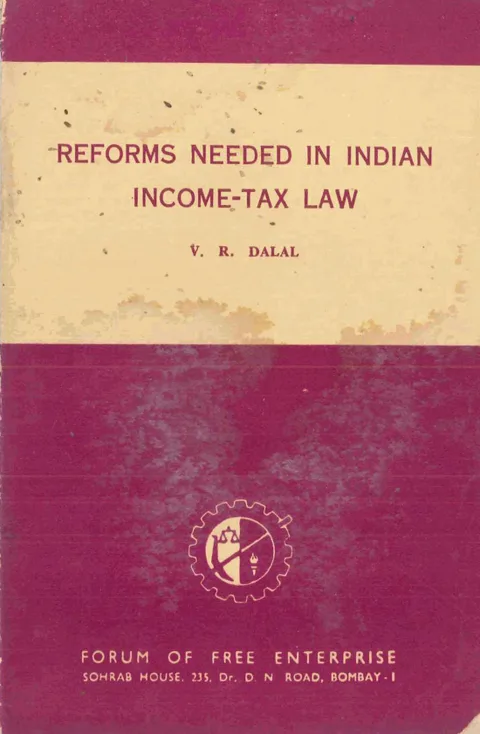
REFORMS NEEDED IN INDIAN INCOME-TAX LAW
By V. R. DALAL
Summary
V. R. Dalal, a chartered accountant writing for the Forum of Free Enterprise in February 1966, audits the Income-tax Act, 1961 — the statute that replaced the 1922 Act after four decades — against the classical canons of taxation: simplicity, certainty, and reference to ability to pay. The opening pages set the polemical frame. In a developing economy, Dalal argues, tax laws must do more than raise revenue: they must encourage business, narrow inequality, and avoid the trap of redistributing scarcity. The booklet then works through five heads — language, tax calculation, procedure, administration, and piecemeal amendments — showing that the new Act fails each test. The 1922 Act’s 67 sections have ballooned to 297 in 1961, and the drafting has grown more (not less) ambiguous: ill-defined provisions on “Not Ordinarily Resident” status, on development-rebate reserves, on capital-gains treatment of bonus shares, and on the carry-forward of losses force constant judicial intervention.
The middle pages catalogue the cumulative drift of the Act away from the principle of taxing real income. Dalal documents how “deeming” fictions, disallowed bona-fide business expenditures, artificial computation rules under Section 37, separate-legal-entity tests under Section 79, and triple-shift depreciation anomalies all push the taxable figure away from what an ordinary accountant or businessman would recognise as income. The effect is high nominal rates compounded by an artificially inflated base — taxing what the law calls income, not what is in fact earned.
The closing sections turn to administration and remedy. Dalal documents wide and largely uncheckable discretion vested in Income-tax Officers — over registration of firms (Section 185), accounting-year changes (Section 3(4)), stay of collection (Section 220), reopening of assessments under Sections 147–148, and rectification under Section 154 — and shows that even where Tribunals and Courts rule for the assessee, the Department routinely appeals or refuses to follow the spirit of the decisions. He endorses the Direct Taxes Administration Inquiry Committee’s warning that wide discretion in the hands of officers, however high-minded, breeds high-handed and unreasonable administration and damages public confidence. The pamphlet ends with a plea for a tax code that is simple, unambiguous, tied to ability to pay, and sparing in fictions and discretion — a code that does not adopt “the policy of killing the goose which lays the golden egg.”
Key points
-
Frames the 1961 Income-tax Act against three canons — simple and clear, certain and unambiguous, equitable and bearable — and finds it deficient on all three.
-
Documents bloat: the 1922 Act’s 67 sections grew to 297 in 1961, yet drafting became more (not less) ambiguous, with model examples drawn from Section 6(6)(a) on “Not Ordinarily Resident” status and Section 34(3)(a) on development rebate reserves.
-
Tracks how “deeming” fictions, disallowed bona-fide expenditures, and artificial computation rules push taxable income away from real income, violating the ability-to-pay canon.
-
Notes the multiplication of piecemeal amendments — including changes pushed through after the Finance Act, 1962 — that introduce ambiguity faster than courts can resolve it.
-
Criticises Section 37 (entertainment expenditure), Section 79 (shareholding-change losses), and the disallowance of depreciation on house property under Section 32 as departures from sound accountancy principles.
-
Catalogues unfettered administrative discretion under Sections 3(4), 147–148, 154, 185, 220, 271(1)(c), and others, where appeals against the Income-tax Officer’s exercise of power offer the assessee little real protection.
-
Endorses the Direct Taxes Administration Inquiry Committee’s caution that giving wide-ranging discretion to officials, even capable ones, breeds high-handed administration and erodes public confidence in tax fairness.
-
Calls for a code that is simple, unambiguous, tied to ability to pay, and that presumes the citizen honest — and reminds the state not to “kill the goose which lays the golden egg.”
Generated by the v1.5 extraction pipeline. Awaiting editorial review.
Metadata and summary are AI-extracted from the source PDF and reviewed for editorial accuracy. The original work is available via the Read PDF tab above (where present); paragraph-level citation inside the PDF is deferred to a future engagement.