edited volume · proceedings
Recent Changes in Laws Affecting Business and Industry
Based on a Symposium Organised by the Forum of Free Enterprise
By N. C. Mehta
POPULAR PRAKASHAN, BOMBAY · Bombay · 1965
153 pages
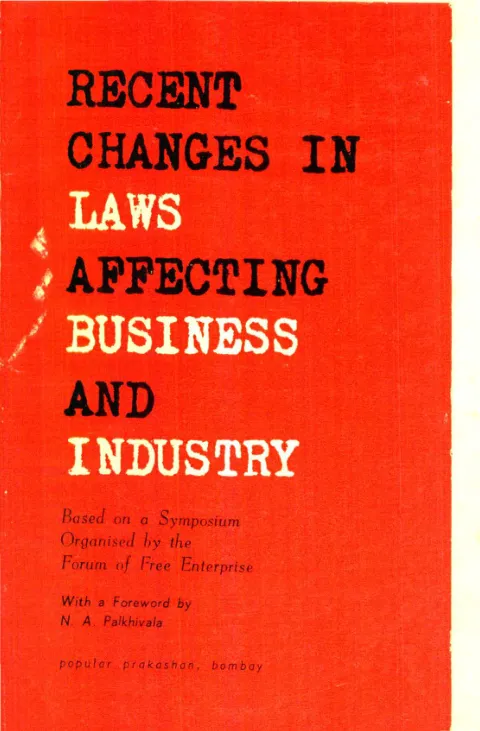
Recent Changes in Laws Affecting Business and Industry
Summary
In the rendered pages, this 1965 Forum of Free Enterprise pocketbook collects talks from a Bombay symposium on how the rapid, repeated amendment of Indian commercial law was affecting business and industry. The front matter rendered here — a foreword by N. A. Palkhivala, an introduction by A. D. Shroff in his capacity as Forum President, and the contents page — frames the project as a complaint against legislative excess: laws so frequent, so complex, and so carelessly drafted that compliance has become near-impossible for laymen and exhausting for experts. The contents page rendered here lists six contributions covering income-tax computation (S. P. Mehta), mercantile law (Khorshed D. P. Madon), company law (H. B. Dhondy), foreign exchange (S. R. Vakil), sales tax (N. C. Mehta), and corporate taxes (S. V. Ghatalia). In the rendered pages, only S. P. Mehta’s opening essay on the computation of business profits under the Income-tax Act is substantively visible, and even there the chunk stops one printed page short of its end. The argumentative centre observable in the rendered pages is the rule-of-law claim — Shroff’s insistence that good and simple laws are a precondition for economic functioning, and Palkhivala’s catalogue of defects (uncertainty, complexity, injustice, careless drafting) — applied to the specific irritants the contributors knew best as practising advocates and chartered accountants.
Key points
-
This 1965 Forum of Free Enterprise pocketbook collects talks from a Bombay symposium on how frequent, complex amendment of Indian commercial law was burdening business and industry.
-
N. A. Palkhivala supplies the foreword and A. D. Shroff, writing as Forum President, an introduction framing the project as a complaint against careless and excessive legislative drafting.
-
The contents list six contributions: S. P. Mehta on income-tax computation, Khorshed D. P. Madon on mercantile law, H. B. Dhondy on company law, S. R. Vakil on foreign exchange, N. C. Mehta on sales tax, and S. V. Ghatalia on corporate taxes.
-
Only S. P. Mehta’s opening essay on computing business profits under the Income-tax Act survives in the rendered material, breaking off one printed page short of its end.
-
Mehta cites the Supreme Court’s Krishna Menon ruling, in which even a Vedanta philosopher’s voluntary receipts from a disciple were taxed as vocation income, to show how elastically ‘business’ is defined.
-
He criticises the Income-Tax Officer’s latitude to reject account books on flimsy grounds and the routine disallowance of pre-commencement expenses and payments to relatives of controlling shareholders.
-
Mehta treats the Supreme Court’s 2-1 ruling in Pingle’s Industries and Abdul Kayoom, holding royalty payments to be non-deductible capital expenditure, as commercially unrealistic and ripe for legislative reversal.
-
He resists extending the Haji Aziz & Bros and Abdul Shakoor precedents, arguing a bona fide payment should not be disallowed merely because an incidental law was breached.
Essays
Few aspects of computation of Business Profits under Income-tax Act
By S. P. Mehta
In the rendered pages, S. P. Mehta — described in the footnote as an eminent advocate specialising in income-tax law — walks through what he treats as a series of unfair or unsettled wrinkles in the computation of business profits under the Income-tax Act. He opens with a Holmesian aphorism on taxes as the price of civilisation, then catalogues the elastic statutory definition of “business” (citing the Supreme Court’s Krishna Menon ruling that even a Vedanta philosopher’s spontaneous receipts were taxable vocation income), the Income-Tax Officer’s freedom to reject account books on flimsy grounds, the harsh treatment of pre-commencement expenses, the disallowance of remuneration to persons connected with controlling shareholders, and the rejection of foreign travel costs as capital expenditure. He extends the critique to royalty payments — citing Pingle’s Industries and Abdul Kayoom, where the Supreme Court by 2-1 held royalty to be non-deductible capital expenditure — and to the broader question of whether the State should disallow payments simply because some incidental law was breached (Haji Aziz & Bros and Abdul Shakoor). The essay closes within the rendered chunk on the treatment of speculative-transaction losses and the misuse of losing companies under Section 79. Throughout, Mehta’s stance is that the legislature and the tax authorities are tilted against the assessee, and that fair drafting and disciplined administrative practice would close most of the disputes.
- Mehta opens with Justice Holmes’s aphorism that taxes are the price of civilised society, then jokes that an Indian taxpayer is surrounded on all sides — income tax, expenditure tax, wealth tax, gift tax, estate duty.
- The statutory definition of “business” is so wide (per the Supreme Court in Krishna Menon vs. Commissioner of Income-Tax, Madras) that even a Vedanta philosopher’s voluntary receipts from a foreign disciple were taxed as vocation income.
- The Income-Tax Officer’s power to reject books of account on flimsy grounds, and to compare marginal units against the largest in a trade, produces systemic unfairness despite the constitutional guarantee of equality.
- Pre-commencement expenses are routinely disallowed even though, if rolled into a third-party turnkey contract, the identical outlays would be capitalised — an arbitrary distinction Mehta urges authorities to abandon.
- Remuneration paid to relatives or associates of company controllers is often disallowed under the wide power in the Act, even when the recipient would draw the same pay on merit elsewhere; Mehta argues the power should be confined to cases where company interests are actually overlooked.
- Foreign travel by directors or partners to acquire know-how is wrongly treated as capital expenditure: improving an individual’s knowledge is not the acquisition of a capital asset.
- On royalty, the Supreme Court’s majority in Pingle’s Industries and Abdul Kayoom treated payments for stock-in-trade as non-deductible capital expenditure — a result Mehta finds at odds with commercial reality and one Parliament should overturn by amendment.
- Mehta resists extending Haji Aziz & Bros and Abdul Shakoor: a bona fide payment should not be disallowed simply because the underlying arrangement contravenes some law, when even tainted income is itself taxable.
Generated by the v1.5 extraction pipeline. Awaiting editorial review.
Metadata and summary are AI-extracted from the source PDF and reviewed for editorial accuracy. The original work is available via the Read PDF tab above (where present); paragraph-level citation inside the PDF is deferred to a future engagement.