speech
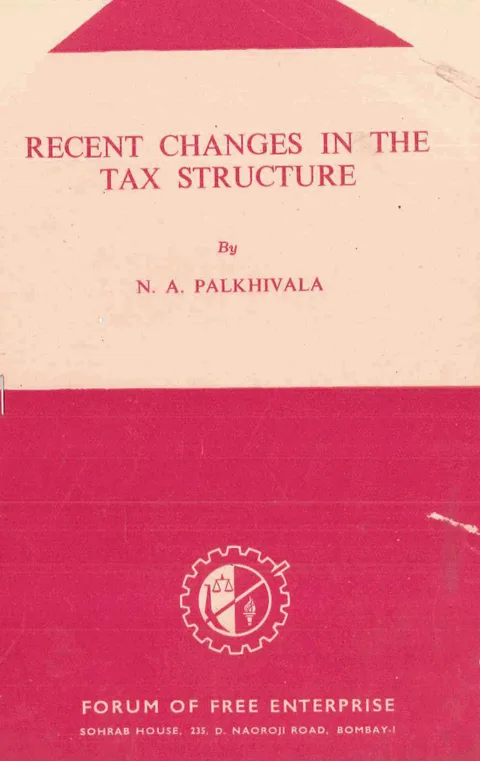
Recent Changes in the Tax Structure
Forum of Free Enterprise, Sohrab House, 235, D. Naoroji Road, Bombay-1 · Bombay · 1958
11 pages
Recent Changes in the Tax Structure
By N. A. Palkhivala
Summary
N. A. Palkhivala’s pamphlet, based on a talk delivered under the auspices of the Forum of Free Enterprise in Bombay on December 2, 1957, treats 1957 as a watershed in Indian fiscal history. He argues that, almost unnoticed, the country has passed through a revolution in its taxation laws, and organises his critique under three heads: the introduction of new taxes, the complication of existing ones, and the growing use of taxation as an instrument of executive control over private life.
The first part dissects the new Wealth-tax, Expenditure-tax and Capital Gains tax. Palkhivala attacks the Wealth-tax Act, 1957 for resting on the subjective opinion of the Wealth-tax Officer (Sections 2(m), 3 and 7), for amounting to virtual expropriation by swallowing income, and for irrationally taxing companies — a measure even Prof. Kaldor, who conceived the combined levy, opposed. He pillories the Expenditure-tax as a fourth bite at the same cake and a futile attempt to discourage ostentation, citing William Pitt’s Napoleonic-war income-tax as proof that ‘temporary’ taxes never die. The Capital Gains tax is judged inopportune in a capital-hungry economy.
The second section catalogues complications such as the Current Profits Deposit Rules and amendments to Section 23-A of the Income-tax Act, which leave ‘approved purposes’ to executive discretion and produce capricious differential super-tax on dividends. The third and most polemical section turns from finance to freedom: tax legislation is becoming the leading edge of a wider regimentation in which executive officers, untrained in judicial reasoning, are vested with the widest powers, redress in court is being narrowed, and Chapter 3 of the Constitution risks becoming a dead letter. Palkhivala closes by warning that doubling the national income through the Five-Year Plan will be a poor bargain if civil liberty and individual freedom are halved in the process — the people would have sold their priceless heritage for a mess of pottage.
Key points
-
Frames 1957 as the most consequential year for Indian taxation, comparable in significance to 1757 and 1857 in earlier Indian history.
-
Organises the critique under three heads: new taxes, complicated existing taxes, and executive control over private life through tax law.
-
Attacks the Wealth-tax Act, 1957 for relying on the subjective opinion of the Wealth-tax Officer and for irrationally double-taxing companies, contrary even to Prof. Kaldor’s original design.
-
Reads the Expenditure-tax as a fourth duplicative levy on already-taxed income, futile as a check on ostentation and likely to be permanent — citing William Pitt’s ‘temporary’ Napoleonic income-tax as precedent.
-
Argues the Capital Gains tax is inopportune in a capital-starved economy that needs investment in industry.
-
Identifies Section 23-A amendments and the Current Profits Deposit Rules as instances of legislation that hands businesses’ commercial judgement to executive discretion under vague ‘approved purposes’ standards.
-
Warns that ‘opinion of the Government’ clauses oust judicial review, citing the Bombay Land Requisition Act as a more drastic instrument than any English wartime measure.
-
Concludes that civil liberty and individual freedom can die in a democracy as surely as under totalitarianism — leaving only the ‘husk of democracy’ if the Five-Year Plan doubles income while halving freedom.
Generated by the v1.5 extraction pipeline. Awaiting editorial review.
Metadata and summary are AI-extracted from the source PDF and reviewed for editorial accuracy. The original work is available via the Read PDF tab above (where present); paragraph-level citation inside the PDF is deferred to a future engagement.