essay
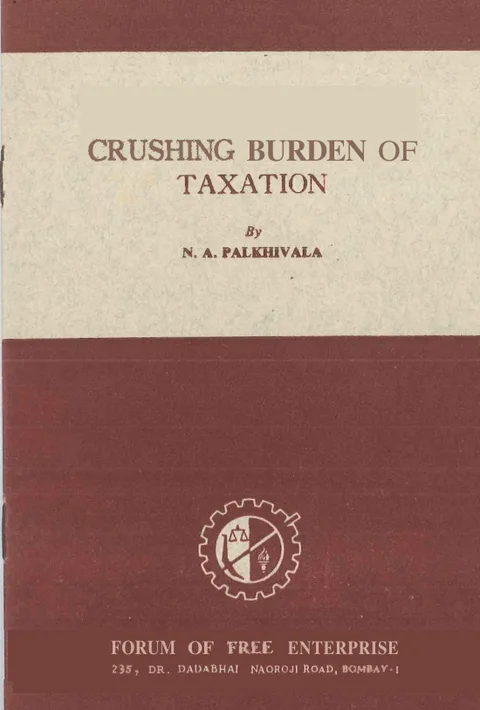
Crushing Burden of Taxation
FORUM OF FREE ENTERPRISE, 235, DR. DADABHAI NAOROJI ROAD, BOMBAY-1 · Bombay · 1958
9 pages
Summary
Reproduced from The Hindu’s Survey of Indian Industry (22 November 1958), this Forum of Free Enterprise booklet is a closely argued polemic by N. A. Palkhivala against the structure and conduct of Indian tax legislation in the eighth year of the Republic. Palkhivala opens with a constitutional complaint: although the Constitution preserves the balance between Legislature, Executive and Judiciary, in practice the Executive has become predominant, unchecked by any effective parliamentary Opposition or organised public opinion, and able to push tax bills through with almost no scrutiny. The Gift-tax Act of 1958, on which the Select Committee was given less than a week to report, is offered as a representative case of the haste with which half-baked tax legislation is being rushed onto the statute book.
The core of the booklet is a forensic tour of recent fiscal statutes. Palkhivala dissects double taxation under the 1957 Wealth-tax Act, the post-1956 income-tax regime that levies tax twice over on registered firms and their partners, the unjustified penal super-tax on companies that declare large dividends out of past reserves (Section 23A) or refuse to declare a dividend at all (Section 33A), and the “business connection” doctrine of Section 42, which he argues is severely damaging India’s trade with foreign countries. India, he notes with characteristic acidity, is the first country in the world to levy expenditure-tax, an unprecedented imposition on “a nation which has so little to expend”, and one whose revenue yield is trivial set against its discouraging effect on businessmen.
The second movement of the argument is moral and institutional. Palkhivala accuses the Government of treating taxation as an exercise in abstract theory and doctrinaire fiscal craftsmanship, designed by statistical experts who ignore the human element. He calls for “men of humanity, vision and imagination” — citing Charles Morgan’s Liberties of the Mind — to be brought into the framing of tax law, and warns that the elaborate new taxing pattern has not in fact checked tax-evasion: “the income-tax, wealth-tax and expenditure-tax returns of some of the wealthiest men in India” should be made public if the authorities’ claims are to be tested. The closing pages invoke Voltaire, Browning, Montesquieu, Justice Harman in Moorhouse v. Dooland, and an edict of Czar Peter I to warn that elected representatives, like autocrats, can grow deaf to reasoned public protest, and that despite all the grievances aired “there has been no response from New Delhi.”
Key points
-
Frames the central problem as constitutional: in the eighth year of the Republic, the Executive has become predominant over the Legislature and Judiciary, allowing tax bills to pass with negligible scrutiny.
-
Singles out the Gift-tax Act of 1958 as an emblem of rushed legislation: the Select Committee was given less than a week to report before it was passed and brought into force retrospectively.
-
Attacks the post-1956 income-tax regime and the 1957 Wealth-tax Act for systematically double-taxing registered firms, partners, companies and shareholders on the same income or assets.
-
Critiques Section 23A and Section 33A of the Income-tax Act for imposing penal super-tax on companies whether they declare large dividends out of past reserves or refuse to declare a dividend altogether.
-
Argues that the ‘business connection’ doctrine in Section 42 is uniquely Indian (with only Australia as a partial parallel) and is damaging the country’s trade with foreign countries.
-
Highlights India as the first country in the world to levy expenditure-tax, a measure he calls economically misconceived and revenue-trivial, and one that may actually encourage evasion through corporate expense accounts.
-
Calls for tax legislation to be drafted with the help of ‘men of humanity, vision and imagination’ — humane counsellors of the sort that Commissions and Advisory Councils conspicuously lack — not only statistical experts.
-
Concludes that despite the elaborate new pattern of taxation, tax-evasion has not been checked, and that grievances ventilated through public protest have been met with silence from New Delhi.
Metadata and summary are AI-extracted from the source PDF and reviewed for editorial accuracy. The original work is available via the Read PDF tab above (where present); paragraph-level citation inside the PDF is deferred to a future engagement.