
speech
An Analysis of Direct Tax Laws (Amendment) Bill, 1988.
By Dinesh Vyas
Published by M.R.PAI for the Forum of Free Enterprise, "Piramal Mansion", 235 Dr. D. N. Road, Bombay - 400 001. and printed by TUSHAR GOSHALIA at Tara Enterprises, 81/7, Raju Villa, Brahmanwada Road, King's Circle, Bombay - 400 019. · Bombay · 1988
20 pages
Summary
Dinesh Vyas, a practising Supreme Court advocate, takes apart the Direct Tax Laws (Amendment) Bill, 1988 — a piece of legislation introduced to walk back the most contentious portions of the Direct Tax Laws (Amendment) Act, 1987. He sets the dispute in long historical terms: taxation is a perpetual battle between the State’s financial claims and the citizen’s proprietary rights, and the 1987 Act provoked the bitterest such battle Indian tax law has seen, with public bandhs in Delhi, Bombay, and Ahmedabad and an appeal to the President to withhold assent. The 1988 Bill, he argues, is the Government’s incomplete retreat: it deletes some provisions, restores some pre-1987 schemes (notably for charitable trusts and the taxation of firms and partners), but retains the new assessment scheme and reintroduces stiffer concealment penalties.
Section by section, Vyas weighs which 1988 changes are welcome and which deserve resistance. He praises the new Section 80HHD for hotels and licensed travel agents earning convertible foreign exchange, the carve-out of export profits from the Section 115J minimum-tax net, the new Section 10(6C) exemption for technical-services fees paid to foreign companies, and the reintroduced Investment Allowance for new plant and machinery installed after 31 March 1988. He objects, however, to the proposed reading of Section 80HHC that would condition the export deduction on actual profits — removing the impetus that previously sustained loss-making exports — and to new valuation rules under the Wealth Tax and Gift Tax Acts that switch unquoted shares to break-up value and burden post-1974 residential property owners.
His fiercest criticism is reserved for the proposed widening of “income” in Section 2(24) to bring employee allowances within the tax net, made retrospective to 1 April 1962. The amendment would supersede two decades of judicial pronouncements favouring employees, fall hardest on the salaried lower-middle class, and require even completed assessments to be reopened. He treats the move as both unjust to working-class taxpayers and a violation of the canons of certainty and stability in tax law.
Vyas closes with a broader indictment: the Income-tax Act, 1961 has been mauled by Parliamentary onslaught since its birth, the canons of simplicity and certainty have been “mercilessly violated”, and the “undue anxiety to reach the last paisa through a statutory net” has produced a foolproof-on-paper system that in practice weakens administration and rewards evasion. India deserves, he writes, simpler direct tax laws tailored to the twenty-first century.
Key points
-
Frames the 1988 Bill as a partial Government retreat after the 1987 Direct Tax Laws Amendment Act provoked unprecedented public protest (city bandhs in Delhi, Bombay, Ahmedabad) and an appeal to the President.
-
Welcomes restoration of the pre-1987 schemes for charitable trusts and institutions, and for taxation of firms and their partners, while noting new conditions on trust exemptions.
-
Praises export-sector reliefs: new Section 80HHD for hotels and licensed travel agents earning convertible foreign exchange, and the exclusion of export profits from the Section 115J minimum-tax computation.
-
Criticises the amendment to Section 80HHC, arguing that conditioning the export deduction on profits removes the incentive that sustained exports even in loss years.
-
Welcomes the reintroduction of Investment Allowance for plant and machinery installed after 31 March 1988, but flags as illusory the requirement that the option, once exercised, is locked in for five years.
-
Strongly opposes the widening of “income” in Section 2(24) to tax employee allowances retrospectively from 1 April 1962, arguing it supersedes two decades of judicial pronouncements and crushes the salaried lower-middle class.
-
Objects to new Wealth Tax / Gift Tax valuation rules that depart from settled Supreme Court principles by applying the break-up method to unquoted shares and that adversely revalue post-1974 residential property.
-
Diagnoses Indian direct tax law as suffering chronic instability — invoking a 1958 verdict that no Act in the country’s history had been changed beyond recognition like the 1922 Income-tax Act, and arguing the 1961 Act has been worse.
-
Argues that the canons of simplicity and certainty have been violated by the State’s anxiety to plug every gap, weakening administration and aiding evasion, and calls for direct tax laws tailored to twenty-first-century India.
Metadata and summary are AI-extracted from the source PDF and reviewed for editorial accuracy. The original work is available via the Read PDF tab above (where present); paragraph-level citation inside the PDF is deferred to a future engagement.
People in this work
Related across the archive
 Primary workThe Taxation Laws (Amendment) Bill, 1973
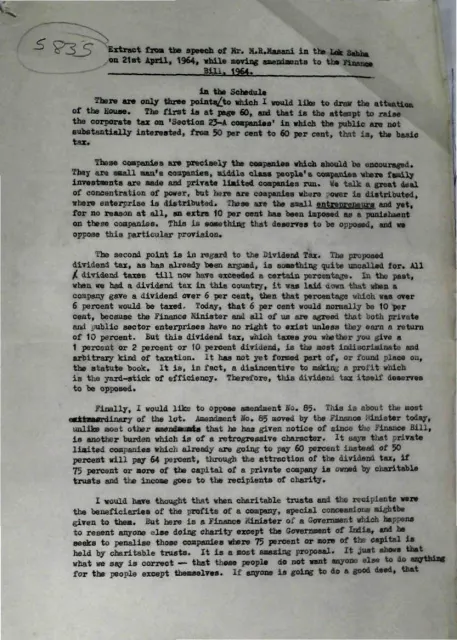 Primary workExtract from the speech of Mr. M.R.Masani in the Lok Sabha on 21st April, 1964, while moving amendments to the Finance Bill, 1964.
 Primary workREFORMS NEEDED IN INDIAN INCOME-TAX LAW
 ExcerptCrushing Burden of Taxation - Nani Palkhivala
 ExcerptJamshed Antia's Views On Sales Tax