
speech
INCOME-TAX BILL PENALISES HONEST TAX-PAYERS
Published by M. R. Pai, for Forum of Free Enterprise, "Sohrab House," 235, Dr. Dadabhai Naoroji Road, Bombay 1, and printed by S. Krishnamoorthy at Western Printers & Publishers (Prop. K. S. Mistry), 15/23, Hamam Street, Bombay 1. · Bombay · 1961
18 pages
Summary
Based on a lecture delivered under the auspices of the Forum of Free Enterprise in Bombay on 25 July 1961, this booklet is N. A. Palkhivala’s clause-by-clause critique of the Income-tax Bill that was then before Parliament. Palkhivala argues that the re-enactment of the 1922 Income-tax Act, far from being used as a golden opportunity to bring “a modicum of justice and fairplay” into Indian tax law, will inject fresh inequities while leaving almost all of the existing ones unredressed. He frames the country as falling into two divisions: those who conceive and administer the laws, and those who timidly suffer them — and the Bill, in his reading, treats the honest taxpayer as the principal target.
The bulk of the booklet is a granular walk through more than a dozen specific clauses. Clause 2(47) imports capital-gains tax onto shareholders of amalgamated companies, hitting the middle classes who hold the bulk of corporate share capital. Clause 9 perpetuates a vague doctrine of “business connection” that deters foreign capital just when India is wooing it. Clauses 10(10), 11 and 13 hit retirement gratuities for private-sector employees and bona fide charitable trusts, including, in his words, charities created for the poor relatives of a settlor — provisions he calls “a more blatant sin against humanity in the name of a Welfare State.” Clauses 62 and 64 tax irrevocable trusts in the hands of the settlor; Clause 67(3) denies legitimate partnership deductions; Clauses 86 and 182 perpetuate the double taxation of registered firms; Clauses 33–34, 87 and 23 strip honest taxpayers of development rebate, life-insurance rebate and full municipal-tax deduction on technical grounds; Clause 104 punishes companies that use current profits to pay past tax arrears or trade liabilities rather than declare dividends; and Clause 179 — described as a “violent departure” from Indian jurisprudence — pierces the corporate veil to make directors, shareholders and even their heirs personally liable for a private company’s tax dues. Clause 254 extends the Tribunal’s powers in a way that can leave the taxpayer worse off for appealing.
Behind every clause, Palkhivala discerns the same impulse: a state that would rather tighten the net around the honest majority than refine its tools for catching the few who are dishonest. He closes by invoking Justice Frankfurter on the citizen’s duty in a democracy — and exhorts the reader, as a holder of the office of citizen, to oppose the Bill’s unjust provisions through public protest and amendment.
Key points
-
The 1961 Income-tax Bill is presented as a missed opportunity to inject justice and fairplay into the income-tax law that has stood since 1922.
-
Palkhivala’s central charge: the Bill is heavily loaded against the taxpayer; honest taxpayers are made worse off merely to widen the net for the dishonest.
-
Clause 2(47) extends capital-gains tax to shareholders of amalgamated companies and Clause 9 entrenches the vague “business connection” doctrine that deters foreign capital.
-
Clauses 10(10), 11 and 13 squeeze private-sector retirement gratuities and bona fide charitable trusts — including those benefitting poor relatives of the settlor.
-
Clauses 62, 64 and 67(3) tax genuine irrevocable trusts in the settlor’s hands and deny legitimate partnership deductions, breeding disrespect for the law.
-
Clauses 86 and 182 perpetuate the double taxation of registered firms, while Clauses 33–34, 87 and 23 deny development rebate, life-insurance rebate and full municipal-tax deduction on technical grounds.
-
Clause 104 penalises companies that pay past tax arrears or trade liabilities out of current profits instead of declaring dividends.
-
Clause 179 — singled out as the most dangerous innovation — pierces the corporate veil to make directors, shareholders and even their heirs personally liable for a private company’s unpaid tax.
Metadata and summary are AI-extracted from the source PDF and reviewed for editorial accuracy. The original work is available via the Read PDF tab above (where present); paragraph-level citation inside the PDF is deferred to a future engagement.
People in this work
Related across the archive
 Primary workA REVIEW OF THE FINANCE (No. 2) BILL, 1962
 Primary workAN ANALYSIS OF BUDGET PROPOSALS (1963-64)
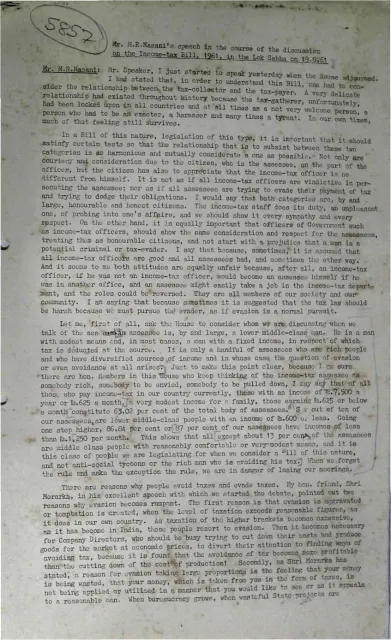 Primary workMr. M.R.Masani's speech in the course of the discussion on the Income-tax Bill, 1961, in the Lok Sabha on 19.8.61
 ExcerptCrushing Burden of Taxation - Nani Palkhivala
 ExcerptIndia: Seeing the Future in its Past