speech
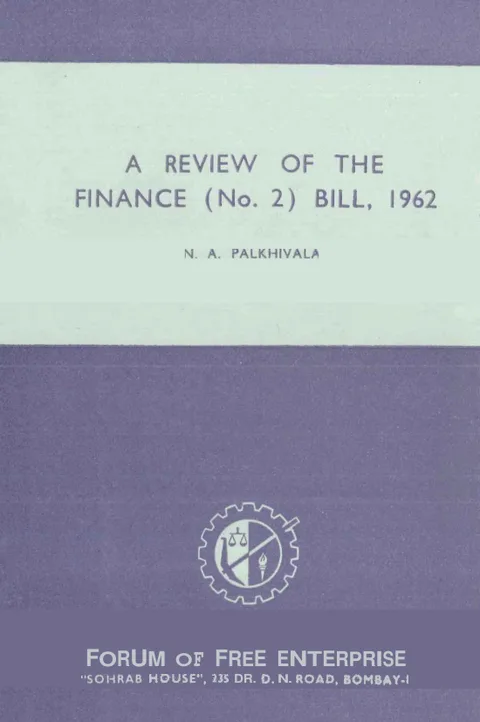
A REVIEW OF THE FINANCE (No. 2) BILL, 1962
FORUM OF FREE ENTERPRISE, "SOHRAB HOUSE", 235 DR. D. N. ROAD, BOMBAY-1 · Bombay · 1962
9 pages
Summary
N. A. Palkhivala’s pamphlet — based on a talk delivered under the auspices of the Forum of Free Enterprise in Bombay on May 7, 1962 — is a clause-by-clause critique of the Finance (No. 2) Bill, 1962. His central charge is that the Bill’s treatment of capital gains and capital losses is the “most blatantly unjust proposal” in the Budget, indefensible “by any process of reasoning or by reference to any notion of fairplay in a socialistic or welfare State.” By limiting the rate on long-term gains while abolishing the right to carry forward long-term capital losses, the Bill places “the thrifty citizen who helps the progress and growth of the nation by saving and investing, in a worse position in many respects than the gambler and the speculator.” Palkhivala walks through three archetypes — Mr. Speculator, Mr. Trader and Mr. Investor — to show that only the long-term investor, “the backbone of a stable and progressive nation,” is denied symmetrical treatment of losses.
The pamphlet then turns to corporate taxation, dividend taxation, the abolition of entertainment-expense deductions, the export incentive, and personal taxation. Palkhivala argues that the proposed rise in corporate tax to 50 per cent, layered onto cascading taxes on inter-corporate dividends, will leave net margins below what the Tariff Commission itself contemplated when fixing administered prices. He notes that the Department’s fear of bogus capital-loss claims is already met by Section 52 of the Income-tax Act, 1961, and that suspending genuine rights because of a handful of wrong-doers “is not a democracy, it is despotism.”
In the final pages Palkhivala turns to personal income-tax and wealth-tax rates — among the highest in the world — showing that the marginal investor of an additional Rs. 100 yielding Rs. 6 will pay more than Rs. 6 in combined wealth-tax and income-tax, a confiscatory result. He praises Morarji Desai’s “great courage and independent thinking” in abolishing the Expenditure Tax but laments that the recommendations of the Law Commission, the Direct Taxes Administration Enquiry Committee, and the Mudaliar-led export committee continue to be ignored. The piece closes with the hope that the Finance Minister will “rise to the occasion and respond to the appeal of reason and justice and withdraw some of the unsatisfactory features of the Budget proposals.”
Key points
-
Frames the capital-gains and capital-losses provisions of the Finance (No. 2) Bill, 1962 as the Bill’s most indefensible feature, penalising the long-term saver relative to the speculator and the trader.
-
Walks through three archetypes — Mr. Speculator, Mr. Trader, Mr. Investor — to show that only the investor is denied the right to carry forward losses, despite being the country’s source of productive capital.
-
Argues that abolishing carry-forward of long-term capital losses, while leaving long-term gains taxed at a concessional rate, has “the astounding result of putting the thrifty citizen … in a worse position than the gambler and the speculator.”
-
Rejects the Department’s anti-abuse rationale: Section 52 of the Income-tax Act, 1961 already empowers it to disallow bogus loss claims, so collective punishment of genuine investors is unjustified.
-
Critiques the proposed rise in corporate taxation to 50 per cent and the cascading taxation of inter-corporate dividends, which renders the Tariff Commission’s earlier price-fixing assumptions obsolete.
-
Attacks the ceiling on entertainment expenses (Rs. 1,00,000 dropped to Rs. 60,000) and the arbitrary cuts in the export-profits rebate as ill-conceived and likely to deter legitimate business activity.
-
Documents that individual income-tax rates in India are among the highest in the world — rising to 82 per cent on earned and 87 per cent on unearned income — and that combined wealth-tax plus income-tax can exceed the total yield on an additional investment.
-
Calls on the Finance Minister to honour the recommendations of the Law Commission, the Direct Taxes Administration Enquiry Committee, and the Mudaliar-led export committee, and to withdraw the Bill’s most unjust features.
Metadata and summary are AI-extracted from the source PDF and reviewed for editorial accuracy. The original work is available via the Read PDF tab above (where present); paragraph-level citation inside the PDF is deferred to a future engagement.