pamphlet
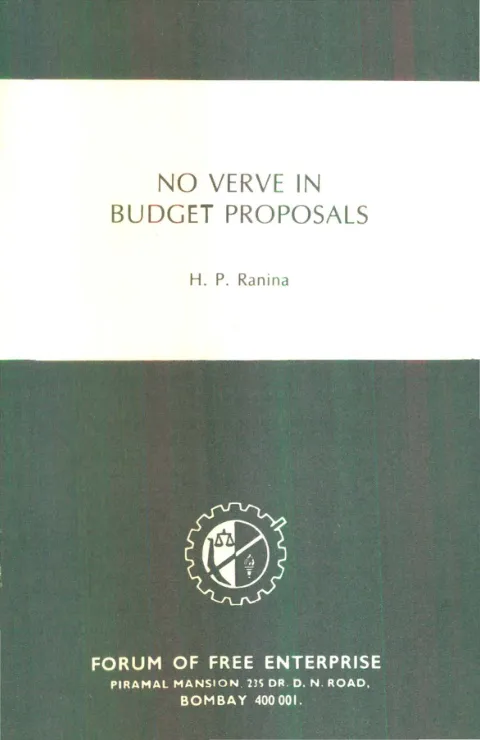
NO VERVE IN BUDGET PROPOSALS
By HP Ranina
FORUM OF FREE ENTERPRISE, PIRAMAL MANSION, 235 DR. D. N. ROAD, BOMBAY 400 001. · Bombay · 1984
22 pages
Summary
Ranina opens with a diagnosis of the Indian economy of 1984 — uncontrollable prices, a stagnant industrial sector, dwindling foreign exchange reserves, the spreading cancer of black money and tax evasion, a flatulent public sector, labour indiscipline, and decaying infrastructure — and argues that the Finance Minister’s Budget proposals do nothing to revive industry or to meet the 9 per cent growth target fixed under the Seventh Five-Year Plan. The pamphlet then walks the reader through the Finance Bill, 1984, in three parts: provisions affecting industry, provisions affecting individuals, and miscellaneous provisions.
On industry, Ranina attacks the persistence of depreciation on historical cost when replacement cost is roughly three times original cost, and proposes either a tax-payer surcharge route or depreciation on double the original cost. He criticises the abolition of weighted deductions under sections 35(2-A), 35(2-B) and 36(1)(ii-a) for scientific research and for salaries paid to blind or physically disabled employees; the discontinuance of the rehabilitation allowance under section 33-B; and the withdrawal of the agricultural-extension deduction under section 35-C. He warns that reductions in the foreign-technology and inter-corporate dividend deductions under sections 80-N, 80-O and 80-M will retard technology imports and discourage subsidiary formation, even as the Bill raises ceilings on managerial remuneration under sections 40(c) and 40-A(5).
On individuals, Ranina credits the Finance Minister for cutting personal income-tax rates but calls the doubled wealth-tax exemption on houses (Rs.1 lakh to Rs.2 lakhs) almost meaningless after Rule 1-BB, and condemns the retrospective abolition of section 80-CC (equity investment relief) and the withdrawal of section 80-D medical-treatment deductions. He welcomes the expansion of section 80-L to National Deposit Scheme deposits and bank deposits, and the procedural relaxation of TDS on small interest and dividend receipts. On miscellaneous provisions, he supports the new compulsory tax audit for businesses above Rs.20 lakh turnover and professions above Rs.10 lakh, and analyses the new prohibition (with criminal penalty) on cash loans and deposits of Rs.10,000 or more. His conclusion is that the proposals merely make cosmetic changes and would do nothing to solve inflation, unemployment, or the foreign exchange crisis — the Budget should have been tailored to the Seventh Plan rather than to the forthcoming elections.
Key points
-
Frames the 1984 economic scenario around three weaknesses — uncontrollable prices, a stagnant industrial sector and dwindling foreign exchange reserves — and argues the Finance Minister has left them untouched.
-
Attacks depreciation on historical cost when replacement cost is roughly three times original cost; proposes either a tax-payer surcharge write-off or depreciation on double the original cost to ensure asset replacement.
-
Criticises the proposed abolition of weighted-deduction provisions under sections 35(2-A), 35(2-B) and 36(1)(ii-a) of the Income-tax Act and the discontinuance of the rehabilitation allowance under section 33-B and the section 35-C agricultural-extension deduction.
-
Warns that the cut in sections 80-N, 80-O and 80-M deductions (from 100 to 50 or 60 per cent) will retard technology imports, foreign-exchange earnings and the formation of priority-industry subsidiaries.
-
Calls the doubling of the wealth-tax exemption for houses from Rs.1 lakh to Rs.2 lakhs almost meaningless after Rule 1-BB collapsed residential valuations, and condemns the retrospective abolition of section 80-CC equity-investment relief and the withdrawal of the section 80-D medical-treatment deduction.
-
Supports the new compulsory tax audit obligation for businesses with turnover above Rs.20 lakhs and professions above Rs.10 lakhs as being in the best interest of taxpayers and the revenue administration.
-
Examines the new section debarring loans or deposits of Rs.10,000 or more otherwise than by account-payee cheque, with penalties of up to two years’ imprisonment, as a device to curb the laundering of unaccounted cash.
-
Concludes that the provisions are cosmetic, will not address inflation, unemployment or foreign exchange depletion, and that the Budget should have been tailored to the Seventh 5-Year Plan rather than to the forthcoming elections.
Metadata and summary are AI-extracted from the source PDF and reviewed for editorial accuracy. The original work is available via the Read PDF tab above (where present); paragraph-level citation inside the PDF is deferred to a future engagement.