edited volume · anthology
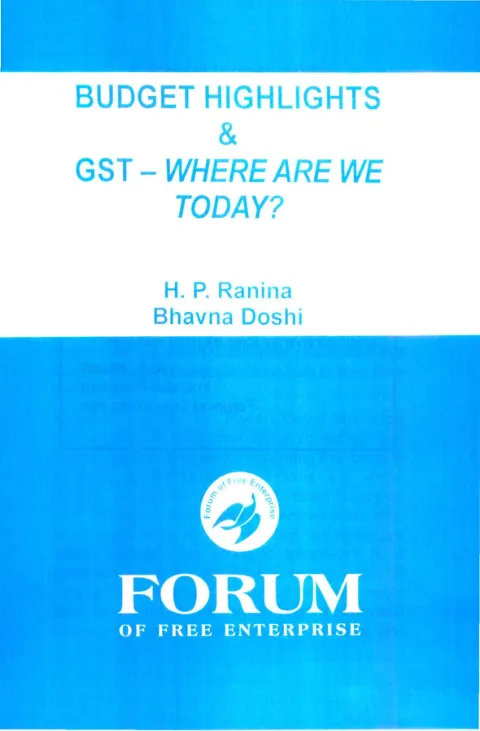
Budget Highlights & GST – Where Are We Today?
By HP Ranina
Forum of Free Enterprise · 2019
32 pages
Summary
This Forum of Free Enterprise booklet bundles two short policy commentaries on India’s Interim Budget for FY 2019-20 and the state of the Goods and Services Tax regime, prefaced by an Editorial Introduction signed by Sunil S. Bhandare. The first article, by Forum President H. P. Ranina, surveys Finance Minister Piyush Goyal’s Interim Budget and reads it as a ‘road map’ for a digitised, manufacturing-led economy that holds fiscal consolidation at 3.4% of GDP while extending social-security cover, direct income support to small farmers, and a conceptual Universal Basic Income. The second article, by indirect-tax expert Bhavna Doshi, takes stock of GST as a ‘mixed bag’ — what is amiss in compliance, rate design and federal coordination, and what the GST Council should change so the regime settles down faster. In the rendered pages only the Editorial Introduction (pp. 1–4) and the Ranina article (pp. 5 onward, seen through p. 18) appear; Doshi’s article is not in this chunk and is summarised in this paragraph only by reference to the editor’s preview, not extracted from her own text.
Key points
-
The booklet bundles two Forum of Free Enterprise commentaries on the Interim Budget for FY 2019-20 and the state of the Goods and Services Tax, prefaced by an Editorial Introduction signed by Sunil S. Bhandare.
-
Forum President H. P. Ranina reads Finance Minister Piyush Goyal’s Interim Budget as a road map for a digitised, manufacturing-led economy that holds the fiscal deficit at 3.4 per cent of GDP.
-
Ranina highlights a new unorganised-sector pension paying Rs. 3,000 a month from age 60 and a conceptual Universal Basic Income delivered through Jan Dhan accounts as the budget’s social-security centrepiece.
-
He notes public-sector bank recapitalisation, Insolvency and Bankruptcy Code recoveries of roughly Rs. 3 lakh crore, and a 2 per cent interest rebate for GST-registered small and medium units.
-
On direct tax, Ranina describes the enlarged Section 87-A rebate taking incomes up to about Rs. 9 lakh to zero tax and a 25 per cent rise in the standard deduction to Rs. 50,000.
-
He calls GST the biggest tax reform since Independence, citing monthly revenue averaging Rs. 97,000 crore, crossing Rs. 1 lakh crore in January 2019, and a doubled small-business exemption of Rs. 40 lakh.
-
Indirect-tax expert Bhavna Doshi’s companion article assesses GST as a mixed bag, identifying shortcomings in compliance, rate design and federal coordination for the GST Council to address.
-
Ranina’s essay closes on the Finance Minister’s Vision 2030 framing of infrastructure, digitisation, pollution-free transport and rural industrialisation, cited alongside claims of 27 kilometres of highway built per day.
Essays
Budget Highlights — Laying the Foundation for the Second Largest Economy
By HP Ranina
Ranina reads the Modi government’s last budget before the 2019 general elections as a ‘road map for transforming the Indian economy by ushering an era of digitization’, anchored on holding the fiscal deficit at 3.4% of GDP despite a Rs. 75,000 crore outlay on direct income support to small and marginal farmers. He treats the Interim Budget as a coherent package: a first-of-its-kind social security floor for unorganised-sector workers (Rs. 3,000 per month pension from age 60), a conceptual Universal Basic Income riding on the Jan Dhan financial-inclusion drive, recapitalisation of public-sector banks under the Insolvency & Bankruptcy Code, expanded loan sanctions plus a 2% interest rebate for GST-registered MSMEs, and a 25% increase in the salaried standard deduction to Rs. 50,000.
On the personal-tax front, Ranina walks through how the enhanced Section 87-A rebate can take individuals with actual incomes up to roughly Rs. 9 lakh per annum out of the tax net once 80-C, 80-CCD and Section 24 deductions are claimed, alongside liberalised withholding-tax thresholds, a two-house capital-gains rollover under Section 54, and full digitisation of the Income Tax Department with 24-hour return processing. He frames the Goods & Services Tax as ‘the biggest taxation reform undertaken since India became independent’, citing monthly GST revenue averaging Rs. 97,000 crore (Rs. 1 lakh crore breached in January 2019), a doubled small-business exemption from Rs. 20 lakh to Rs. 40 lakh, and a lower 6% composition rate for service providers up to Rs. 50 lakh turnover. The essay closes — in the rendered pages — on the Finance Minister’s Vision 2030: physical and social infrastructure, digitisation of the economy, a pollution-free nation, rural industrialisation, and the start of further pillars cut off at p. 18.
- Ranina reads the Interim Budget as a digitisation-and-manufacturing road map that holds the fiscal deficit at 3.4% of GDP even after the Rs. 75,000 crore farmer income-support outlay.
- A new unorganised-sector pension scheme paying Rs. 3,000 per month from age 60, plus a conceptual Universal Basic Income delivered through Jan Dhan accounts, is framed as the first serious social-security floor for India’s informal workforce.
- Public-sector bank recapitalisation, Insolvency & Bankruptcy Code recoveries of roughly Rs. 3 lakh crore, and a 2% interest rebate for GST-registered small units are presented as a coherent financial-sector reform package.
- On direct tax, the enlarged Section 87-A rebate combined with 80-C, 80-CCD and Section 24 deductions can take individuals with actual incomes up to about Rs. 9 lakh per annum to zero tax, while the salaried standard deduction rises 25% to Rs. 50,000.
- GST is described as the biggest tax reform since Independence, with monthly revenue averaging Rs. 97,000 crore, crossing Rs. 1 lakh crore in January 2019, and the small-business exemption doubled from Rs. 20 lakh to Rs. 40 lakh.
- Infrastructure claims — 27 km/day of highway construction, 4,087 Rkm of rail electrification, the Sagarmala port programme, and the India-hosted International Solar Alliance — are offered as evidence of the budget’s continuity with prior years’ physical-capex push.
- The Vision 2030 framing is introduced (physical/social infrastructure, digitisation, pollution-free transport, rural industrialisation), but the full ten-pillar list is cut off at the end of this rendered chunk.
Metadata and summary are AI-extracted from the source PDF and reviewed for editorial accuracy. The original work is available via the Read PDF tab above (where present); paragraph-level citation inside the PDF is deferred to a future engagement.