
speech · memorial lecture
Reform of Direct Taxes
Published by M. R. PAI for the Forum of Free Enterprise, "Piramal Mansion", 235 Dr. Dadabhai Naoroji Road, Bombay-1, and printed by U.K. Goshalia at Ruby Printers, 30-D, Cowasji Patel Street, Fort, Bombay-400 023. · Bombay · 1983
14 pages
Reform of Direct Taxes
By K.R. Ramamani
Summary
This Forum of Free Enterprise booklet reproduces the A. D. Shroff Memorial Lecture delivered by tax counsel K. R. Ramamani at the Forum’s Madras centre on 17 November 1982. Ramamani opens by inverting Justice Holmes’s famous fondness for taxes — given India’s punishing rates and the decline of civilised life, he argues, Holmes would today stand alone. Reaching back to Mill’s classic definition of a direct tax, he insists that the system’s efficacy depends entirely on honest reporting, and that the chasm between that ideal and Indian realities is what makes reform urgent.
The core of the lecture is an attack on Indian corporate taxation, where basic rates run between 45% and 65% (exclusive of surtax). Ramamani rebuts the claim — drawn from a sample of twenty public limited companies — that the effective rate is only around 40%, calling the figure fallacious: the divergence comes from straight-line versus written-down-value depreciation methods, initial depreciation, investment allowance, Section 80J relief and scientific-research write-offs, all of which favour large and expanding firms while leaving the average industrialist exposed. Many concessions in the statute book, he says, are illusory because Chapter VIA reliefs require a profit that new units rarely earn, and the tax treatment of convertible debentures effectively double-taxes equity capital.
Ramamani widens the lens by citing a 1976 UN Inter-Regional Seminar on Development Planning in Amsterdam, which warned that heavy taxation of productive sectors blunts incentive and breeds evasion, and that lower corporate taxation is consistently associated with faster growth. He calls for tax provisions that encourage the splitting up of unwieldy companies (mirroring the existing relief for amalgamation), rate reductions for smaller companies, removal of disallowances on managerial remuneration and the Compulsory Deposit Scheme, and additional relief on capital gains for plant and machinery. Pointing to South Korea and Taiwan, he closes with a paraphrase of Francis Bacon: a people overlaid with tax will never be prosperous or honest.
Key points
-
Frames Indian direct taxation as a moral and economic burden, inverting Justice Holmes’s defence of taxes as the price of civilisation.
-
Anchors the argument in Mill’s definition of a direct tax — a levy on the very person intended to pay — and stresses that the system depends wholly on voluntary honest reporting.
-
Disputes the claim that the effective corporate tax rate is around 40%, calling it fallacious and demonstrating how depreciation method, investment allowance and Section 80J relief skew the headline.
-
Argues that many statutory reliefs (notably Chapter VIA deductions) are illusory because they require profits that new industrial undertakings cannot generate in early years.
-
Identifies double taxation of equity capital via the treatment of interest on convertible debentures and dividend distribution as a structural disincentive to raising equity.
-
Cites a 1976 UN Inter-Regional Seminar at Amsterdam to argue that heavy taxes on productive sectors depress output, incentive and honesty, while lower corporate taxation correlates with faster growth.
-
Proposes seven reforms: relief for splitting large companies, rate cuts for smaller firms, restructuring to encourage equity investment, removal of disallowances on managerial and hospitality expenses, removal of the Chapter VIA profit pre-condition, capital-gains relief on selected plant and machinery, and abolition of the Compulsory Deposit Scheme.
-
Invokes South Korea and Taiwan as evidence that pragmatic taxation policy and rapid industrial growth are inversely correlated, closing with a paraphrase of Francis Bacon.
Generated by the v1.5 extraction pipeline. Awaiting editorial review.
Metadata and summary are AI-extracted from the source PDF and reviewed for editorial accuracy. The original work is available via the Read PDF tab above (where present); paragraph-level citation inside the PDF is deferred to a future engagement.
People in this work
Related across the archive
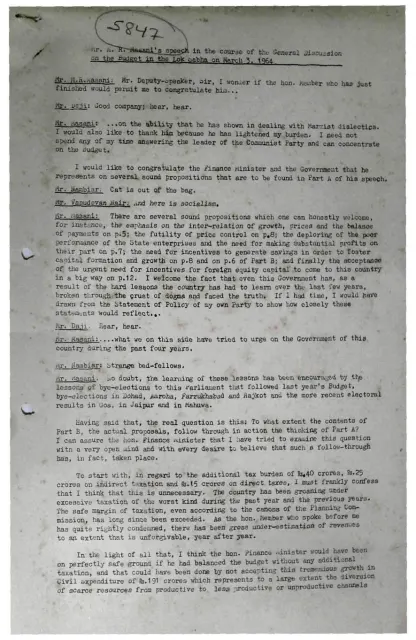 Primary workMr. M. R. Masani's speech in the course of the General discussion on the Budget in the Lok Sabha on March 3, 1964
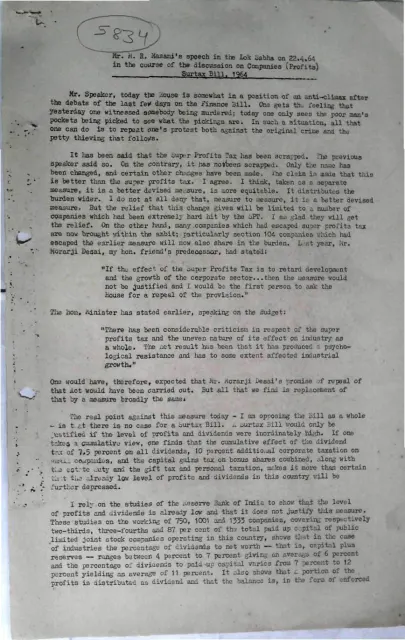 Primary workMr. M. R. Masani's speech in the Lok Sabha on 22.4.64 in the course of the discussion on Companies (Profits) Surtax Bill, 1964
 Primary workNO VERVE IN BUDGET PROPOSALS
 ExcerptThe Budget Versus The People
 ExcerptEconomic Reforms In India: Where Are We And Where Do We Go?