speech
PRESS FREEDOMS AND HUMAN RIGHTS
Published by M. R. PAI for the Forum of Free Enterprise, 235 Dr. Dadabhai Naoroji Road, Bombay-400 001, and printed by H. NARAYAN RAO at H. R. Mohan & Co., 9-B Cawasji Patel Street, Bombay 400 001 · Bombay · 1978
11 pages
PRESS FREEDOMS AND HUMAN RIGHTS
By C. R. IRANI
Summary
C. R. Irani’s A. D. Shroff Memorial Lecture, delivered for the Forum of Free Enterprise on 19 October 1977 and issued as a booklet on 16 January 1978, argues that press freedoms are not adjacent to human rights but constitutive of them. Irani opens with US Secretary of State Cyrus Vance’s three-part definition of human rights — protection from governmental violation of the person, fulfilment of basic needs, and political and civil liberties — and uses Solzhenitsyn’s image of peoples who ‘soar unhampered over the peaks of freedom’ only to lose the will to defend it. His diagnosis is that free peoples are seduced into slavery because they are unwilling to pay the continuing price of liberty.
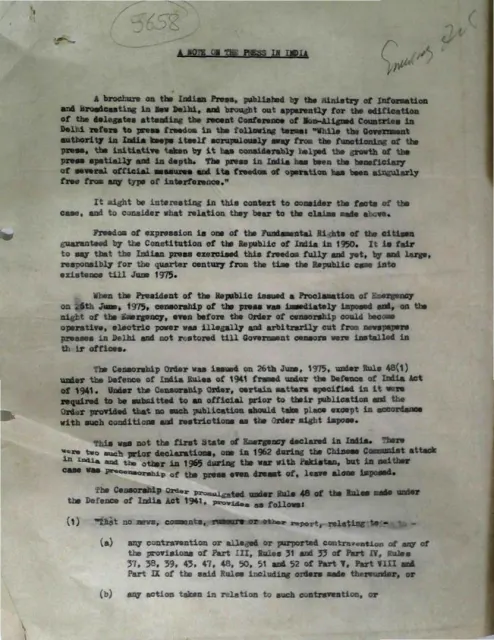
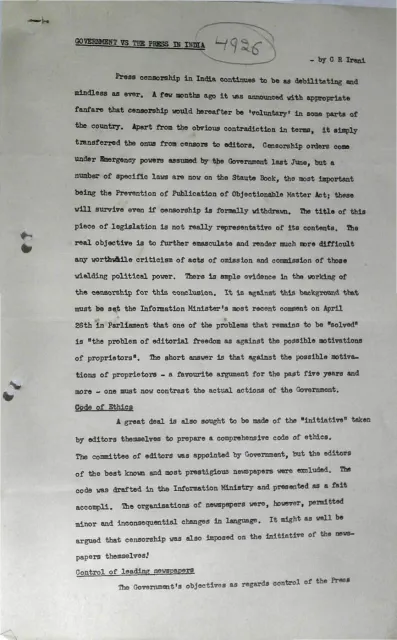
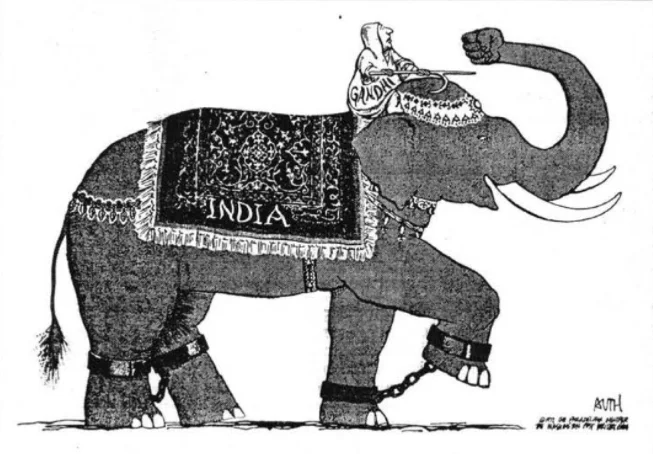
The centre of the lecture is a first-hand narrative of the assault on the Indian press from 1969 onward, climaxing in the Emergency of 1975. Irani, then Managing Director of The Statesman, recounts the ‘carrot-and-stick’ regime used against prestige editors — attempts to take over The Statesman by stacking its board, the cutting of the Indian Express’s electricity supply, MISA arrests of journalists, full pre-censorship, and the PPOMA legislation slipped into the Ninth Schedule to head off legal challenge. He pays tribute to the ‘brave little band’ of dissident editors — Gorwala’s Opinion, Raj Mohan Gandhi’s Himmat, N. G. Goray’s Janata, Thatte’s Sadhana, Minoo Masani’s Freedom First — and to advocates such as Soli Sorabjee who carried the press’s case into the Bombay High Court before Justice Tulzapurkar.
Irani then attacks the construction of Samachar as a single news pool, framed as an instrument of state propaganda that destroyed credibility, and turns to the wider doctrinal argument made by some Third World governments under UNESCO auspices that economic development justifies state direction of news. He rejects the trade-off, citing The Economist’s verdict after the Lok Sabha elections that ‘no one will ever be able to claim again that there is a choice between freedom and bread.’ Personal anecdotes — a Bombay customs officer who quietly waved him through after the Emergency, the ‘halaas ordinary people’ who kept resistant editors going — round out a closing prescription: the press’s duty is to report objectively, analyse logically, and criticise fearlessly, always with an ear to the voice of dissent.
Key points
-
Frames press freedom as constitutive of human rights, anchoring the case in Cyrus Vance’s April 1977 Georgia Law School speech and its three-part definition (personal integrity, basic needs, political and civil rights).
-
Diagnoses, via Solzhenitsyn, that free peoples lose liberty because they will not pay its continuing price — ‘it is only this unwillingness to pay a proper price for liberty that seduces people to slavery.’
-
Dates the assault on the Indian press to 1969, escalating in 1971 with a plan to put the press in a ‘strait-jacket’ via two cabinet ministers, and intensifying through the 1975 Emergency.
-
Recounts as Managing Director of The Statesman: attempts to forfeit printing presses, install hostile directors, impose pre-censorship by telephone, and use MISA arrests and PPOMA legislation (placed in the Ninth Schedule) to insulate censorship from legal challenge.
-
Salutes a small dissident press — Gorwala’s Opinion, Raj Mohan Gandhi’s Himmat, N. G. Goray’s Janata, Thatte’s Sadhana, Minoo Masani’s Freedom First — and tributes Soli Sorabjee for arguing their cases before Justice Tulzapurkar’s Bombay High Court bench.
-
Attacks the Samachar news pool as a fabricated ‘government organ’ that destroyed the credibility of Indian news agencies and was used to circulate fake nation-wide surveys.
-
Rebuts the UNESCO / Third World doctrine that economic development justifies state control of news, citing The Economist’s post-election conclusion that there is no choice between freedom and bread.
-
Closes with the press’s prescriptive duty: to report objectively, analyse logically, criticise fearlessly, and remain attentive to dissent as the ‘one unfailing test of respect for Human Rights.’
Generated by the v1.5 extraction pipeline. Awaiting editorial review.
Metadata and summary are AI-extracted from the source PDF and reviewed for editorial accuracy. The original work is available via the Read PDF tab above (where present); paragraph-level citation inside the PDF is deferred to a future engagement.