essay
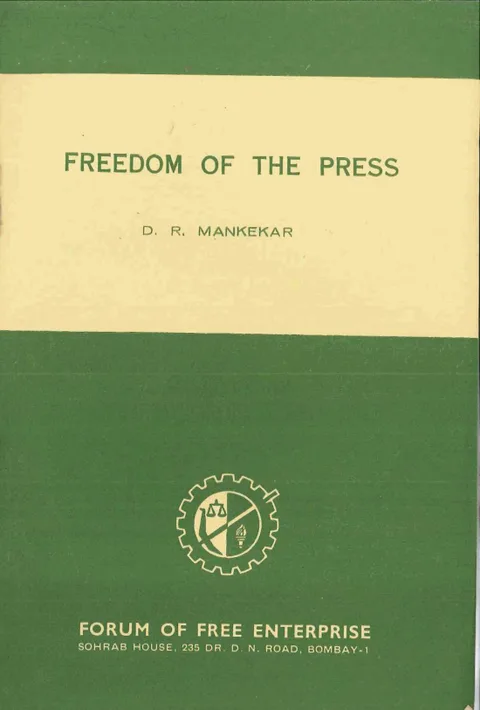
Press and Private Enterprise in a Democracy
Published by M. R. PAI for Forum of Free Enterprise, "Sohrab House", 235, Dr. Dadabhai Naoroji Road, Bombay 1, and printed by H. NARAYAN RAO at H. R. MOHAN & Co., 9-B, Cawasjee Patel Street, Bombay 1. · Bombay · 1963
4 pages
Press and Private Enterprise in a Democracy
By N. J. N.
Summary
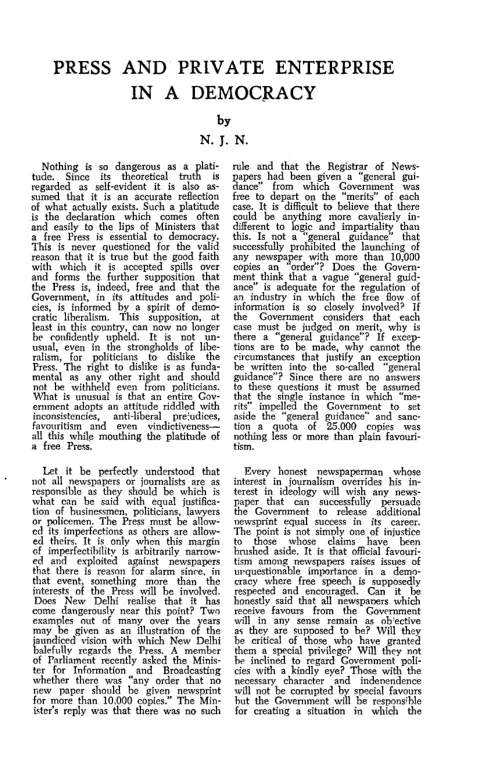
Published as a Forum of Free Enterprise leaflet on 9 September 1963 and reproduced from the Times of India of 15 April 1963, this short polemic — signed only with the initials N. J. N. — challenges the gap between the Indian government’s rhetorical fealty to press freedom and what the author sees as its actual record of harassment, favouritism and slogan-mongering against newspapers. The opening pages target a Government of India directive that permitted papers under 10,000 copies to expand at will while requiring ‘general guidance’ from the Registrar of Newspapers for larger papers; the author reads this as a deliberate effort to reward small, pliant titles and discipline the independent ones, and asks whether any paper that accepts newsprint favours from government can remain objective.
The second half broadens the indictment. The author argues that hostile slogans such as ‘jute press’ and ‘monopoly’ have been mainstreamed by Nehru himself — most recently at an A.I.C.C. session denouncing newspapers as ‘wholly undesirable and objectionable’ — and amplified by Congressmen, Communists and ‘leader-writers’ who have built a career of disparaging the press. He insists no single agency or family controls all the newspapers, magazines and weeklies in the country, and that what looks like a chain is in fact a sustained conflict of different views and ideas. Defending career editors as a ‘few individuals’ whose tradition-bound judgment is more reliable than that of Ministers, he reminds readers that it was these same journalists who warned of the Chinese threat and the inadequacies of Nehru’s China policy years before the crisis broke. He closes with the proposition that ‘the greatest of all Press freedoms is freedom from Government interference and prejudice,’ warning that if constant vilification is not replaced by genuine understanding, the loser will be democracy itself, not just the press.
Key points
-
Frames Indian press freedom as a platitude routinely mouthed by Ministers while the Government’s actual conduct is riddled with anti-liberal prejudice and favouritism.
-
Attacks a Ministry of Information and Broadcasting order that lets newspapers under 10,000 copies expand freely but requires ‘general guidance’ from the Registrar of Newspapers for larger papers — read as a sanctioned vehicle for discriminating against independent titles.
-
Argues that government newsprint allocations are a covert form of patronage and that any paper accepting such favours cannot credibly claim objectivity.
-
Catalogues the slogans — ‘jute press’, ‘monopoly’, ‘cute press’ — used to discredit the privately owned press, and traces them to Nehru’s own remarks at an A.I.C.C. session against ‘personal attacks’.
-
Disputes the monopoly charge empirically: no single person, agency or family controls all newspapers, magazines and weeklies in India; what critics call a chain is actually a competing field of views and ideas.
-
Defends career editors and journalistic tradition against the Prime Minister’s dismissal of them as having mental equipment ‘slightly above zero’, noting that it was journalists who first warned of the Chinese threat and the failures of non-alignment.
-
Worries that Government policy is shifting from criticism of newspapers to building up a class of dependent, smaller papers willing to trade independence for state favours.
-
Concludes that the greatest press freedom is freedom from Government interference and prejudice, and that constant vilification ultimately injures democracy rather than just the press.
Generated by the v1.5 extraction pipeline. Awaiting editorial review.
Metadata and summary are AI-extracted from the source PDF and reviewed for editorial accuracy. The original work is available via the Read PDF tab above (where present); paragraph-level citation inside the PDF is deferred to a future engagement.