speech
Freedom of the Press
Published by M R PAI for the Forum of Free Enterprise, "Sohrab House", 235 Dr. Dadabhal Naoroji Road. Bombay-1. and printed by H. NARAYAN RAO at H. R. MOHAN & CO. (PRESS), 9-B, Cawasjee Patel Street. Bombay-1. · Bombay · 1971
9 pages
Summary
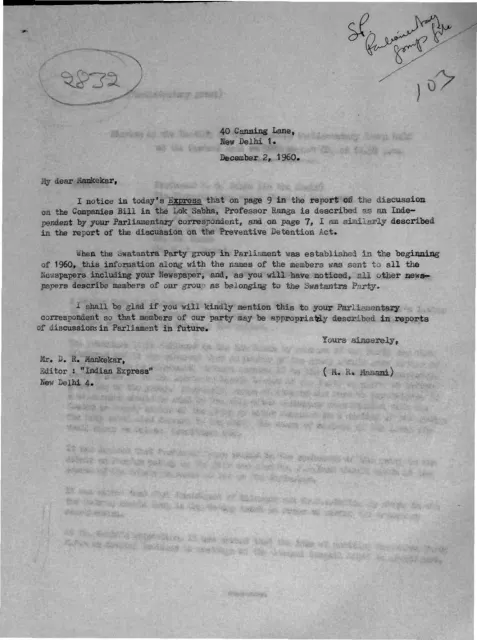
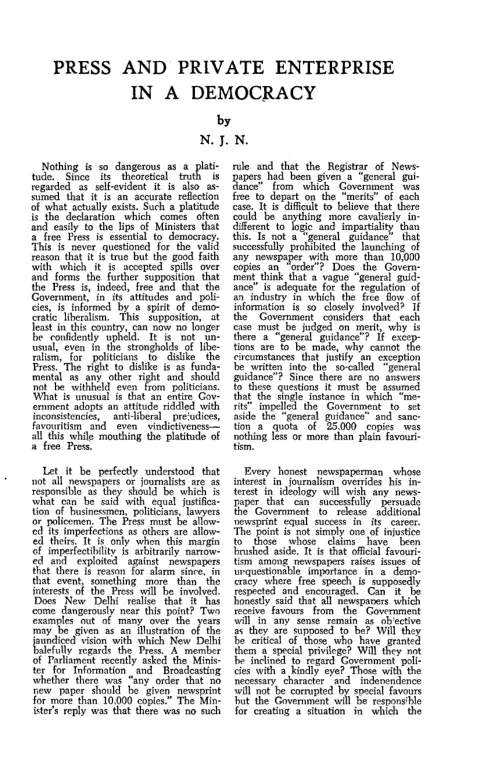
D. R. Mankekar’s 1971 booklet reprints a speech delivered on 15 September at the New Delhi Centre of the Forum of Free Enterprise. It is a polemic against two emerging Government misconceptions about the press in the months leading up to the draft Bill on diffusion of newspaper ownership and the 25th Constitution Amendment: first, that dissent is a grave crime and conformity to the Government’s thinking is the quintessence of free expression; and second, that diffusion of press ownership somehow secures the independence of the press. Mankekar frames press freedom as the right of dissent — the co-existence of conflicting viewpoints contending for the minds of citizens — and reads the assault on the so-called ‘monopoly business’ papers as an ideological vendetta against the only papers financially strong enough to resist Government pressure and patronage.
The argument moves through international comparisons. Mankekar invokes the U.S. First Amendment as the bulwark behind a press that took on Franklin Roosevelt, Harry Truman and John Kennedy; the Republican-owned American papers that nevertheless criticised Republican policies; Edward Heath’s grumbles in Britain; M. Hubert Beauve-Mery of Le Monde on why a newspaper cannot allow dissensions in command; and John Thaddeus Delane’s classic claim that the duties of government and press are ‘constantly separate, generally independent, sometimes diametrically opposite.’ He treats the draft Bill’s call for editorial unity in a board of representative trade unions and elective directors as a ‘tall order’ that would either deliver the editorial sanctum to trade-union ideology, hand it to Government nominees through the back door, or leave editorial anarchy in place of proprietorial discipline. The ‘Yugoslav analogy’ of co-existence of conflicting ideologies within one paper is dismissed as inapplicable to a republic whose constitution lays down a single ideological framework and whose industries are not socially owned.
The remedy Mankekar proposes is not structural reform of ownership but the elevation of the editor — protecting the editor’s supremacy against proprietorial interference and undue commercial considerations, while urging the proprietor to divest commercial interests that conflict with the paper’s vocation. He closes by recommending that the Government refer charges against the press to the Press Council and seek its expert opinion before legislating. An appendix collects Mankekar’s own credo of the journalist’s vocation, his invocations of Lokmanya Tilak and Mahatma Gandhi as exemplars of journalism as ‘foundry of the nation’, a 1968 passage from Indira Gandhi on the threat to a free press coming as much from within journalism as from authority, and Justice Hugo Black’s opinion in U.S. v. New York Times.
Key points
-
Frames the essence of press freedom as the right of dissent and the co-existence of conflicting viewpoints, against a Government view that equates dissent with grave crime and ‘commitment’ with blind acceptance of policy.
-
Argues that the draft Bill on diffusion of press ownership and the 25th Constitution Amendment together threaten the Fundamental Right of free expression and amount to ‘nationalisation of the Press by the backdoor’.
-
Reads the Government’s championing of ‘small newspapers’ as an ideological vendetta against larger, financially independent papers that resist governmental pressure and patronage.
-
Anchors the argument in U.S. and U.K. parallels — the First Amendment, Republican-owned papers opposing Republican presidents, Heath’s complaints about the British press — to show that a hostile press is the normal condition of a working democracy.
-
Critiques co-operative or employee-shareholder schemes as an opening for trade-union political ideology to penetrate the editorial sanctum, and the ‘Yugoslav analogy’ as inapplicable to Indian constitutional and economic conditions.
-
Locates the real measure of press reform in editorial supremacy: protecting the editor from proprietorial and commercial interference, and asking proprietors to disengage from conflicting commercial interests.
-
Recommends that Government route any charges against the press through the Press Council and act on its expert opinion rather than through new legislation.
-
Concludes with an appendix triangulating Mankekar’s own credo, Indira Gandhi’s 1968 warning about threats to press freedom from within journalism, and Justice Hugo Black’s defence of the press’s right to expose deception in government.
Metadata and summary are AI-extracted from the source PDF and reviewed for editorial accuracy. The original work is available via the Read PDF tab above (where present); paragraph-level citation inside the PDF is deferred to a future engagement.