essay
SHOULD WE ALTER OUR CONSTITUTION?
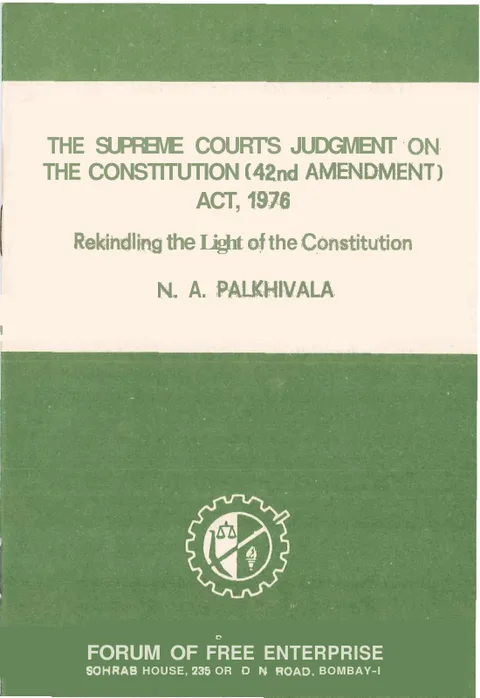
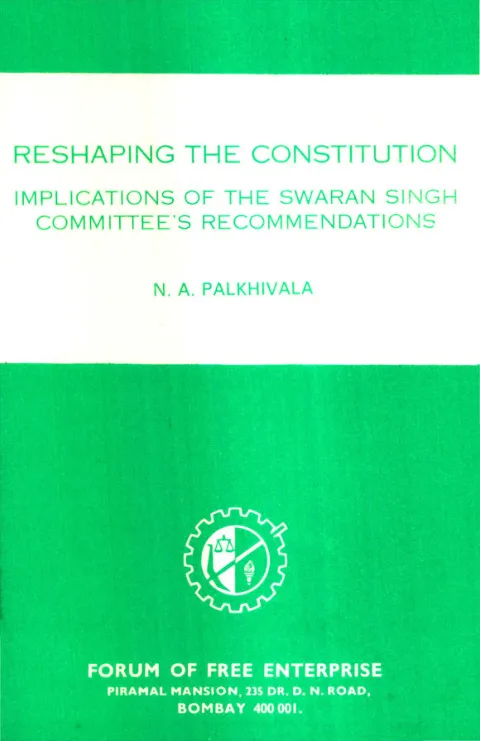
FORUM OF FREE ENTERPRISE, SOHRAB HOUSE, 235 DR. D. N. ROAD, BOMBAY-1 · Bombay · 1976
21 pages
SHOULD WE ALTER OUR CONSTITUTION?
By N. A. Palkhivala
Summary
Delivered in February 1976 (and reprinted from the Illustrated Weekly of India, January 4–10, 1976), this Forum of Free Enterprise pamphlet by N. A. Palkhivala is a constitutional-lawyer’s alarm bell against a then-circulating paper of ‘Some Suggestions’ for amending the Indian Constitution. Palkhivala opens with a wry meditation on the imperfection of law and the relentlessness of India’s ‘law-making industry,’ insisting that the most useful reform Parliament could grant the country is a stated period during which no new laws are passed. From there he pivots to his central preoccupation: the indispensability of an independent judiciary as the only effective check on executive excess, illustrated by examples ranging from the Bombay Police Commissioner’s blanket ban on assemblies of five (struck down as ultra vires on 18 December 1975) to the Bhanudas Krishna Gawde case in which government counsel suggested detenus could be denied food, or even shot, without remedy under Article 226 while the Presidential Order suspending Article 21 was in force.
The core argument rests on the Supreme Court’s 1973 decision in Kesavananda Bharati’s case, which held that Parliament cannot alter or destroy the ‘basic structure’ of the Constitution. Palkhivala enumerates nine essential features of that basic structure — supremacy of the Constitution, sovereignty and integrity of India, the republican form of government, democracy distinct from mere adult franchise, fundamental rights, secularism, an independent judiciary, the federal Union-State structure, and balance among the three organs of government — and uses this list as the yardstick against which to measure the proposed amendments. He warns that the ‘Some Suggestions’ paper would replace the Westminster model with a presidency more powerful than the American one, reduce Parliament to subservience, and substitute the courts’ interpretive authority with a ‘Superior Council of the Judiciary’ whose composition would leave ten of fifteen members beholden to the President and ruling party — reducing the higher judiciary, in Justice Staple’s phrase, to ‘mice squeaking under the Home Minister’s chair.’
Palkhivala then turns to the Constitution (Forty-first Amendment) Bill, already passed by the Rajya Sabha in August 1975, which would grant the President, Prime Minister and State Governors total civil immunity during office for personal acts and lifelong criminal immunity for any crime committed before or during office. He calls this ‘a Bill that has no parallel in civilized jurisprudence,’ arguing it destroys the first principle of republicanism — equality before the law. He closes with an appeal to Indira Gandhi, citing her own 25th-anniversary speech describing the Constitution as ‘a charter of a peaceful, democratic, social revolution,’ and trusting that, properly briefed, she would not lend her support to proposals that ‘aim at drastically diluting the essence of our democracy.’ A coda invokes a recent UK Court of Appeal episode, the imperative of open public debate before any further amendment, and Joseph Story’s warning that whether the Constitution descends ‘in its masculine majesty’ or ‘an idle mockery’ depends on the present generation.
Key points
-
Frames legal reform as urgently needing restraint: the most welcome amendment would be an assurance that no new laws are passed for a stated period.
-
Insists that whatever else is altered, the Supreme Court and High Courts must retain their power to interpret the Constitution and grant relief under Articles 32 and 226.
-
Uses the Bombay Commissioner’s assembly-of-five order (struck down on 18 December 1975) and the Bhanudas Krishna Gawde case to illustrate executive overreach answerable only to an independent court.
-
Enumerates nine ‘essential features’ of the basic structure of the Constitution — supremacy, sovereignty, integrity, republican form, democracy with fundamental rights, secularism, independent judiciary, federal dual structure, and balance of powers.
-
Concedes a presidential form of government could be acceptable, but condemns the ‘Some Suggestions’ paper for envisaging a President more powerful than the US President and a ‘Superior Council of the Judiciary’ that would supersede the courts.
-
Attacks the Constitution (Forty-first Amendment) Bill for granting blanket civil and criminal immunity to the President, Prime Minister and Governors as a destruction of equality before the law.
-
Appeals to Indira Gandhi’s own characterisation of the Constitution as a ‘charter of a peaceful, democratic, social revolution’ and urges a public announcement that the amendment proposals are not Government-sponsored.
-
Closes with a UK Court of Appeal precedent and a Joseph Story quotation framing constitutional fidelity as a generational choice on which India’s place in ‘one-sixth of the human race’ will turn.
Generated by the v1.5 extraction pipeline. Awaiting editorial review.
Metadata and summary are AI-extracted from the source PDF and reviewed for editorial accuracy. The original work is available via the Read PDF tab above (where present); paragraph-level citation inside the PDF is deferred to a future engagement.