speech · memorial lecture
Population and Economic Development In India
Published by S.S. Bhandare for Forum of Free Enterprise, Peninsula House, 235, Dr. D.N. Road, Mumbai 400 001, and printed at Vijay Printing Press, 9-10, 3rd Floor, Mahalaxmi Industrial Estate, Gandhi Nagar, Lower Parel, Mumbai 400 013. · Mumbai · 2005
20 pages
No. 38 in A. D. Shroff Memorial Lecture
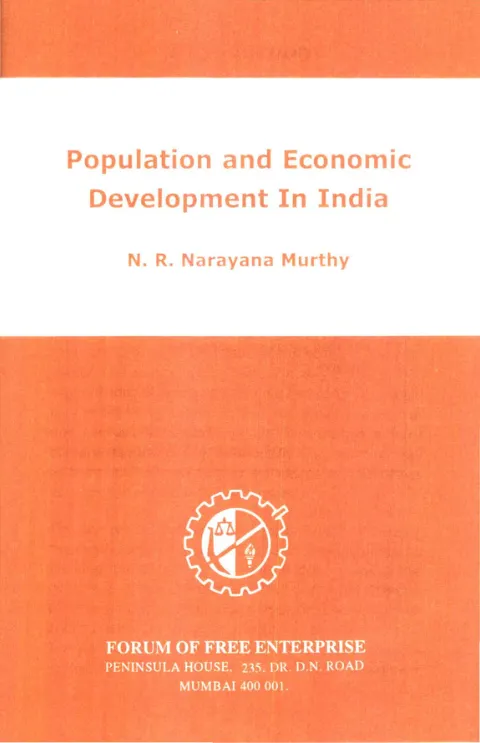
Population and Economic Development In India
By N. R. Narayana Murthy
Summary
This booklet reproduces the 38th A. D. Shroff Memorial Lecture, delivered by N. R. Narayana Murthy in Mumbai on 8 April 2005 and published by the Forum of Free Enterprise. An introduction by Minoo R. Shroff frames the lecture within the Forum’s classical-liberal tradition, recalling A. D. Shroff’s stand against the “ominous clouds of socialism” gathering over 1950s India and crediting Shroff — and later Nani Palkhivala — with sustaining a three-decade campaign for free enterprise whose fruits, he argues, India is now harvesting through liberalisation.
Murthy’s lecture takes up the “sixty-four million dollar question” of whether India’s billion-strong, fast-growing population is a drag or an opportunity. His answer is neither in itself: drawing on demographic comparisons with China, the East Asian tigers, and the ageing developed economies, he reframes the issue as a “demographic window of opportunity” that converts into growth only when accompanied by “good human capital” — a workforce equipped with skills, schooling, health, and labour-market access. Without that, he insists, large numbers turn into a liability.
He stitches the argument together with a dense statistical comparison: India’s 1.5% population growth still adds 16 million people a year against China’s 10; India ranks 127th of 177 on the Human Development Index with 39% adult illiteracy and 64% child malnourishment; 27% of urban Indians lack sanitation; the water table is falling six feet annually; half of India’s 329 million hectares of soil are already degraded. He calls for stabilising population at 1.7 billion by 2045 through replacement-level fertility of 2.1 by 2010, achieved via state-level performance targets, NGO involvement, women’s literacy, and primary healthcare — citing Kerala and the southern states as proof of concept against the high-fertility “Bimaru” north.
The closing chapters press a twin economic-and-environmental brief: India must simultaneously stabilise population, raise GDP growth to 8–9%, reform labour markets, scrap distorting subsidies on fuel and flat-rate electricity, and “leapfrog” to clean-fuel transport, bioengineered crops, and efficient sanitation. The Western consumption model, he warns, is unrepayable. Quoting Martin Luther King, George Eliot, and Albert Einstein in turn, Murthy ends on the Forum’s preferred register — that India has the talent to convert demographic burden into demographic dividend, provided leaders manufacture the urgency for change.
Key points
-
The text is the 38th A. D. Shroff Memorial Lecture (Mumbai, 8 April 2005), with a Forum of Free Enterprise introduction by Minoo R. Shroff situating it in the classical-liberal lineage of A. D. Shroff and Nani Palkhivala.
-
Murthy reframes the population question: a billion Indians are neither inherently a drag nor an asset — they convert into growth only as ‘good human capital’ supported by education, healthcare, and labour-market flexibility.
-
He benchmarks India relentlessly against China — fertility (3.3 vs near-replacement), HDI rank (127/177), illiteracy (39% vs 9%), poverty (26% vs 11%), and per-capita income ($530 vs $1,100 in 2003).
-
He treats the ‘demographic window’ as time-limited: by 2020 India will hold a surplus of 47 million working-age people against US/China/Japan shortages, but only if growth is stepped up to 8% and jobs are actually created.
-
Stabilisation target: 1.7 billion by 2045, via replacement fertility of 2.1 by 2010, achieved through state-level performance targets, women’s literacy, primary healthcare, and NGO-led local family planning — citing Kerala and the southern states as exemplars.
-
The lecture’s environmental case argues that resource degradation already costs India 4.5% of GDP, water scarcity will bite by 2025, and Western consumption patterns are unrepayable — making clean-technology leapfrogging and subsidy reform mandatory.
-
Policy prescriptions are practical and state-capacity-oriented: 66,000 new primary schools and 3,000 new health centres a year, 3% annual food output growth, removal of fuel and flat-rate electricity subsidies, and labour-market liberalisation.
-
The framing is recognisably Forum-liberal — free enterprise as ‘affirmative good’ (Eugene Black on the back cover), private-sector productivity as the engine of human-capital uplift, government’s role recast as regulator and enabler.
Generated by the v1.5 extraction pipeline. Awaiting editorial review.
Metadata and summary are AI-extracted from the source PDF and reviewed for editorial accuracy. The original work is available via the Read PDF tab above (where present); paragraph-level citation inside the PDF is deferred to a future engagement.