speech
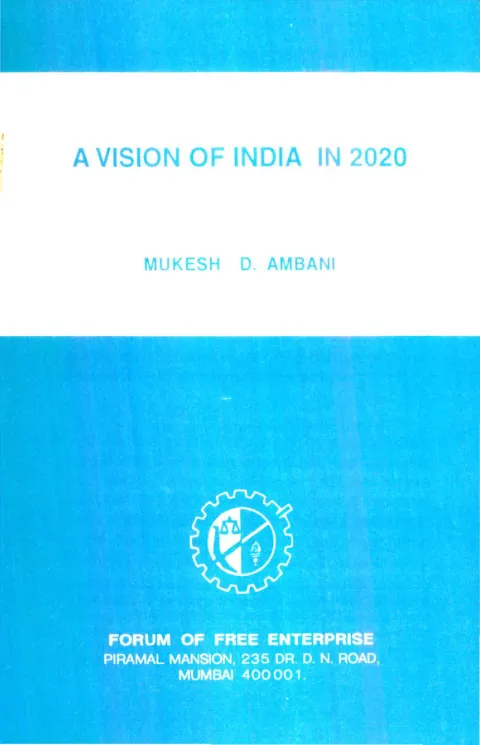
A VISION OF INDIA IN 2020
Published by M. R. Pai for the Forum of Free Enterprise, "Piramal Mansion", 235, Dr D. N. Road, Mumbai 400 001 and Printed by S. V. Limaye at India Printing Works, India Printing House, 42 G. D. Ambekar Marg, Wadala, Mumbai 400 031. · Mumbai · 1998
20 pages
Summary
Delivered as a Forum of Free Enterprise talk in April 1998 under the auspices of the Ladies’ Wing of the Indian Merchants’ Chamber, Mukesh D. Ambani’s booklet is a sustained argument that India can become one of the world’s five leading economic powers by 2020. Ambani frames the coming two decades as a transition from the industrial age to an information-driven, globalised economy in which transparency, speed, and human capital decide national success. He insists that the orthodox forecast of 7% annual growth would condemn India to wait 68 years to reach developed-world GDP, and instead urges a strategy aimed at doubling per capita income every five years — a target India must meet because, he writes, the country has “really no options” between great-power status and going under.
The substantive programme rests on two leapfrog sectors. Agriculture, with 329 million hectares of land and a competitive advantage in soil, sunshine and rain, can be quintupled in output by raising yields to international standards, employing 120 million additional workers on wasteland and reversing rural-to-urban migration. Information technology can place an Indian worker at USD 20,000 a year, eventually drawing in roughly a trillion dollars over twenty years as 50 million skilled young workers service global demand. Around these pillars Ambani lists six “foundations” — a young population (400 million Indians under 35 by 2020), a large domestic market, the dramatic compression of doubling times since Japan and Korea, India’s pluralist and democratic ethos, the resilience of the Indian family, and the easing of infrastructure constraints by technology.
The second half of the booklet shifts from forecast to prescription. Ambani argues that a 21st-century economy cannot be administered by an 18th-century state apparatus: the government-people relationship must move from “benefactor and supplicants” to one of partnership, and he explicitly rejects the cliché that the state has no role in a market-driven economy, assigning it macro-economic management and a competition-promoting regulatory framework. Education reform, participatory institutions, the return of non-resident professionals, and — given centrality — the full participation of women in the knowledge economy are presented as non-negotiable. The work closes with a personal credo, the “Mantras” Ambani says he learned from his father at Reliance: think big, work long-term, demand excellence, embrace technology, never accept defeat. An A. D. Shroff epigraph at the front and a Eugene Black epigraph at the back frame the booklet within the Forum’s classical-liberal advocacy of private enterprise as an affirmative good.
Key points
-
Sets the target of India becoming one of the world’s five major economic powers by 2020, alongside USA, Germany, China and Japan.
-
Rejects the consensus 7% growth path; argues India must double per capita income every five years and that double-digit GDP growth is feasible on a sustained basis.
-
Identifies agriculture and information technology as the two leapfrog sectors capable of generating maximum wealth on modest investment.
-
Frames a demographic dividend: roughly 400 million Indians below 35 by 2020 — a young, English-conversant workforce primed for the information economy.
-
Argues that India’s pluralist, tolerant, democratic and family-centred ethos is itself a competitive advantage in the information age.
-
Calls for modernising the state — a 21st-century economy cannot operate with an 18th-century state apparatus — while explicitly rejecting the view that government has no role in a market-driven economy.
-
Treats full participation of women in the workforce as a non-negotiable condition of a knowledge-based society, holding up Sushmita Sen, Aishwarya Rai and Kalpana Chawla as exemplars.
-
Closes with a personal credo (“Mantras”) learnt at Reliance — think big, demand excellence, embrace technology, never accept defeat.
Metadata and summary are AI-extracted from the source PDF and reviewed for editorial accuracy. The original work is available via the Read PDF tab above (where present); paragraph-level citation inside the PDF is deferred to a future engagement.