speech · memorial lecture
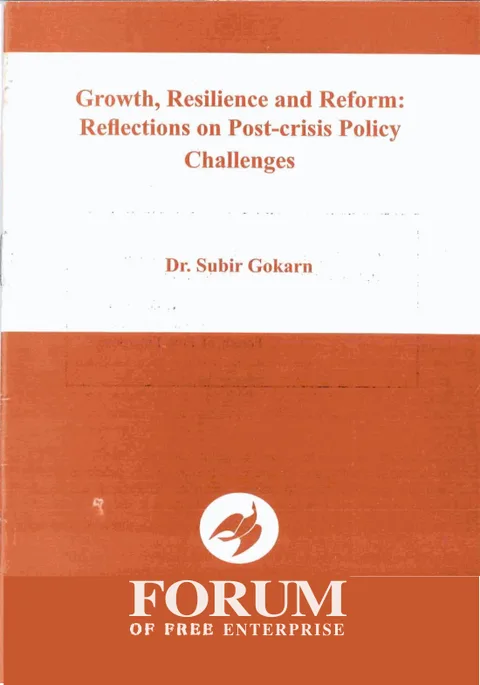
Growth, Resilience and Reform
Reflections on Post-crisis Policy Challenges
Published by S S Bhandare for the Forum of Free Enterprise, Peninsula House, 2nd Floor, 235, Dr D N Road, Mumbai 400001, and Printed by S V Limaye at India Printing Works, India Printing House, 42 G D Ambekar Marg, Wadala, Mumbai 400 031. · Mumbai · 2011
17 pages
No. 45 in A. D. Shroff Memorial Lecture
Growth, Resilience and Reform
By Dr. Subir Gokarn
Summary
This booklet reproduces the 45th A. D. Shroff Memorial Lecture, delivered by Dr. Subir Gokarn — then Deputy Governor of the Reserve Bank of India — at the Indian Merchants’ Chamber, Mumbai, on 2 November 2011 under the auspices of the Forum of Free Enterprise. Gokarn’s central proposition is that the balance between efficiency and stability must be built into India’s development strategy: reforms that open the economy to competition and accelerate growth have to be complemented by safeguards that contain the risks those very reforms generate. He reads the post-1991 record through this lens and argues that the same balance explains both the dream run of 2003-08 (when GDP averaged 8.9 per cent) and the relatively short-lived, transitory impact of the 2008 global financial crisis on India compared with developed economies.
Using a 2x2 matrix of favourable / unfavourable global and domestic conditions, Gokarn maps Indian performance from 2003 to 2010, frames 2008-10 as the crisis quadrant, and treats 2011-onward as the new question. He stresses that the 1991 reforms were evolutionary rather than revolutionary — trade liberalisation in two stages, gradual financial-sector reform, capital-account opening through preference ordering (FDI preferred over portfolio, equity over debt, long-term debt over short), and fiscal consolidation under the Fiscal Responsibility and Budget Management Act of 2003 — and that their full impact only arrived when these strands reached a critical threshold around 2003. The accompanying slides (rising investment and falling deficits, increasing global integration, contributors to inflation, stable private consumption, monetary policy responses, banks’ balance sheet composition, food inflation, and the diverging GDP/employment shares of agriculture, industry and services) anchor the empirical narrative.
On risks, Gokarn singles out two channels arising from greater global integration: capital-flow volatility, which India’s preference-ordered capital-account framework has dampened, and energy-import dependence, which has translated global price shocks into domestic inflation. On resilience he identifies four structural buffers — domestic-consumption-led demand, an anti-inflationary monetary stance built up before the crisis, fiscal space created by the 2003-08 consolidation, and bank balance sheets dominated by loans rather than mark-to-market investments. Looking forward, he calls for an integrated energy strategy that conserves use and shifts toward renewables, supply expansion in proteins / vegetables / fruits to entrench food disinflation, infrastructure and labour-market reform so industry can absorb workers leaving agriculture, and a financial sector capable of safely funding rapid growth — a “tightrope walk” between too much and too little caution. The closing message is that growth and resilience together require speed, synchronisation, and a continuing balance between exploiting opportunities and managing risk.
A. D. Shroff’s institutional voice frames the booklet: the cover and final pages identify the Forum of Free Enterprise as publisher (sponsored by The New India Assurance Co. Ltd.), the front matter carries Shroff’s motto on free enterprise and a biographical sketch quoting J. R. D. Tata and former World Bank President George Woods, and the back matter lists every Shroff Memorial lecture from 1966 to 2010 — situating Gokarn’s argument inside the Forum’s classical-liberal lineage even as he speaks from the central bank.
Key points
-
Delivered as the 45th A. D. Shroff Memorial Lecture on 2 November 2011 at the Indian Merchants’ Chamber, Mumbai, under the auspices of the Forum of Free Enterprise; the speaker is the sitting Deputy Governor of the Reserve Bank of India.
-
The organising frame is a 2x2 matrix of favourable / unfavourable global and domestic conditions: 2003-08 sits in the favourable / favourable quadrant (8.9% average growth), 2008-10 in the unfavourable / unfavourable crisis quadrant, and the future is presented as an open question.
-
Gokarn argues the 1991 reforms were evolutionary, not revolutionary — trade reform in two stages, gradual financial-sector liberalisation, preference-ordered capital-account opening, and fiscal consolidation under the FRBM Act of 2003 — with full effects only arriving around 2003 when all strands crossed a tipping point.
-
Three drivers of the pre-crisis acceleration are identified: a stable, predictable investment environment; a virtuous cycle that raised the investment-to-GDP ratio above 35 per cent; and a fiscal switch from government consumption toward investment.
-
Two new risks from greater global integration are highlighted — capital-flow volatility (mitigated by India’s preference-ordered capital-account framework) and rising energy-import dependence (which transmits global price shocks into domestic inflation).
-
Four structural sources of Indian resilience to the 2008 shock are catalogued: large share of domestic private consumption in demand, an anti-inflationary monetary stance with high policy rates and CRR going into the crisis, fiscal space accumulated during 2003-08, and bank balance sheets dominated by loans rather than mark-to-market investments.
-
Forward-looking policy priorities cover an integrated energy strategy, supply-side expansion of protein and horticultural foods to break entrenched food inflation, infrastructure and labour-market reform so industry can absorb labour leaving agriculture, and a financial sector that can finance rapid growth without amplifying risk.
-
Concluding messages: balanced reform produced both pre-crisis growth and post-crisis resilience; future performance depends more heavily on reinforcing domestic drivers given a hostile external environment; and ‘speed, synchronization and the balance between exploiting opportunities and managing risk’ should govern any reform strategy.
Generated by the v1.5 extraction pipeline. Awaiting editorial review.
Metadata and summary are AI-extracted from the source PDF and reviewed for editorial accuracy. The original work is available via the Read PDF tab above (where present); paragraph-level citation inside the PDF is deferred to a future engagement.