speech · memorial lecture
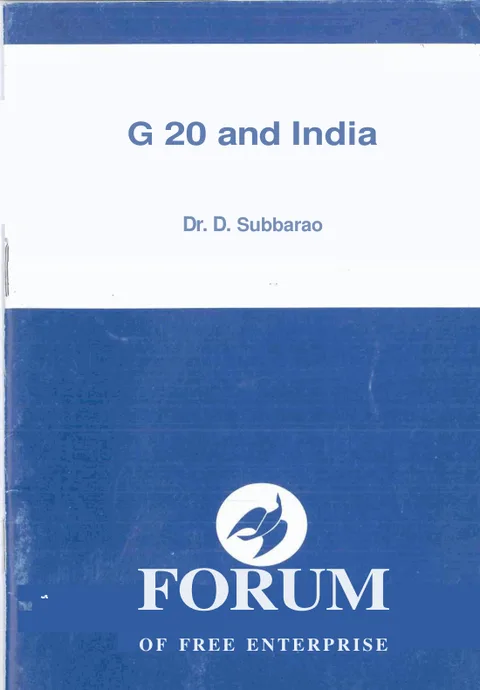
G 20 and India
Published by S. S. Bhandare for the Forum of Free Enterprise, Peninsula House, 2nd Floor, 235, Dr. D. N. Road, Mumbai 400001, and Printed by S. V. Limaye at India Printing Works, India Printing House, 42 G. D. Ambekar Marg, Wadala, Mumbai 400 031. · Mumbai · 2012
15 pages
No. 46 in A. D. Shroff Memorial Lecture
Summary
Delivered as the 46th A. D. Shroff Memorial Lecture in Mumbai on 20 November 2012 under the auspices of the Forum of Free Enterprise, this address by Dr. D. Subbarao — then Governor of the Reserve Bank of India — offers a comprehensive account of the G20’s origins, architecture, agenda and future challenges from the standpoint of a central banker who had participated directly in its deliberations. The lecture was published as a pamphlet and sponsored by New India Assurance Co. Ltd. Subbarao opens by honouring A. D. Shroff himself, noting the irony that this ‘perceived Congress Economist’ became one of the most trenchant critics of Congress economic policy, and that the liberalisation Shroff advocated from 1956 onwards did not fully arrive until the 1990s — a quarter-century after his death.
Subbarao traces the G20’s genesis not to the 2008 global financial crisis but to the Asian crisis of 1997, explaining how it evolved from a Finance Ministers’ forum into a Leaders’ forum at the London Summit of April 2009 — which he identifies as the clear turning point where coordinated fiscal stimulus, monetary accommodation, deposit guarantees and currency swaps halted the crisis spiral. He then works through the major items on the post-crisis G20 agenda. On global imbalances, he argues that the root cause was a ‘consumption binge’ in advanced economies matched by a ‘savings glut’ in emerging market economies (EMEs), and that correction requires symmetric adjustment — deficit economies saving more, surplus economies spending more — even though the incentives are asymmetric. He is precise about China’s exchange rate: the yuan appreciated 20–35 per cent against major currencies between 2005 and 2012, yet remained widely considered undervalued.
On the global reserve currency, Subbarao explains the Triffin paradox — the US, as issuer of the reserve currency, runs persistent deficits and enjoys ‘exorbitant privilege’ while creating the very imbalances that destabilise the system. He reviews four reform options (multiple reserve currencies, SDR development, SDR basket expansion, and multilateral credit lines) and concludes that none fully resolves the problem; India’s position is that the number of reserve currencies should increase organically. On financial sector reform, he commends the Basel III framework while warning against regulatory arbitrage, the risk of emerging market deleveraging, and the neglect of redirecting savings from volatile financial assets into real-economy infrastructure investment. He concludes with three future challenges for the G20: balancing short-term fiscal compulsions against medium-term sustainability; holding sovereigns accountable to commitments without a legal enforcement mechanism; and coordinating domestic policy actions in a world where economic integration has outrun political integration.
Key points
-
The G20 was formed in 1997 in response to the Asian financial crisis, not 2008; it was elevated from a Finance Ministers’ forum to a Leaders’ forum at the London Summit in April 2009, which Subbarao identifies as the decisive turning point in managing the global financial crisis.
-
The G20’s 19 member countries plus the EU represent 90 per cent of global GDP, 80 per cent of global trade and two-thirds of the global population; its decisions are not legally binding and it has no formal mandate for global governance.
-
Global imbalances — a ‘consumption binge’ in advanced economies and a ‘savings glut’ in EMEs — are identified as a root cause of the 2008 crisis; symmetric correction requires deficit economies to save more and surplus economies to consume more, but incentives are asymmetric.
-
China’s real effective exchange rate appreciated 20–35 per cent against major currencies between 2005 and 2012, yet pressure for further appreciation persisted; oil-producing countries had by 2012 overtaken China as the largest contributors to global current account surpluses.
-
The Triffin paradox is central to Subbarao’s analysis: the US runs persistent fiscal and external deficits as the price of issuing the reserve currency, enjoying ‘exorbitant privilege’ while generating the global imbalances that threaten financial stability; paradoxically the dollar strengthened during the crisis as a flight-to-safety asset even as the US economy contracted.
-
India’s exchange rate policy is described as ‘festina lente’ (make haste slowly) — largely market-driven, with intervention only to manage volatility; India co-chaired the G20 Framework and Mutual Assessment Process (MAP) Working Group alongside Canada.
-
Financial sector reform rests on four pillars — regulation, supervision, resolution (especially for systemically important financial institutions), and implementation assessment; Subbarao warns that tighter Basel III standards must not inadvertently disadvantage emerging market financial intermediaries or trigger deleveraging out of EMEs.
-
The three forward challenges for the G20 are: (i) harmonising short-term fiscal stimulus with medium-term consolidation; (ii) holding member governments accountable to non-binding commitments in the absence of an enforcement mechanism; and (iii) achieving policy coordination in a world where economic integration has moved far ahead of political integration.
Metadata and summary are AI-extracted from the source PDF and reviewed for editorial accuracy. The original work is available via the Read PDF tab above (where present); paragraph-level citation inside the PDF is deferred to a future engagement.