speech · memorial lecture
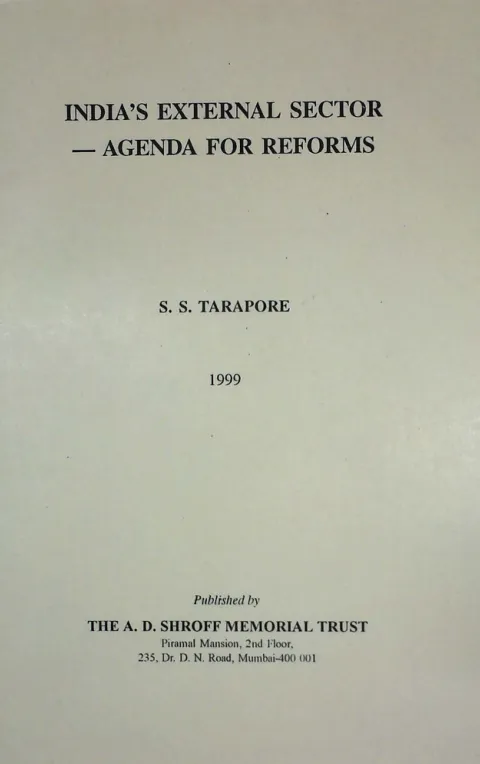
INDIA'S EXTERNAL SECTOR — AGENDA FOR REFORMS
THE A. D. SHROFF MEMORIAL TRUST, Piramal Mansion, 2nd Floor, 235, Dr. D. N. Road, Mumbai-400 001 · Mumbai · 1999
33 pages
Part of A. D. Shroff Memorial Lecture
Summary
S. S. Tarapore — economist, former Reserve Bank of India Deputy Governor, and chairman of the RBI Committee on Capital Account Convertibility — delivers the 1998 A. D. Shroff Annual Public Lecture (read on 7 April 1999) on the reform of India’s external sector. After a personal tribute to Shroff and to Nani Palkhivala, who invited him to speak, Tarapore frames the external sector as ‘in a sense, the true success story of Indian economic reforms’ since 1991, citing the climb from under $1 billion in foreign currency assets in July 1991 to over $27 billion at the time of the lecture, the fall in external debt from 41 per cent of GDP in 1991-92 to 24 per cent in 1997-98, and the collapse of the debt service ratio from 35.3 to 19.5 per cent over the same period. He nonetheless flags a measurement gap: India’s external debt is reported on a contracted-maturity rather than a residual-maturity basis, which understates short-term liabilities.
The second section turns to the South East Asian currency crisis. Tarapore argues that India is ‘learning precisely the wrong lessons’ — drawing comfort from its own controls instead of confronting the deeper causes of the Asian collapse. Drawing on Y. C. Richard Wong’s Cato Institute lecture of October 1998, he attributes the crisis to opaque banking, defended exchange-rate pegs, currency and maturity mismatches, and weak prudential supervision rather than to capital account convertibility as such. He also pushes back on the post-crisis fashion among ‘renowned experts’ who he believes have given respectability to capital controls and to a low-interest-rate, fiscal-expansion response that, applied to India, would ‘be a sure way of ensuring a severe external payments crisis in 24-36 months’.
The third section, on the sequencing of financial liberalisation, situates Tarapore’s view inside the academic literature — invoking John Williamson and Molly Mahar’s 1998 Princeton survey, Joseph Stiglitz on continued interest-rate controls, Jeffrey Frankel’s ICRIER lecture on the theory of the second best, and Rudiger Dornbusch’s dictum that ‘capital controls are an idea whose time is past’. He concedes that liberalisation must follow a sequence — prudential norms first, then financial-sector reform, then capital-account opening, with trade reform as the indispensable real-sector precondition and inflows liberalised before outflows — but insists that ‘caution on proper sequencing of reform is not an advocacy of total paralysis’. He warns specifically against ad hoc suspension of convertibility as a response to outflow pressure, calling such episodes of ‘slamming on’ controls ‘just about the worst kind of system’.
The rendered pages end inside the opening of the ‘Agenda for External Sector Reforms’ section, where Tarapore (echoing Stiglitz’s phrase) urges India not to ‘slide in its external sector reforms from gradualism to zeroism’ and begins his concrete twelve-month agenda: a stable foreign-investment regime, removal of bureaucratic redtape, and — under the sub-heading ‘Foreign Institutional Investors’ — unfettered FII access to the forward exchange market, dematerialisation of debt and equity, and an end to ‘moral’ distinctions between ‘good’ and ‘bad’ capital flows. The remaining thirteen pages of the booklet, not in this chunk, presumably carry the rest of the agenda and any concluding remarks.
Key points
-
External sector reform is presented as the most successful strand of India’s post-1991 liberalisation: foreign currency assets up from under $1 billion (July 1991) to over $27 billion; external debt down from 41% of GDP (1991-92) to 24% (1997-98); debt service ratio down from 35.3% to 19.5%.
-
Reported external-debt figures understate short-term exposure because they use contracted rather than residual maturity; letters-of-credit-based trade credit is excluded.
-
Tarapore rejects the popular Indian reading of the South East Asian crisis as a verdict against capital-account convertibility; the real causes were opaque banking, defended exchange-rate pegs, currency and maturity mismatches, and weak prudential supervision.
-
He warns that the post-crisis vogue of low interest rates plus fiscal expansion would, if imported into India, trigger ‘a severe external payments crisis in 24-36 months’.
-
Sequencing matters: trade reform first, then prudential norms and domestic financial-sector reform, then capital-account liberalisation, with inflows liberalised before outflows; but caution must not become paralysis.
-
Ad hoc suspension of convertibility in response to outflow pressure is ‘just about the worst kind of system’ because investors pre-empt it with capital flight.
-
The immediate twelve-month agenda begins with stabilising the foreign-investment policy framework, removing redtape, granting FIIs unfettered access to the forward exchange market, completing dematerialisation in debt and equity segments, and abandoning ‘moral’ distinctions between FDI and portfolio flows.
-
He explicitly cites Stiglitz’s phrase to argue that India must not let recent events push it ‘from gradualism to zeroism’ in external-sector reform.
Metadata and summary are AI-extracted from the source PDF and reviewed for editorial accuracy. The original work is available via the Read PDF tab above (where present); paragraph-level citation inside the PDF is deferred to a future engagement.