speech
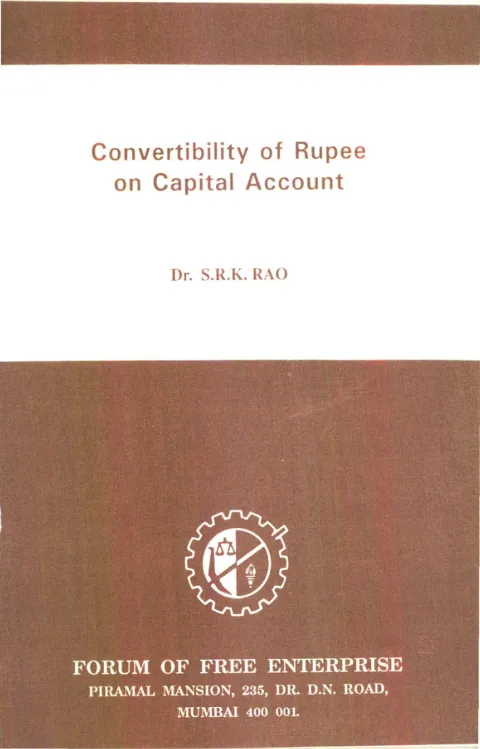
Convertibility of Rupee on Capital Account
Published by M.R. Pai for the Forum of Free Enterprise, "Piramal Mansion", 235, Dr. D.N. Road, Mumbai 400 001. · Mumbai · 1997
16 pages
Summary
Dr. S. R. K. Rao, a former Principal Adviser to the Reserve Bank of India, uses this Forum of Free Enterprise booklet — based on a talk delivered in Mumbai on 30 September 1997 — to assess whether India should move to full capital account convertibility (CAC) of the rupee. He opens with a working definition: a currency is convertible on capital account when residents can freely convert local financial assets into foreign assets and vice versa at market-determined exchange rates, without government controls. He then catalogues the advantages — integration with global capital markets, cheaper foreign capital, higher growth, portfolio diversification, deeper derivatives and risk-management products, and alignment of the domestic tax regime with developed economies.
The bulk of the booklet maps the pre-conditions for a successful transition and tracks the steps India has already taken. Rao stresses that capital account convertibility and domestic economic reforms are inseparable: fiscal consolidation, a manageable inflation target, deregulated interest rates, reduced cash reserve ratios, lower banking-sector NPAs, a strengthened balance-of-payments position, and at least six months of forex reserves must move in tandem. He chronicles India’s progressive liberalisation since the July 1991 devaluation — automatic FDI approvals, FIPB and SIA mechanisms, FERA amendments, the August 1994 acceptance of Article VIII obligations of the IMF (current account convertibility), the unified market-determined exchange rate of March 1993, and the opening of GDR, FCCB, FCNR(B) and NRNRRD windows.
Rao then walks through the Tarapore Committee on Capital Account Convertibility’s recommendations — a three-year sequenced roadmap with explicit targets (fiscal deficit down to 3.5 per cent by 2000 AD, inflation of 3–5 per cent, NPAs to 5 per cent, CRR to 3 per cent, debt service to 20 per cent of current receipts) — and contrasts it with the RBI’s preferred “eclectic approach” of liberalising even as pre-conditions are being met. He surveys the likely effects on banks (mergers and “narrow banks”), financial institutions, stock exchanges (need for an efficient Depository, T+3 settlement, derivatives, international disclosure norms), and the rupee’s exchange rate (RBI intervention only within a ±5 per cent band).
The booklet closes with a cautionary look at the 1997 Asian crisis. Drawing on Y. V. Reddy and S. Venkitaramanan, and citing Mahathir Mohammad’s denunciation of speculative currency trading as “unnecessary, unproductive and immoral,” Rao endorses the post-Hong Kong proposals for a Tobin tax, “Global Watch dogs” and stronger disclosure standards for global fund managers. He welcomes the replacement of FERA by FEMA and concludes that India can no longer treat full CAC as an academic question — the prudent course is the eclectic one of pushing ahead while strengthening banks, markets and forex reserves.
Key points
-
Defines capital account convertibility as the free two-way movement of financial assets between residents and non-residents at market-determined exchange rates, with no government controls except against transactions of an “undesirable nature”.
-
Lists CAC’s advantages: integration with global capital markets, cheaper foreign capital, higher growth, portfolio diversification, deeper derivatives and risk-management products, and alignment of the domestic tax regime with developed economies.
-
Argues that capital account convertibility and domestic economic reforms are inseparable — fiscal consolidation, manageable inflation, deregulated interest rates, reduced NPAs, a strong BOP and at least six months of forex reserves are essential pre-conditions.
-
Chronicles India’s liberalisation since the July 1991 devaluation: FDI/FII access, FIPB/SIA approvals, FERA amendments, March 1993 unified market-based exchange rate, and August 1994 acceptance of Article VIII current account convertibility.
-
Summarises the Tarapore Committee’s three-year sequenced roadmap and its quantitative targets (fiscal deficit 3.5 per cent, inflation 3–5 per cent, NPAs 5 per cent, CRR 3 per cent, debt-service 20 per cent of current receipts by 2000 AD).
-
Contrasts the Committee’s “pre-conditions first” stance with the RBI’s preferred “eclectic approach” of liberalising even as pre-conditions are being met, and sides with the latter.
-
Maps likely sectoral impacts: bank consolidation and “narrow banks”, squeezed spreads, demands on stock exchanges for a Depository, T+3 settlement and international disclosure norms, and RBI intervention within a ±5 per cent band on the rupee.
-
Reads the 1997 Asian crisis through Mahathir Mohammad’s denunciation of speculative currency trading and endorses post-Hong Kong proposals for a Tobin tax, “Global Watch dogs” and disclosure rules for global fund managers, while welcoming the FERA-to-FEMA transition.
Metadata and summary are AI-extracted from the source PDF and reviewed for editorial accuracy. The original work is available via the Read PDF tab above (where present); paragraph-level citation inside the PDF is deferred to a future engagement.