speech · memorial lecture
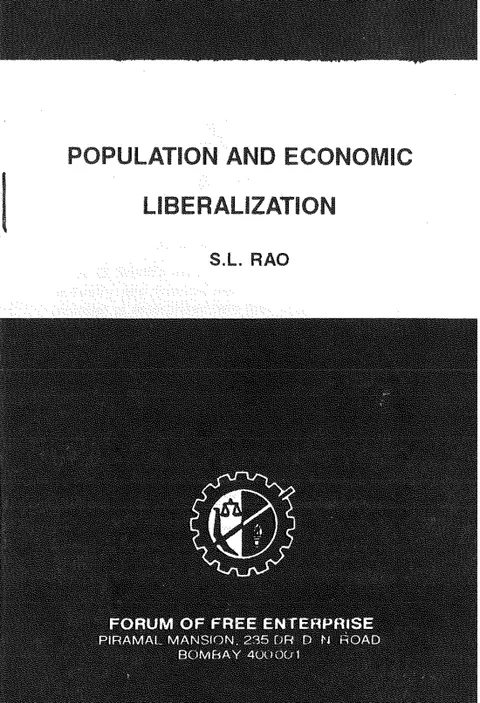
Population and Economic Liberalization
Published by M.R. PAI for the Forum of Free Enterprise, 235, Dr. D.N. Road, Bombay 400 001., and Printed by S.V. Limaye at India Printing Works, 42, G.D. Ambekar Marg, India Printing House, Wadala, Bombay 400 031. · Bombay · 1995
15 pages
No. 30 in A. D. Shroff Memorial Lecture
Population and Economic Liberalization
By S.L. RAO
Summary
Delivered as the 30th A. D. Shroff Memorial Lecture at the Forum of Free Enterprise in Bombay on 3 November 1995, S. L. Rao’s address argues that the economic freedoms India has begun to enjoy since 1991 must now be extended to population policy. Rather than persisting with target-driven family planning and large-scale female sterilisation, Rao calls for a re-orientation of government effort toward investment in human capital — child nutrition, infant mortality reduction, female schooling, adult female literacy, maternal health and basic preventive services — delivered through better-targeted programmes that actually reach the poor.
The heart of the lecture is a comparative reading of India against China, Thailand, Malaysia and South Korea. Drawing on the National Family Health Survey (1992), the 1995 Human Development Report and NCAER work, Rao shows that India’s East Asian neighbours have moved faster on fertility, infant mortality, female life expectancy, schooling and inequality because they invested earlier in women’s education, health and labour-force participation, built credible local government, and (in China’s case) carried out land reform and basic social security. Within India, Kerala and Tamil Nadu confirm the same lesson: relatively poor states with strong female literacy and health systems have outperformed the demographically worst-off “BIMARU” group of Bihar, Madhya Pradesh, Rajasthan and Uttar Pradesh.
From this evidence Rao draws an explicitly liberal conclusion. Economic development alone is not the best contraceptive; women’s status is. The state’s job is not to set sterilisation targets but to create the “enabling environment” — schools, clinics, nutrition, panchayat-level participation — in which families freely choose smaller size. To finance and sustain this, India must press ahead with trade liberalisation, disinvest from public enterprises, decentralise political power, and reduce the role of government in running the economy, so that public resources and managerial talent can be focused on human development. Population policy, in his framing, becomes a continuation of the 1991 economic reforms by other means.
Key points
-
Rao’s central thesis: the economic liberalisation begun in 1991 must be extended to population policy, replacing target-driven family planning with investment in human capital and an ‘enabling environment’ for families to choose smaller size.
-
He traces fifty years of Indian population control — from the ‘clinic’ approach of the First Five Year Plan, through ‘extension’ education, the coercive sterilisation ‘camps’ of the early 1970s, the Emergency watershed, and the continuing target-and-incentive regime — and judges all of them as having coerced women and failed on outcomes.
-
Cross-country comparison with China, Thailand, Malaysia and South Korea shows India lagging on Total Fertility Rate, infant mortality, female life expectancy, female literacy, female labour-force participation and inequality, despite India having started reforms only in 1991.
-
Within India, Kerala and Tamil Nadu demonstrate that relatively poor states with strong female literacy and health services can beat richer ‘BIMARU’ states (Bihar, Madhya Pradesh, Rajasthan, Uttar Pradesh, and to a lesser extent Andhra and Orissa) on demographic and human-development indicators.
-
Female literacy, female labour-force participation, rising age at marriage, and reduction of gender bias in child survival emerge as the most powerful levers on fertility — economic growth by itself is not the best contraceptive.
-
Social service delivery in India fails because of poor targeting, leakage, excessive administrative cost, low motivation of workers, and a wide gulf between citizens and the state; the 73rd/74th panchayat amendment is welcomed as a step toward participatory delivery.
-
Public policy implications: invest in child nutrition and health, infant mortality reduction, female schooling, adult female literacy, maternal health and care of older girls; ensure cheap food, immunisation, safe water and disease control; and provide minimal social security to the aged poor.
-
These investments require fiscal space, which Rao argues will only come from continuing trade liberalisation, disinvestment from government-owned enterprises, decentralisation of political power, and a smaller managerial role for the state in the economy.
Generated by the v1.5 extraction pipeline. Awaiting editorial review.
Metadata and summary are AI-extracted from the source PDF and reviewed for editorial accuracy. The original work is available via the Read PDF tab above (where present); paragraph-level citation inside the PDF is deferred to a future engagement.