speech
Population, Development and Environment
By S. P. GODREJ
Published by M. R. Pai for the Forum of Free Enterprise, "Piramal Mansion", 235, Dr. D. N. Road, Bombay 400 001. Laser Typesetting by FINESSE, Tel : 285 47 06 and printed at TARA ENTERPRISES 30-D, Cowasji Patel Street, Fort, Bombay 400 001 • Tel: 287 05 84 · Bombay · 1994
16 pages
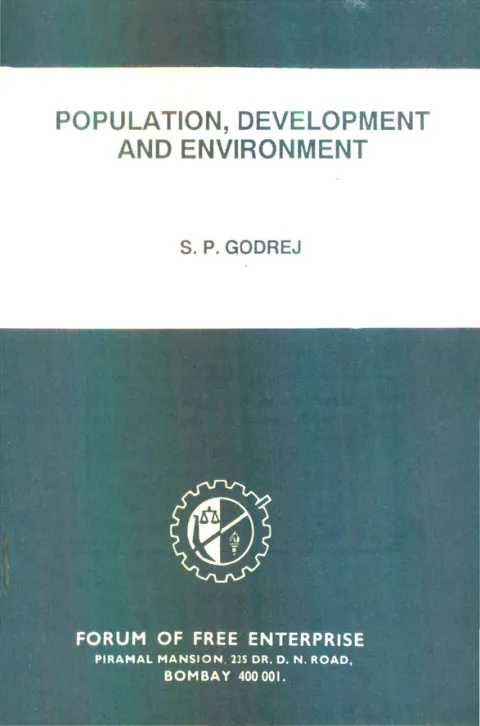
Population, Development and Environment
By S. P. GODREJ
Summary
Published by the Forum of Free Enterprise in December 1994, this twelve-page booklet reproduces S. P. Godrej’s keynote address to a WWF-India seminar in New Delhi in November 1994. Godrej, an industrialist and Vice-President of the World Wide Fund for Nature - India, argues that the new economic policy’s promise will not be realised so long as India fails to confront its ‘population holocaust’. Development, environment and population, he contends, constitute a trinity in which the third element relentlessly degrades the other two: India must support 16 per cent of the world’s population on 2.5 per cent of its land and 1.5 per cent of its income, while 170 million go hungry, 48 per cent remain illiterate, and 1.3 million hectares of forest are cleared every year.
The essay reads as a polemic of missed opportunities. Godrej notes that India was the first country to adopt family planning as state policy and the first to open a birth-control clinic (Mysore, 1930), yet has fallen behind Sri Lanka, Korea, Taiwan, Indonesia and Japan. He blames the political backlash from Emergency-era coercion (‘we threw out the baby with the bath water!’), an over-concentration on economic growth at the expense of health and education, a ‘chalta hai, chalne do’ fatalism that mistakes karma and astrology for thought, and ‘religious’ zeal around the Five-Year Plans. He invokes Gandhi on village uplift, J. R. D. Tata on a ‘global concern’ for population, Karan Singh on a national movement for population control, and the Pearson Commission’s warning that no other phenomenon ‘casts a darker shadow’ over development.
His prescriptions are positive rather than coercive: sound education, crash programmes for female literacy (citing Kerala’s example, where rising literacy reduces fertility), trade unions as carriers of awareness, committed media, scientists and ‘medical men particularly’ agitating against the conditions that breed disease, and electoral incentives that reward politicians who plan their own families. Godrej praises WWF-India’s expanding network of branches and its Pirojsha Godrej National Conservation Centre, lauds the Grow More Food Campaign and the Earth Summit/Cairo agendas while faulting them for sidelining population, and closes by tying the booklet’s argument to the Forum of Free Enterprise tradition with framing quotations from A. D. Shroff (‘Free Enterprise was born with man and shall survive as long as man survives’) and Eugene Black on private enterprise as ‘an affirmative good’.
Key points
-
Frames development, environment and population as a trinity in which uncontrolled population growth inevitably degrades the other two.
-
Marshals stark comparative data: India carries 16 per cent of world population on 2.5 per cent of its land and 1.5 per cent of its income; 170 million go hungry and 48 per cent remain illiterate.
-
Reads India’s family-planning record (first to adopt it as state policy, first birth-control clinic in Mysore 1930) as a story of squandered firsts compared to Sri Lanka, Korea, Taiwan, Indonesia and Japan.
-
Blames the Emergency’s coercive excesses for politically discrediting the family-planning movement: ‘we threw out the baby with the bath water!’
-
Argues that excess concentration on economic growth has starved health and education; cites Kerala and partially Tamil Nadu as proofs that welfare investment lowers fertility.
-
Faults Rio’s Earth Summit and the Cairo Conference for prioritising contraception, abortion and women’s rights over population control itself, while still endorsing female literacy as the most powerful demographic lever.
-
Rejects fatalistic ‘chalta hai, chalne do’ cultural attitudes, belief in karma and astrology, and ‘religious’ faith in Five-Year Plans as traditional weaknesses obstructing demographic transition.
-
Proposes positive solutions — sound education, crash programmes for female literacy, trade-union mobilisation, a committed media, doctors as advocates, and an electoral norm that withholds tickets from politicians who do not practise small-family planning.
Generated by the v1.5 extraction pipeline. Awaiting editorial review.
Metadata and summary are AI-extracted from the source PDF and reviewed for editorial accuracy. The original work is available via the Read PDF tab above (where present); paragraph-level citation inside the PDF is deferred to a future engagement.