pamphlet
OUR FOREIGN EXCHANGE PROBLEM CAN BE SOLVED BY A NEW EXPORT POLICY
FORUM OF FREE ENTERPRISE, SOHRAB HOUSE, 235, Dr. D. N. ROAD, BOMBAY - 1 · Bombay · 1961
10 pages
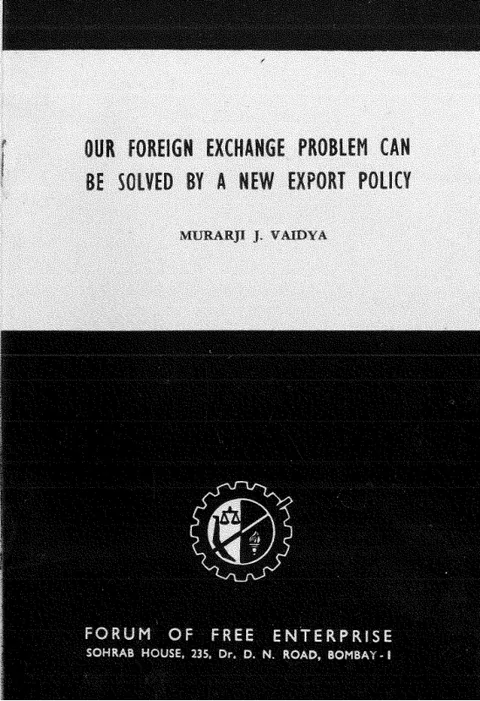
OUR FOREIGN EXCHANGE PROBLEM CAN BE SOLVED BY A NEW EXPORT POLICY
By MURARJI J. VAIDYA
Summary
In this 1961 Forum of Free Enterprise pamphlet, Murarji J. Vaidya argues that India’s chronic foreign-exchange deficit cannot be cured by tighter import controls and ought to be tackled through a more liberal export policy that leans on private enterprise rather than the State Trading Corporation. He opens with the data — exports of Rs. 6,300 million against imports of Rs. 10,100 million in 1960, with the gap widening from Rs. 2,900 million in 1958 to a likely Rs. 3,200 million in 1961 — to insist that the solution does not lie in further restricting imports but in expanding earnings abroad.
Vaidya then dissects why the medium-term credits extended by Western governments since 1956 have failed to translate into commissioned plant on schedule: licensing delays, Government-to-Government negotiations skewing project priorities, and a chronic distrust between the political-official class and the commercial community. He concedes that a small section of business has not lived up to ethical standards but argues that blanket controls and the Government’s refusal to extend export incentives — such as retention of foreign exchange against exported items, or import-licence entitlements tied to export performance — punish honest exporters and choke supply. The State Trading Corporation, in his account, has channelised exports of certain commodities into Communist markets at the cost of established Western buyers, and its monopolistic role over private trading houses needs to be confined to genuinely non-convertible currency areas.
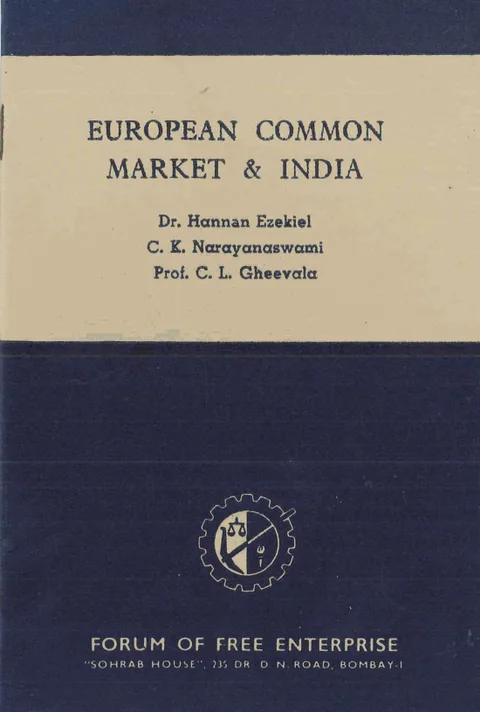
In an appended essay on the European Common Market, Vaidya turns to the strategic question raised by Britain’s pending negotiations to join the E.E.C. He warns that the Commonwealth preferences governing the bulk of Indian exports to the U.K. could erode, and that Indian products would face stiffer competition in Western Europe from the associated countries of the E.C.M. itself. Against this backdrop he urges that India consider an active role in some regional economic union of “appropriate and suitable neighbours” rather than standing alone in the face of growing trading blocs — a stand he says the Government has cold-shouldered “probably as a projection of our political neutrality.” He closes by pointing to the example of Mr. B. B. Lall’s appointment as Ambassador to Belgium and Commissioner-General to the E.C.M., and to nearly eight years already lost in inaction.
Key points
-
India’s trade deficit widened from Rs. 2,900 million in 1958 to a projected Rs. 3,200 million in 1961, despite very strict import controls.
-
Medium-term foreign credits extended since 1956 have not delivered commissioned industrial plant on schedule, because of licensing delays and intergovernmental priority disputes.
-
Vaidya defends the integrity of private enterprise against the dominant ‘industrial-distrust’ narrative and argues that ethical lapses are not confined to business.
-
He calls for export incentives — retention of part of foreign exchange earned, or import-licence rights against exported items — which the Government has rejected as contrary to its socialistic pattern.
-
The State Trading Corporation is criticised for monopolising exports of certain commodities and channelling trade to Communist countries at the cost of established Western buyers.
-
Government spending on commercial exhibitions abroad is judged disproportionate to actual Indian export development on the ground.
-
On the European Common Market, Vaidya warns that Britain’s likely entry will erode Commonwealth Preferences and intensify competition from E.C.M.-associated countries in markets like the U.K.
-
He urges India to consider active membership of a regional economic union with neighbours of similar outlook, rather than persisting in economic isolation.
Generated by the v1.5 extraction pipeline. Awaiting editorial review.
Metadata and summary are AI-extracted from the source PDF and reviewed for editorial accuracy. The original work is available via the Read PDF tab above (where present); paragraph-level citation inside the PDF is deferred to a future engagement.