edited volume · proceedings
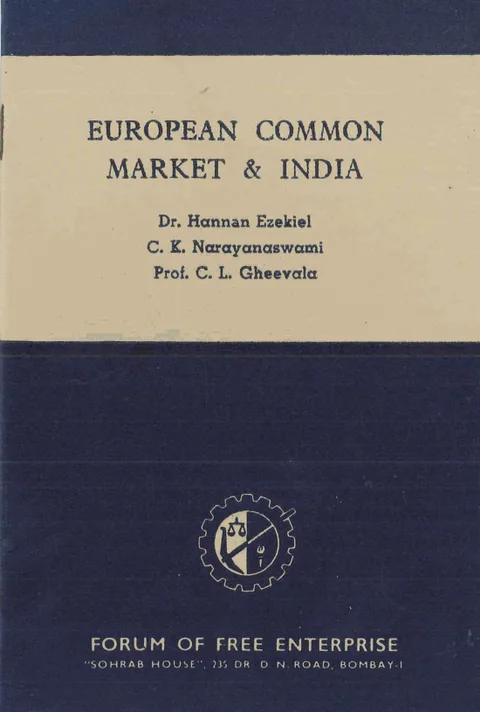
European Common Market & India
FORUM OF FREE ENTERPRISE, "Sohrab House", 235 Dr. D. N. Road, Bombay-1 · Bombay · 1962
15 pages
Summary
This Forum of Free Enterprise booklet reproduces a symposium held in Bombay on 3 November 1961 on the implications of the European Common Market (ECM) for India. Three speakers — Dr. Hannan Ezekiel (Financial Editor, Economic Times), C. K. Narayanaswami (Assistant Editor, Free Press Journal), and Prof. C. L. Gheevala (Secretary, Indian Merchants’ Chamber) — assess what Britain’s anticipated entry into the European Economic Community would mean for Indian exports, the Commonwealth preference regime, and India’s wider development strategy. A brief editorial introduction (drawn from a Deutsche Bank publication on the European Economic Community) summarises the Treaty of Rome’s customs-union, social-policy and capital-mobility provisions and prints a 1959 chart comparing the Six with the USA and the USSR on population, steel, electricity, vehicles and external trade.
Across the three contributions the speakers diverge in tone but converge on a single editorial line: Britain’s accession is essentially inevitable, India will lose some Commonwealth preferences, and the right response is internal economic discipline, faster industrialisation and a search for new markets — not protest against Europe. Ezekiel reads British entry as ‘a very good idea’ that will pull world trade toward the more liberal policies championed by the Kennedy administration and the Economic Commission for Europe. Narayanaswami warns against treating Britain as a betrayer and urges India to develop its own immense domestic market and, in the longer run, to build an Afro-Asian common market alongside African and Asian neighbours. Gheevala concentrates on foreign-exchange and competitiveness implications, documents India’s heavy export dependence on the UK and the Six (around 35% of total exports combined), and argues that the country’s high-cost, inflation-prone economy under defective planning must be reformed if India is to meet the slogan he calls operative: ‘Export or stagnate’.
Key points
-
Dr. Hannan Ezekiel opens the symposium by laying out the Rome Treaty’s twelve-year, three-stage timetable for a customs union and common external tariff among the Six.
-
Ezekiel identifies textiles, where India then enjoyed roughly a seventeen per cent Commonwealth preference, as the export category most exposed if Britain joins the Common Market.
-
He reads British accession as ‘a very good idea’ because it pulls Europe, and world trade policy generally, toward the liberal tariff regime favoured by the Kennedy administration and the Economic Commission for Europe.
-
C. K. Narayanaswami traces the Common Market’s lineage from the 1949 Council of Europe statute through the Coal and Steel Community and Euratom to the 1957 Treaty of Rome.
-
He argues Britain’s accession should not be read as betrayal and urges India instead to develop its vast domestic market and pursue an eventual Afro-Asian common market.
-
Prof. C. L. Gheevala documents India’s heavy export dependence on Britain and the Six, around thirty-five per cent of total exports combined, and warns of the foreign-exchange risk.
-
He argues India’s high-cost, inflation-prone economy under defective planning must be reformed to meet what he calls the operative slogan, ‘Export or stagnate’.
-
A brief editorial introduction, drawn from a Deutsche Bank publication, summarises the Treaty of Rome’s customs-union and capital-mobility provisions alongside a 1959 comparative chart of the Six against the USA and USSR.
Essays
I. [Dr. Hannan Ezekiel]
By Dr. Hannan Ezekiel
Ezekiel opens the symposium by laying out the structural facts of the European Common Market and the three possible futures Britain faces: staying with the Commonwealth, joining the Common Market, or developing the European Free Trade Association. He explains that the Rome Treaty establishes a real free-trade area among the Six — backed by a common external tariff set as a weighted average of member duties — and that Britain’s accession would replace Commonwealth preferences with that common tariff for Indian goods unless specific exceptions are negotiated. He concedes that textile exports, where India currently enjoys around a 17 per cent preference, would be among the most exposed.
Against the static loss-counting that dominated the Indian reaction, Ezekiel insists on a dynamic reading: if British entry accelerates European growth, the expanding market will more than compensate for lost preferences. He frames Britain’s accession as ‘a very good idea’ precisely because it pulls Europe — and through Europe, world trade policy — toward the more liberal external-tariff and import regime now being pressed by the Economic Commission for Europe and endorsed by the Kennedy administration. The essay closes by linking the Common Market debate to the wider Western swing in favour of trade-led help to underdeveloped countries.
- Lays out the Rome Treaty’s twelve-year, three-stage timetable for creating a customs union and a common external tariff among the Six, with internal duties progressively eliminated.
- Walks through three scenarios for Britain — remaining with the Commonwealth, joining the Common Market, or building up the European Free Trade Association — and the differing implications of each for Indian exports.
- Identifies textiles and cotton as the Indian export categories most exposed if Commonwealth preferences (around 17 per cent over the Common Market) are extinguished by Britain’s accession.
- Rejects a purely static analysis of preference loss in favour of a dynamic reading in which faster European growth from a wider market enlarges the absolute demand for Indian goods.
- Cites the Kennedy administration’s backing of the Economic Commission for Europe’s call for more liberal external tariffs and import policies favourable to underdeveloped countries as evidence that British entry will reinforce a global liberal swing.
II. [C. K. Narayanaswami]
By C. K. Narayanaswami
Narayanaswami situates the Common Market historically — from the Council of Europe statute signed in London in May 1949 through the European Coal and Steel Community (1950–51), Euratom and the Treaty of Rome (1957) — and reminds the audience that Britain originally scoffed at the project before changing course as the European Free Trade Association proved a thinner instrument. He stresses that the ECM is not purely an economic arrangement: its main animating force is political, an effort by Western European states to consolidate against the Soviet bloc and, in the process, raise their own standards of living.
For India, Narayanaswami refuses both fatalism and grievance. He concedes that Britain’s accession will cost India some preferences, particularly in textiles and other protected items, but argues that calling Britain a betrayer is unworthy and beside the point. The honourable response is to turn inward: develop the country’s vast potential domestic market, lift mass purchasing power through better planning, and look outward to Africa and Asia for new trading partners and even an Afro-Asian common market. He cites a Ford Foundation study that judged India’s domestic market to be one of the largest potential markets in the world, capable of producing ‘perhaps the greatest industrial revolution ever seen’ if cities and villages were developed together.
- Traces the ECM’s institutional lineage from the Council of Europe (1949) through the European Coal and Steel Community to Euratom and the Treaty of Rome (1957).
- Argues that the principal force behind the Community is political — Western European consolidation against the powerful might of the Soviet bloc — and that Britain’s earlier dismissal has given way to inevitable accession.
- Rejects the framing of Britain as betraying India, treating preference loss as a survival problem for the UK rather than an act of hostility toward the Commonwealth.
- Urges India to develop its enormous domestic market and to combine with African and Asian neighbours to evolve an Afro-Asian trade mechanism rather than seek charity from Europe.
- Cites a Ford Foundation team’s verdict that India’s market is one of the largest potential domestic markets in the world and could stimulate a sweeping industrial revolution if developed across both cities and villages.
III. [Prof. C. L. Gheevala]
By Prof. C. L. Gheevala
Gheevala treats Britain’s accession to the ECM as a ‘compulsion’ the UK cannot avoid: with the Empire dissolved and Soviet pressure mounting, splendid isolation is no longer available. He argues that the EEC is at bottom a regional response to post-war European problems and must be viewed in that broader political-economic frame. For India the relevant question is foreign-exchange capacity: the UK accounts for roughly 27 per cent of Indian exports, the rest of the Common Market countries another 8 per cent, and the loss of about one-fifth of UK trade is a realistic risk if no concessions are negotiated.
He rejects the language of charity in favour of enlightened self-interest. India must offer the Common Market goods and capital equipment that buyers actually want, on commercial terms, and use the proceeds to finance the imports its development plans require. The deeper problem, he argues, is internal: defective planning has produced a high-cost, inflation-prone economy whose products struggle in foreign markets. Unless India confronts the inflationary pressures generated by its own development pattern, it will fail to meet the challenge posed by Britain’s entry into the ECM. He distils the choice in a slogan: ‘Export or stagnate.’
- Frames Britain’s accession as an unavoidable compulsion produced by Empire’s dissolution, shrinking political power and the consolidation of Western Europe against the Soviet bloc.
- Quantifies India’s exposure — roughly 27 per cent of Indian exports go to the UK and another 8 per cent to the Common Market countries (35 per cent combined), with a realistic risk of losing about one-fifth of UK trade.
- Recasts the relationship from charity to enlightened self-interest: India should sell goods and capital equipment the Common Market actually wants, on commercial terms, rather than appeal for special concessions.
- Identifies inflationary pressures, defective Third-Plan planning and high-cost domestic production as the underlying weakness behind India’s export problem.
- Distils India’s options into the slogan ‘Export or stagnate’ and argues that meeting the ECM challenge requires confronting internal economic distortions rather than blaming external trade arrangements.
Metadata and summary are AI-extracted from the source PDF and reviewed for editorial accuracy. The original work is available via the Read PDF tab above (where present); paragraph-level citation inside the PDF is deferred to a future engagement.