speech · memorial lecture
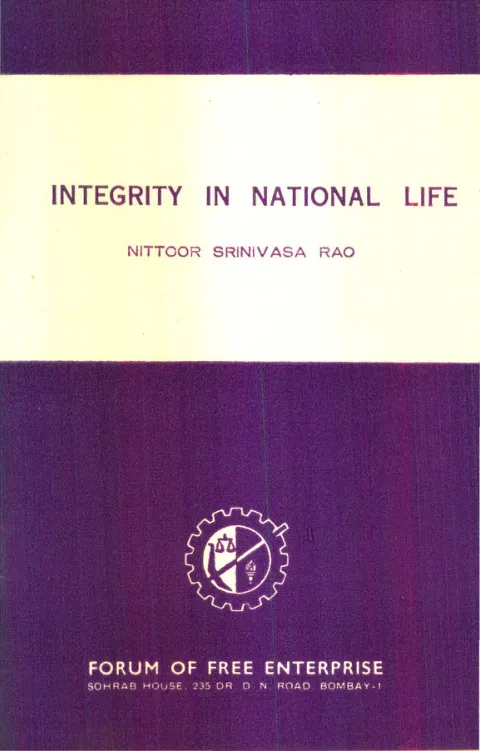
INTEGRITY IN NATIONAL LIFE
Published by M. R. PAI for the Forum of Free Enterprise, "Sohrab House", 235 Dr. Dadabhai Naoroji Road, Bombay-1, and printed by H. NARAYAN RAO at H. R. MOHAN & CO. (PRESS), 9-B, Cawasjee Patel Street, Bombay-1. · Bombay · 1971
20 pages
Part of A. D. Shroff Memorial Lecture
Summary
This booklet reproduces the A. D. Shroff Memorial Lecture delivered by Nittoor Srinivasa Rao — former Chief Justice of Mysore and Central Vigilance Commissioner from 1964 to 1968 — at the Madras Centre of the Forum of Free Enterprise on 7 November 1970. Rao takes ‘Integrity in National Life’ as a topic ‘of basic importance to all systems of society’, then narrows the lens to post-Independence India, where, he warns, corruption and the erosion of ethical standards have spread to a point that endangers the country’s future.
Rao locates the problem in three overlapping zones. First, the moral climate of the community itself: where the prevailing code is corrupt, conformity makes it ‘virtually impossible’ for an honest functionary to operate, and the higher the level at which low standards are tolerated the more they cascade downward. Second, the political level: he argues that in representative democracy the unscrupulous acquisition and retention of power — through patronage of supporters, favours to financiers, and the wielding of political authority by men ‘not of character and calibre’ — necessarily demoralises the permanent civil services beneath. Third, the citizen’s side of the transaction: corruption is also the act of the private individual who exploits monopoly or seeks an illegitimate favour, so the remedy cannot lie only with public functionaries.
A long historical middle section sets India’s position against the West — virtual absence of corruption today in Britain and Scandinavia, but a Walpole-era past in which ‘every man has his price’, and a still-surviving American spoils system in which thousands of federal offices change hands at each election. Within India, Rao traces a deteriorating arc: the East India Company’s looting servants, gradual improvement under the Crown, war-time backsliding, and a ‘progressive deterioration in standards’ after 1947, capped by floor-crossing, undisciplined Legislatures, and routine attacks on the bona fides of judges and election officials — a slide he dates to ‘the last days of Jawaharlal Nehru’s Prime Ministership.’
The institutional response Rao surveys is the Santhanam Committee, the Administrative Vigilance Division, the Central Vigilance Commission, and the Administrative Reforms Commission’s proposal for a Lokpal at the Centre and Lokayuktas in the States, modelled on the Scandinavian Ombudsman. He endorses these as necessary but insufficient: because most corrupt transactions have no aggrieved party, grievance-based machinery alone cannot reach them. He closes by calling for non-official supplements — Citizens’ Advice Bureaus staffed by ‘men of experience and knowledge’ and Consumers’ Organisations to discipline those wielding economic power — and expresses a guarded hope that ‘the nation’s inner strength and stamina will assert itself in due course, but before long.‘
Key points
-
Frames integrity as a universal problem of organised life, citing Kautilya’s Arthasastra and Aristophanes’ ‘The Frogs’, and warns that corruption has historically toppled regimes (Rome, Vichy France, Chiang Kai-Shek’s China).
-
Identifies low-income society, weak administration, and bureaucratic delay (the ‘speed money’ that mutates into deliberate obstruction) as enabling conditions for petty corruption.
-
Argues that the moral climate of the community is the single most powerful variable — conformity makes individual rectitude almost untenable in a corrupt environment.
-
Treats representative democracy as especially vulnerable: politicians dependent on supporters trade favours, demoralise the permanent services, and recruit men of wealth outside the legislature as patrons in exchange for influence.
-
Reads Indian public life since Independence as a story of ‘progressive deterioration’, dating the sharpest decline in legislative conduct (floor-crossing, defection, attacks on judges and election officials) to the closing years of Nehru’s premiership.
-
Surveys the institutional toolkit — Santhanam Committee, Administrative Vigilance Division, Central Vigilance Commission, Administrative Reforms Commission’s Lokpal/Lokayukta proposal modelled on the Scandinavian Ombudsman — and warns that grievance-driven machinery cannot reach the typical corrupt transaction, which has no aggrieved party.
-
Extends the moral burden to the citizen and the private monopolist, arguing that ‘the man who makes excessive profit by exploiting the needs of society or by creating a monopoly also acts without integrity and anti-socially’.
-
Recommends non-official supplements — Citizens’ Advice Bureaus and Consumers’ Organisations — to back up the new vigilance institutions, closing on a guarded hope for national moral revival.
Metadata and summary are AI-extracted from the source PDF and reviewed for editorial accuracy. The original work is available via the Read PDF tab above (where present); paragraph-level citation inside the PDF is deferred to a future engagement.