edited volume · anthology
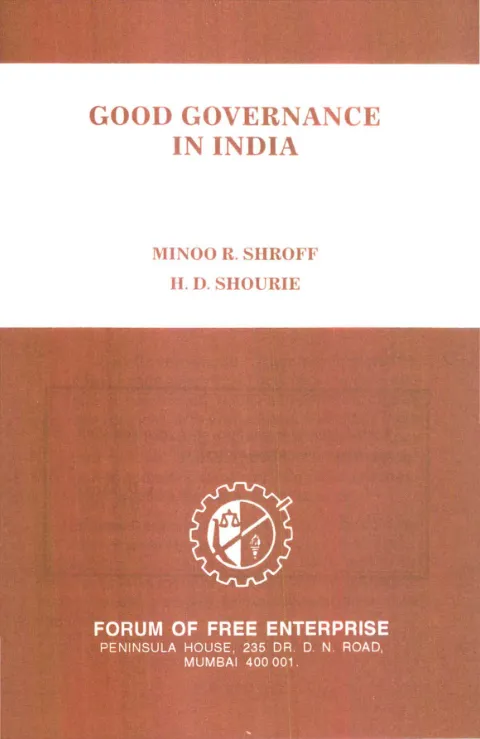
Good Governance in India
By MINOO R. SHROFF, H. D. Shourie
Published by M. R. Pai for the Forum of Free Enterprise, "Peninsula House", 235 Dr. D. N. Road, Mumbai - 400 001. · Mumbai · 2002
20 pages
Good Governance in India
By MINOO R. SHROFF, H. D. SHOURIE
Summary
Good Governance in India is a January–March 2002 booklet published by the Forum of Free Enterprise (Mumbai) that pairs two short addresses on the institutional preconditions for good governance — one trained on the voluntary sector, the other on the machinery of the State. Minoo R. Shroff, President of the Forum, writes on the effective governance of NGOs, importing the Nolan Committee’s seven principles of public life (selflessness, integrity, objectivity, accountability, openness, honesty, leadership) into a checklist for Indian charitable boards and their chief executives. H. D. Shourie, Director of Common Cause, reproduces a January 14, 2002 circular he addressed to all Chief Ministers and Chief Secretaries, cataloguing seven concrete remedies for State-level administrative malaise: tenure assurance via a Civil Services Board, grievance redressal, accountability via Citizens Charters, transparency and Right to Information, de-bloating of staff, anti-corruption machinery (CVC, CBI, Lokayukta, Benami and money-laundering laws), and modernisation through e-governance. Both pieces frame Indian state and civil-society failure as a problem of culture-of-office — bribery, opaque transfers, conflict of interest — and converge on the prescription that boards, chairmen, and chief executives must lead by personal example and operate under codified, monitored standards.
Key points
-
The booklet pairs two January-March 2002 addresses published by the Forum of Free Enterprise: Minoo R. Shroff on NGO governance and H. D. Shourie on reforming State administration.
-
Shroff imports the Nolan Committee’s seven principles of public life — selflessness, integrity, objectivity, accountability, openness, honesty, leadership — as the template for an Indian NGO Charter of Governance.
-
Shroff proposes board term limits of no more than ten years and a retirement-age cap around seventy-five to keep NGO boards refreshed with new members.
-
Shroff insists on merit-based hiring with no nepotism whatsoever, matched to an internal audit function backed by reputed Chartered Accountants for NGO chief executives.
-
Shourie reproduces his 14 January 2002 circular to all Chief Ministers and Chief Secretaries, citing Uttar Pradesh’s six-month average officer tenure as evidence of politically motivated transfers.
-
Shourie reports 41,647 cases pending across thirty-three Benches of the Central Administrative Tribunal, drawn from 3,45,436 cases filed with it since 1985.
-
Shourie’s seven-point reform programme covers a statutory Civil Services Board, Citizens Charters, freedom-of-information legislation, de-bloated staffing, anti-corruption enforcement via the CVC, CBI and Lokayukta, and e-governance.
-
Shourie cites Orissa’s reported diversion of cyclone relief funds toward staff salaries as an example of why de-bloating state administration is urgent.
Essays
Effective Governance of NGOs
By Minoo R. Shroff
Minoo R. Shroff, President of the Forum of Free Enterprise, lays down a governance manual for the Indian NGO sector, treating non-governmental organisations as serious institutions that must be ‘run on commercial lines albeit with great accent on social good.’ He argues that the Board is the apex custodian of values and must be staffed with high-calibre, ethically clean members who steer clear of conflict of interest; he imports verbatim the seven principles of public life from Britain’s Nolan Committee (selflessness, integrity, objectivity, accountability, openness, honesty, leadership) as the template for a ‘Charter of Governance.’ Shroff insists on Chairman–Chief Executive synergy, fixed terms (not exceeding ten years), a retirement age cap around 75, internal audit, merit-based hiring with zero nepotism, and a five-point checklist for purposeful functioning (vision, road map, organisation, systems, financial plan). The closing reflection concedes that administering NGOs is daunting because expectations outrun resources, yet stresses that voluntary effort matters all the more ‘in our country where the delivery and response of public services is so poor.’
- NGOs span education, health, charity, environment, arts and public awareness, and must be run on commercial lines with social accent — generating a surplus for renewal.
- Boards must be ethically clean, free of conflict of interest, and built around a strong Chairman who acts as the ‘Kingpin’ and custodian of values.
- The seven Nolan principles (selflessness, integrity, objectivity, accountability, openness, honesty, leadership) are explicitly imported as the template for an Indian Charter of Governance.
- Term limits (≤10 years) and a 75-year retirement cap are proposed to keep fresh blood flowing into Boards.
- Chief Executive must be empowered with clear delegation, backed by internal audit (departmental or via reputed Chartered Accountants), and matched to staff hired strictly on merit — ‘nepotism in any shape or form should be scrupulously avoided.’
- A five-step checklist — Strategic Vision, Road Map, Effective Organisation, Systems and Procedures, Financial Plan — is offered as the discipline of purposeful functioning.
Our Governmental System Must Improve
By H. D. Shourie
H. D. Shourie, Director of the citizen-grievance body Common Cause, frames Indian governance as a ‘malaise’ fifty years after independence: bloated, inefficient, riddled with arbitrary transfers and corruption, and lacking transparency and accountability. The body of the piece reproduces his January 14, 2002 circular letter to every Chief Minister and Chief Secretary in the Union, distilling the recommendations of past Commissions, Committees and the 1997 Chief Ministers’ Conference into seven concrete reform demands. These cover (i) tenure assurance via an institutionalised Civil Services Board to insulate officers from politically motivated transfers — citing Uttar Pradesh’s six-month average tenure as a scandal; (ii) grievance redressal mechanisms within departments and districts to relieve the Central Administrative Tribunal of its 41,647-case backlog; (iii) accountability through universally published Citizens Charters; (iv) transparency by enacting freedom-of-information laws and gutting the Official Secrets Act; (v) de-bloating of state staffing, citing Orissa’s reported diversion of cyclone relief funds to salaries; (vi) anti-corruption enforcement via Vigilance officers, Lokayuktas, CVC/CBI, the Benami Transactions Prohibition Act and pending money-laundering legislation; and (vii) modernisation through e-governance, websites and Total Quality Management. The letter closes with an explicit appeal for time-bound action by each State Government.
- Frames the problem as ‘general feeling’ that India’s governmental and administrative machinery generates delays, frustrations and ‘resort to bribery and corruption’ for routine service delivery.
- Proposes a statutory Civil Services Board (Chief Secretary + two Secretaries) in every State to control postings and transfers — directly attacking politically-motivated reshuffles.
- Cites concrete data: 3,45,436 cases taken to the Central Administrative Tribunal since 1985, with 41,647 currently pending across 33 Benches.
- Endorses Citizens Charters, Right to Information Acts and the pending Freedom of Information Bill; calls for eliminating ‘inhibiting clauses in the Official Secrets Act and Conduct Rules.’
- Couples anti-corruption enforcement (CVC, CBI, Lokayuktas) with statutory teeth — Benami Transactions Prohibition Act, the pending Corrupt Public Servants (Forfeiture of Property) Act, and Prevention of Money Laundering legislation.
- Treats e-governance and Total Quality Management as the modernisation track, channelling assistance from the Department of Administrative Reforms, Government of India.
Generated by the v1.5 extraction pipeline. Awaiting editorial review.
Metadata and summary are AI-extracted from the source PDF and reviewed for editorial accuracy. The original work is available via the Read PDF tab above (where present); paragraph-level citation inside the PDF is deferred to a future engagement.