pamphlet · collected works
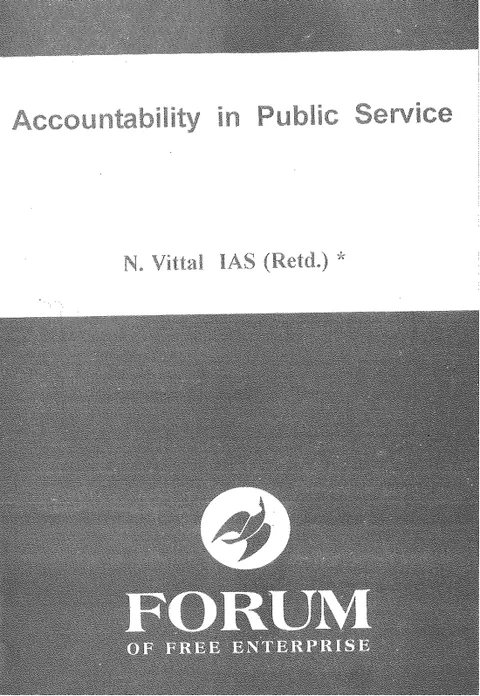
Accountability in Public Service
By N. Vittal
Published by S. S. Bhandare for the Forum of Free Enterprise, Peninsula House, 2nd Floor, 235, Dr. D. N. Road, Mumbai 400001, and Printed by S. V. Limaye at India Printing Works, India Printing House, 42 G. D. Ambekar Marg, Wadala, Mumbai 400 031. · Mumbai · 2011
16 pages
Summary
Reproduced from successive issues of Freedom First (November–December 2010 and January 2011), this Forum of Free Enterprise booklet by former Central Vigilance Commissioner N. Vittal frames accountability as the missing soul of Indian public service. Sunil Bhandare’s editorial preface places the essay in the immediate context of the 2010–11 scams and an open letter of fourteen prominent citizens calling for empowered Lok Ayuktas and the Lok Pal Bill, while invoking M. C. Chagla’s Ninth A. D. Shroff Memorial Lecture on the judiciary as a long-standing Forum touchstone for the ‘principle of zero tolerance’ toward corruption.
Vittal’s central argument is a simple equation — Input × Accountability = Output — that he uses to insist accountability is finally fixable only on individual human beings, never on the abstract ‘organisation’. He diagnoses several Indian pathologies that erode this individual responsibility: Parkinson’s Law expansion of the bureaucracy; the constitutional cushion of Article 311, which converts the public servant’s relationship with the state from a contract into a security tenure and ‘blunts’ performance discipline; a broken Annual Confidential Reports system in which ‘good’ has become a synonym for average or even poor; caste and reservation-related complications around adverse remarks; entrenched opacity nourished by the Official Secrets Act; and corruption itself, which Transparency International’s Corruption Perceptions Index tracks year after year.
The second half of the essay turns prescriptive. Vittal endorses the Right to Information Act of 2005 as ‘a great blessing’ and recommends the standard procedural toolkit of elimination, combination, e-sequencing, substitution and modification, alongside aggressive use of information technology (the Railways’ passenger reservation system is his model case). He draws extensively on Pradip Khandwalla’s Transforming Governance through New Public Management to argue for a directly elected Prime Minister and Chief Ministers serving fixed five-year terms, run-off elections requiring 50%+1 majorities, Margaret Thatcher-style agencification of two-thirds of departmental functions, and competition as a cure (the 1994 telecom de-monopolisation having delivered teledensity from 1 in 1990 to 53 by 2010). The 3G spectrum auction is cited approvingly against the 2G scam as proof that transparent processes pay.
Vittal closes optimistically at ‘the age of 72’, resting his hope on India’s free press, alert electronic and print media, residual self-correction (the courts have forced corrections via the Hawala case and the Vineet Narain judgement of December 1997, which made the CBI and Enforcement Directorate statutory under CVC supervision), and on culture-building through professional ethics codes and Hippocratic-style oaths. A short biographical note on Shailesh Kapadia (1949–1988), whose Memorial Trust sponsored the booklet, and a Eugene Black epigraph on private enterprise as ‘an affirmative good’ close the volume.
Key points
-
Frames the quality of public service as Input × Accountability = Output (I × A = O), with accountability fixable only on individuals, never on the abstract organisation.
-
Diagnoses Article 311 of the Constitution as a security-tenure shield that converts the public servant–state relation from contract to status and blunts accountability; proposes replacing it with a rolling contract.
-
Indicts the Annual Confidential Reports system: ‘good’ has become a synonym for average or even poor, with adverse remarks chilled by reservation politics and post-Andhra Pradesh judicial scrutiny.
-
Identifies four root causes of corruption in Indian bureaucracy — lack of transparency, red tape, complicated procedures, and ‘groupism or brotherhood’ culture nourished by the Official Secrets Act.
-
Endorses the Right to Information Act 2005 as ‘a great blessing’ and recommends elimination–combination–e-sequencing–substitution–modification of procedures plus e-governance (Railways reservation as model).
-
Borrows Pradip Khandwalla’s New Public Management agenda: directly elected PM/CMs on fixed five-year terms, run-off elections at 50%+1, Thatcher-style agencification of two-thirds of departmental functions.
-
Cites the 1994 telecom de-monopolisation and the 3G auction as evidence that competition and transparent design dramatically reduce corruption while expanding service.
-
Closes with a culture-and-ethics argument: Hippocratic-style oaths, ethics modules in professional education, and a free press as the indispensable countervailing force.
Metadata and summary are AI-extracted from the source PDF and reviewed for editorial accuracy. The original work is available via the Read PDF tab above (where present); paragraph-level citation inside the PDF is deferred to a future engagement.