speech · memorial lecture
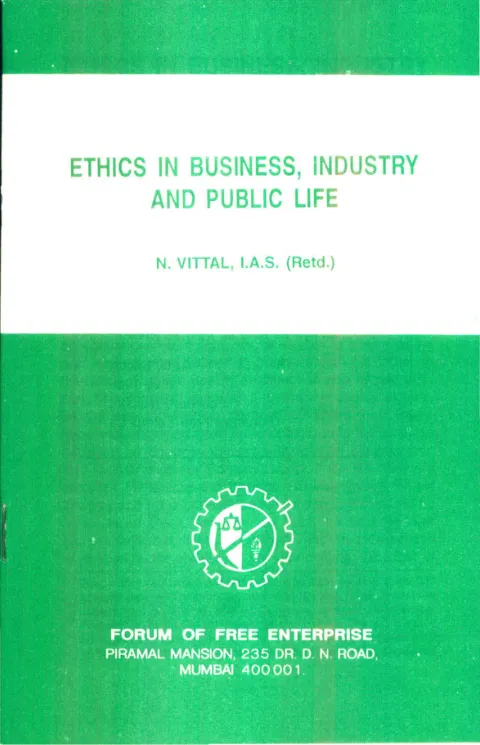
ETHICS IN BUSINESS, INDUSTRY AND PUBLIC LIFE
By N. Vittal
FORUM OF FREE ENTERPRISE, PIRAMAL MANSION, 235 DR. D. N. ROAD, MUMBAI 400 001. · Mumbai · 1999
20 pages
No. 10 in Bhogilal Leherchand Memorial Lecture
Summary
Delivered as the Tenth Bhogilal Leherchand Memorial Lecture in Mumbai on 8 January 1999 and published by the Forum of Free Enterprise, this booklet captures N. Vittal’s diagnosis of India’s corruption problem from his vantage as Central Vigilance Commissioner. Vittal opens with a tribute to Bhogilal Leherchand — the Bombay diamond merchant who diversified into textiles, engineering and petrochemicals while keeping a reputation for integrity — and uses that example to ask why ethical standards in Indian business, industry and public life have decayed so badly that the country is rated the world’s ninth most corrupt.
His central thesis is structural rather than moral. While ten per cent of Indians will be saintly and ten per cent crooked whatever the rules, the remaining eighty per cent calibrate their behaviour to the system — and India’s system rewards corruption. Vittal identifies five drivers: scarcity engineered by the permit-licence raj (the “neta babu lala raj”), opacity in decision making, delays and red tape that attract speed money, procedural cushions that shelter the guilty under the presumption of innocence, and the tribalism or biradri by which corrupt officials protect one another.
The remedies he advances are practical and statutory rather than exhortatory: open sectors to competition (he cites the National Telecom Policy as a case of using market competition to dissolve scarcity-driven corruption); legislate a Freedom of Information Act and adopt a U.S.-style “sunset principle” so that no rule remains in perpetuity; raise the cost of corruption through the draft Corrupt Public Servants (Forfeiture of Property) Act 1999, whose clauses Vittal reproduces in detail; and use the statutory authority the CVC acquired through the Vineet Narain judgment to focus enforcement on the highest-level offenders so that the system is no longer “a spider’s web” that catches only small insects.
The lecture closes by invoking the Vedic dictum Aano bhadrah kritavo yantu vishwatah (“let noble thoughts come to us from all sides”) and the Taitreya Upanishad’s call to collective debate, framing anti-corruption reform as an exercise in moral as well as institutional renewal.
Key points
-
Vittal speaks as Central Vigilance Commissioner, delivering the Tenth Bhogilal Leherchand Memorial Lecture under Forum of Free Enterprise auspices on 8 January 1999.
-
Frames ethics as a function of system design, not individual virtue: a 10/10/80 distribution where the 80 per cent majority responds to incentives rather than exhortation.
-
Identifies five drivers of corruption: scarcity (the permit-licence raj), opacity in decision making, delay and red tape, legal cushions that protect the accused, and biradri solidarity among corrupt officials.
-
Diagnoses corruption as “a low risk high profit business” and proposes raising its cost through the Corrupt Public Servants (Forfeiture of Property) Act 1999, reproducing the draft clauses in full.
-
Treats the Vineet Narain judgment (making the CVC a statutory body) and the JMM judgment (bringing Ministers and MPs within the Prevention of Corruption Act) as enabling instruments for prosecuting high-level corruption.
-
Advocates a U.S.-style sunset principle on rules, a Freedom of Information Act and the use of Information Technology to reduce official discretion.
-
Argues that opening sectors to competition — as in the National Telecom Policy — is the structural cure for scarcity-driven corruption.
-
Closes with Vedic and Upanishadic invocations, warning that unless top-level offenders are punished the public will see the system as a spider’s web that catches only flies.
Metadata and summary are AI-extracted from the source PDF and reviewed for editorial accuracy. The original work is available via the Read PDF tab above (where present); paragraph-level citation inside the PDF is deferred to a future engagement.