pamphlet · anthology
Corruption Can Be Controlled
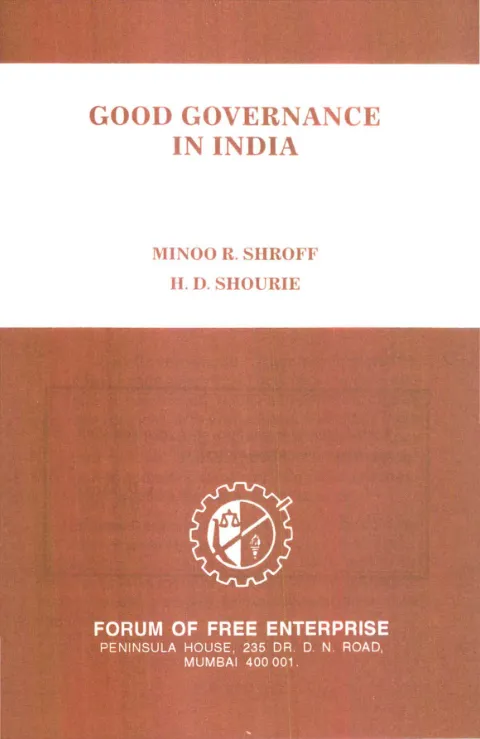
FORUM OF FREE ENTERPRISE, PIRAMAL MANSION, 235, DR. D.N. ROAD, MUMBAI 400 001 · Mumbai · 1998
20 pages
Summary
Published by the Forum of Free Enterprise in Mumbai on 14 October 1998, this booklet brings together two complementary addresses on the economics and politics of corruption in India. The first, by Dr. P. V. Shenoi, IAS (Retd.), Director of the Institute for Social and Economic Change, Bangalore, is based on a seminar presentation of January 1998; the second, by Ram Gandhi, immediate Past President of the Indian Merchants’ Chamber, is drawn from his welcome address at an IMC meeting of 21 December 1997 at which Prime Minister I. K. Gujral was the chief guest. Both authors share a common premise—that India ranked among the world’s ten most corrupt nations—but approach the problem from different angles: Shenoi from the standpoint of administrative and constitutional reform, Gandhi from the standpoint of economic costs and a sequenced action agenda.
Shenoi’s argument is that corruption flows from the top down. He documents the failure of the Lok Pal Bill to progress in thirty years, the routine appointment of ‘transparently unfit people to high constitutional offices,’ and the fact that an estimated one-quarter of legislators had criminal records. His prescriptions move through seven domains: transparent appointment councils for constitutional offices (chaired by the President/Governor and including the Chief Justice and opposition leaders); realistic election-expenditure ceilings and state funding of elections; salary parity for legislators with State/Central Government Secretaries, coupled with mandatory annual asset declarations; full privatisation of the public sector (which was earning only a 2 per cent return on an investment of roughly Rs. three lakh crores, financed by borrowings at 10 per cent); a business-like public service with market-comparable salaries and strict integrity enforcement; a Vigilance Commissioner drawn from the judiciary with adequate investigative staff and powers to lay traps; and replacement of the Official Secrets Act with a right-to-information law covering everything except genuine security matters.
Gandhi’s contribution focuses on the economic cost and tactical sequencing. He cites an IMF study of 70 countries showing that reducing corruption levels from India’s to Scandinavia’s would raise the annual investment rate by 10–12 per cent and GDP growth by 1.5 per cent; Harvard research estimated that India’s corruption was equivalent to raising the effective marginal tax rate by 20 percentage points. Gandhi disaggregates corruption into three levels—petty (passport bribes), enterprise (customs clearances), and political (major contracts and licences)—and argues that petty corruption cannot be eradicated until political and enterprise corruption are tackled first. At the political level, his ‘low-hanging fruit’ are the Right to Information Bill and making the CBI independent of the executive (with Election Commission-like status). At the enterprise level, he notes that 67 per cent of India’s laws had never been used in any court since independence, that 47 approvals were required to construct a building in Mumbai, and that small-scale entrepreneurs faced 36 inspectors monthly and 46 separate export documents—making time-bound decision-making and the scrapping of blanket discretionary clauses the most actionable first steps.
Key points
-
An IMF study of 70 countries estimated that reducing India’s corruption to Scandinavian levels would raise investment by 10–12% per annum and GDP growth by 1.5% per annum; Harvard research put India’s corruption burden as equivalent to a 20-percentage-point increase in the effective marginal tax rate.
-
India’s public sector investment of approximately Rs. three lakh crores was earning only a 2% return while financed by borrowings at 10% per annum; Shenoi argues for full privatisation within five years, treating token disinvestment of 5–10% of shares as ‘practically a joke’.
-
An estimated one-quarter of India’s legislators held criminal records at the time of writing; Shenoi recommends salary parity with government Secretaries plus mandatory annual asset declarations open to public comment.
-
The Lok Pal Bill had been pending for thirty years; no Prime or Chief Minister wished to be subject to its integrity regime, and the bill’s stagnation exemplified the broader failure of top-down accountability.
-
Gandhi identifies three distinct tiers of corruption—petty (passport and ration-card bribes), enterprise (customs and regulatory clearances) and political (major contracts and licences)—and argues that petty corruption can be eradicated only after the higher tiers are addressed first.
-
67% of India’s laws had never been used in any court since independence; 47 approvals were required to construct a building in Mumbai; a small-scale entrepreneur faced 36 monthly inspectors and 46 separate export documents—making procedural simplification the most tractable entry point for anti-corruption reform.
-
Gandhi proposes giving the CBI Election Commission-like statutory independence—ending the requirement to seek ministerial approval before prosecuting a public servant—and creating exclusive fast-track courts for all corruption cases.
-
A World Bank study cited in the booklet placed India in a corruption tier alongside Belarus, Moldova, Russia, Ukraine, Fiji and Malaysia; the top performers were Ireland and the United Kingdom.
Metadata and summary are AI-extracted from the source PDF and reviewed for editorial accuracy. The original work is available via the Read PDF tab above (where present); paragraph-level citation inside the PDF is deferred to a future engagement.