speech · memorial lecture
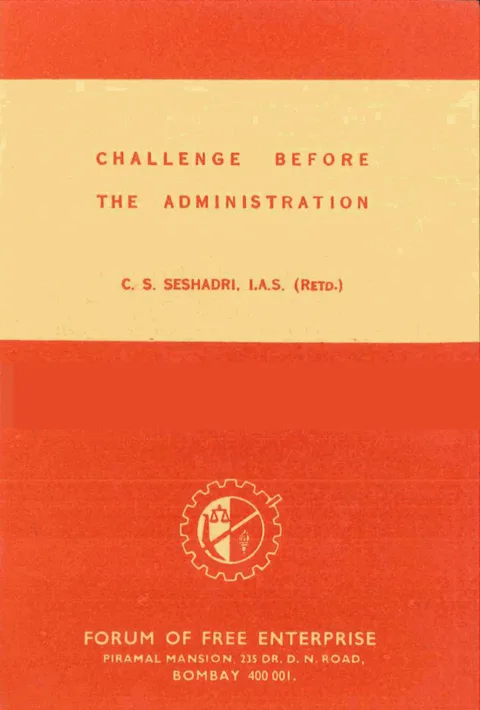
Challenge Before the Administration
Forum of Free Enterprise, Piramal Mansion, 235 Dr. D. N. Road, Bombay 400 001. Published by M. R. Pai for the Forum of Free Enterprise, 235 Dr. Dadabhai Naoroji Road, Bombay-400 001, and Printed by H. Narayan Rao at H. R. Mohan & Co., 3-B Cawasji Patel Street, Bombay-400 001. · Bombay · 1980
9 pages
Part of A. D. Shroff Memorial Lecture
Summary
Delivered as the A. D. Shroff Memorial Lecture in Bangalore on 30 October 1979 and published by the Forum of Free Enterprise, this booklet is C. S. Seshadri’s diagnosis of what has gone wrong with Indian public administration after more than three decades of self-government. Drawing on his career as a senior civil servant (1943–1976), Seshadri argues that public administration is the indispensable infrastructure of national survival — whatever the constitutional form — and that India’s administrative machinery, inherited from the colonial ‘Steel Frame’ system of area administrators, has deteriorated in both integrity and efficiency as ethical and moral standards in public life have declined.
The lecture organises the diagnosis around three pressures on the system: the rising quantitative and qualitative demands of a more rights-conscious public; the shift of government into private-enterprise-like activities that has widened the opportunities for corruption; and chronic political instability. Seshadri identifies three specific failures of the modern administration — delay and cumbersome procedure, widespread corruption at all levels, and an attitude of apathy and discourtesy toward the public — and traces them to the loss of status, integrity and competence that earlier attracted talented young people into the service. He laments that civil servants now resort to strikes, demonstrations and agitational methods, that ministers and secretaries are entangled in confused lines of control, and that audit and evaluation systems penalise initiative by treating every honest mistake as misconduct.
His remedies are deliberately modest. He advocates strict enforcement of conduct rules and discipline; reorganisation of the secretariat and rationalisation of the minister–secretary structure; and adoption of modern management techniques — clear statement of objectives, delegation of powers, monitoring and evaluation — borrowed from the private sector, while warning that public administration is not identical to business management. The closing note is sobering: administrative efficiency can be improved, but moral and ethical standards in the administration ultimately depend on those of its political masters and, behind them, the people.
Key points
-
Framed as the A. D. Shroff Memorial Lecture (Bangalore, 30 October 1979), published 11 May 1980 by the Forum of Free Enterprise; Seshadri speaks as a retired IAS officer with 33 years of service.
-
Central thesis: no nation, whatever its form of government, can progress without a competent and honest administrative set-up, and India’s is in clear ethical and operational decline.
-
Three structural pressures on the administration: rising quantitative and rights-based demands from the public; the state’s expansion into business-like activities (which widens scope for corruption); and political instability with general deterioration in moral standards.
-
Three concrete criticisms of the administration: undue delays and cumbersome procedures; widespread corruption at almost all levels; and an attitude of apathy and discourtesy in dealing with the public.
-
Historical narrative: India’s administrative system descends from a colonial ‘area administrator’ model — the British ‘Steel Frame’ staffed by ICS-style generalist career managers — that survived Independence but has steadily lost its earlier status, integrity and inducement to talent.
-
Audit/evaluation pathology: Seshadri argues current systems punish honest errors and any deviation from rules, producing a culture of ‘management by objections’ rather than ‘management by objectives’ and inducing decision-paralysis.
-
He deplores the spread of strikes, demonstrations and agitational methods among government employees and even essential-services magistrates, and calls for strict enforcement of conduct and discipline rules.
-
Reform agenda is administrative rather than ideological: reorganise the secretariat and minister–secretary structure, modernise equipment and procedures, adopt private-sector-style management tools (objectives, delegation, monitoring), without pretending that public administration is identical to business management.
-
Closing frame: ‘The challenge before the administration is an integral part of the challenge before the nation’ — administrative reform is possible, but the moral standard of the bureaucracy ultimately reflects the moral standard of its political masters and electorate.
Metadata and summary are AI-extracted from the source PDF and reviewed for editorial accuracy. The original work is available via the Read PDF tab above (where present); paragraph-level citation inside the PDF is deferred to a future engagement.