speech · memorial lecture
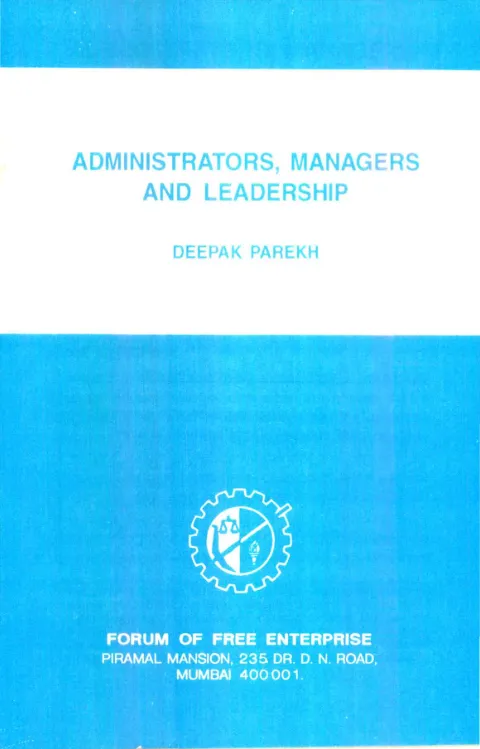
Administrators, Managers and Leadership
FORUM OF FREE ENTERPRISE, PIRAMAL MANSION, 235 DR. D. N. ROAD, MUMBAI 400001. · Mumbai · 1997
24 pages
Summary
Delivered as the Lalit Doshi Memorial Lecture in Mumbai on 4 August 1997 and reprinted by the Forum of Free Enterprise, Deepak Parekh’s address argues that India’s post-liberalisation moment demands a deliberate metamorphosis of its civil services from rule-bound administrators into managers and, ultimately, leaders. Parekh begins by distinguishing the three roles: an administrator ensures decisions are executed and rules followed; a manager organises people and information to react to external stimuli; a leader adds risk-taking, foresight and the charisma to inspire willing followers. He treats his late friend Lalit Doshi as the case study — a celebrated IAS officer whose work on inward investment to Maharashtra showed bureaucracy at its best.
The core diagnosis is that the ICS-to-IAS legacy bred an elitist, rule-bound officialdom that suited an information-scarce industrial age but is now obsolete. With liberalisation, the state must shrink from patron-licenser-enforcer to partner-facilitator. Parekh borrows the Singapore Inc. analogy — civil services working in tandem with the private sector, with the head of state issuing a chairman’s-style annual report — and urges India’s bureaucracy to follow CEOs in evolving from administrator to manager to leader. He calls for in-service training (Stanford, Oxford-style executive courses), lateral entry of private-sector talent, and the cultivation of specialists alongside generalists.
On governance, Parekh argues that the loudest deficits sit in the public sector: PSU boards subservient to ministries, CEO appointments delayed, and accountability missing. He attacks the “peculiarly complex legal, fiscal and regulatory” environment that “regulates rather than supervises; complicates rather than clarifies” and coins the line that complexity generates “a corruption tax which accrue to others rather than the exchequer.” Two structural pathologies receive special censure: the colonial-era filing system, ill-suited to public-private partnership projects that require quick judgement calls, and the practice of filling top bureaucratic slots with officers who have only months of tenure left — leaving them risk-averse, especially given the threat that pensions could be revoked years into retirement.
Parekh closes by sketching the leader of tomorrow: customer-and-employee facing, willing to re-engineer government as the corporate sector has re-engineered itself, and citing IL&FS as proof that talented IAS officers, given specialist roles, deliver outsized results. The rendered chunk runs through page 18 of a 24-page pamphlet; the closing pages on what constitutes a good leader continue beyond this set.
Key points
-
Frames a three-tier hierarchy — administrator, manager, leader — and argues that India’s civil services must climb it, with probationers honing administrative skills to director level, joint secretaries shifting to managerial focus, and senior bureaucrats consciously cultivating leadership.
-
Treats the ICS/IAS legacy as a rule-bound, elitist inheritance suited to an information-scarce industrial age but obsolete in an information-rich, liberalised economy where government must become a partner and facilitator, not a patron-licenser-enforcer.
-
Proposes Singapore Inc. as a model: civil services working in tandem with the private sector under a unified national framework, with the head of state issuing a chairman-style annual report on the country’s balance sheet.
-
Diagnoses public-sector governance as the real corporate-governance crisis — PSU boards subservient to ministries, CEO appointments delayed, accountability absent — and contrasts this with private-sector AGMs scrutinised by analysts and financial journalists.
-
Attacks India’s regulatory complexity as itself a corruption-generating mechanism, coining the line that complexity is a “corruption tax which accrue to others rather than the exchequer.”
-
Identifies two structural pathologies of governance: the century-old colonial filing system, which breaks down on judgement-call decisions needed for public-private partnership projects; and the practice of filling top bureaucratic slots with officers whose residual tenure is only months, sapping vision and risk appetite.
-
Notes that the threat of post-retirement pension revocation and decades-later allegations from junior officers’ file notings disincentivises bureaucrats from making honest judgement calls — a candid defence of risk-averse senior officials.
-
Calls for specialist tracks within the civil services alongside general-management grooming, and for opening the doors consciously to private-sector lateral entry, citing IL&FS’s success in deploying seconded IAS officers.
Metadata and summary are AI-extracted from the source PDF and reviewed for editorial accuracy. The original work is available via the Read PDF tab above (where present); paragraph-level citation inside the PDF is deferred to a future engagement.