essay
GRAVE DANGERS OF STATE TRADING IN FOODGRAINS
Published by M. R. Pai for Forum of Free Enterprise, "Sohrab House", 235 Dr. Dadabhai Naoroji Road, Bombay 1, and printed by P. A. Raman at Inland Printers, 55 Gamdevi Road, Bombay 7. · Bombay · 1959
6 pages
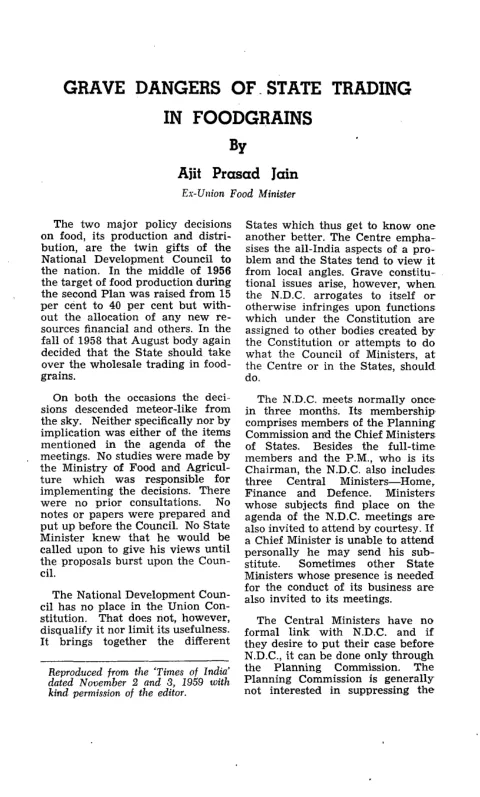
GRAVE DANGERS OF STATE TRADING IN FOODGRAINS
By Ajit Prasad Jain
Summary
Ajit Prasad Jain, a former Union Food Minister, dissects two of independent India’s most consequential food-policy decisions: the 1956 commitment to raise foodgrain production from 75 to 80 million tons under the second Plan, and the fall-1958 resolution that the State should take over the wholesale trade in foodgrains. Both, he writes, ‘descended meteor-like from the sky’, taken at meetings of the National Development Council without prior consultation, papers, or notes — and put up before the Council essentially as faits accomplis. He uses the occasion to anatomise the N.D.C. itself: an extra-constitutional body with no formal link to the Cabinet, suited equally to debate and to no real responsibility, where Chief Ministers attend by courtesy and the Prime Minister’s compromise instincts paper over genuine conflicts between Centre and States.
The heart of the pamphlet is Jain’s account of how the food-production target was inflated. He recounts that in April 1956 a Planning Commission member — ‘an academician but had little to do with agriculture’ — wrote to the Prime Minister citing 8 per cent annual growth in Chinese foodgrain output and commending a ‘two-fold programme’ built on a Marxian view of labour as the sole source of value. Jain shows that this enthusiasm crowded out capital: of Rs. 369 crores allotted for Food and Agriculture, only Rs. 170 crores were earmarked for production itself, and Ford Foundation experts had to remind the government that labour alone could not substitute for fertilizers, irrigation, and other inputs. The Mussoorie conference of State Agriculture Ministers, the Foodgrains Enquiry Committee, and the warning bell of the failed 1957 fertilizer supply all went unheeded.
On State trading, Jain’s verdict is uncompromising. Where the State is only a partial buyer, prices can be controlled only through statutory mechanism — meaning, in practice, seizure of stocks. The two-year experiment of buffer-stock operations before State trading proper had already produced ‘a plethora of harsh words’ but words break no bones. Citing the breakdown of controls in Orissa, Andhra and Bihar — where smuggling rose ‘to six-digit-ton figures’ and the Bihar Government had to retrace its measures — he argues that full State trading implies the complete elimination of wholesale traders, and that controls on price and movement of foodgrains will have to follow. He closes by noting that Nehru wields, in this area, powers President Roosevelt once exercised in America, and that the A.I.C.C. Chandigarh announcement has tripled his responsibility: ‘A mere play with State trading can only involve the country in grave dangers.’ The text is reproduced from the Times of India of November 2 and 3, 1959, and circulated by the Forum of Free Enterprise.
Key points
-
Frames the 1956 production target hike and the 1958 decision on State wholesale trade in foodgrains as two NDC decisions taken without prior consultation, papers or notes.
-
Argues the National Development Council has no constitutional basis, no formal link with the Union Cabinet, and increasingly resembles the ‘German Diet of the pre-Bismarck era’ — suited only to debate and advice.
-
Traces the inflated foodgrain target to a Planning Commission member’s April 1956 letter to the PM about Chinese 8% annual growth, built on a Marxian valuation of labour as the only source of value.
-
Shows that Rs. 369 crores were allotted to Food and Agriculture but only Rs. 170 crores were earmarked for food production proper, with the rest going to Community Development, N.E.S. blocks and irrigation.
-
Quotes the Ford Foundation team’s insistence that abundant labour cannot substitute for capital — fertilizers, irrigation, drainage and improved seed — in raising agricultural output.
-
Recounts the 1957 Foodgrains Enquiry Committee’s finding that most State governments achieved less than 60 per cent of the revised second-Plan targets, and the 1958 fertilizer supply shortfall of 45 per cent.
-
Contends that State trading in any partial form requires statutory controls on price and movement, citing breakdowns in Orissa, Andhra and Bihar where smuggling reached ‘six-digit-ton figures’.
-
Closes with the warning that the Chandigarh A.I.C.C. announcement has tripled the Prime Minister’s responsibility, and that ‘a mere play with State trading can only involve the country in grave dangers.’
Generated by the v1.5 extraction pipeline. Awaiting editorial review.
Metadata and summary are AI-extracted from the source PDF and reviewed for editorial accuracy. The original work is available via the Read PDF tab above (where present); paragraph-level citation inside the PDF is deferred to a future engagement.