
edited volume · anthology
STATE MONOPOLY OF TEXT-BOOKS
By m-r-masani-m-p, s-s-patke, a-b-shah
FORUM OF FREE ENTERPRISE, SOHRAB HOUSE, 235, Dr. D. N. ROAD, BOMBAY-1 · Bombay · 1964
28 pages
STATE MONOPOLY OF TEXT-BOOKS
Summary
State Monopoly of Text-Books is a 1964 Forum of Free Enterprise booklet that gathers three pieces against the drift toward government nationalisation of school textbooks, prompted by the scandal of grossly defective Maharashtra-state geography textbooks. A short Forum introduction frames the issue, four R. K. Laxman cartoons reprinted from The Times of India lampoon the policy, and the body of the booklet then reproduces an unsigned essay ‘Freedom of Choice’ from the Year Book of Education (London/New York, 1960) alongside the texts of two talks delivered at a Forum meeting in Bombay on 5 August 1964 by M. R. Masani M.P. and S. S. Patke, ex-President of the Maharashtra State Federation of Headmasters’ Associations. Together the contributors argue, on economic, educational and civil-liberty grounds, that state production and prescription of textbooks degrades quality, raises costs, fosters piracy, restricts the freedom of teachers and authors, and opens the door to political indoctrination of children — and they urge that publishing be left to private and voluntary initiative, with the State at most reviewing approved lists rather than holding a monopoly.
Key points
-
The booklet gathers three pieces opposing state nationalisation of school textbooks, prompted by the scandal of defective Maharashtra-government geography textbooks, alongside four R. K. Laxman cartoons reprinted from The Times of India.
-
An essay reprinted from the Year Book of Education, London and New York 1960, argues that single-text national systems exist mainly in Communist countries and produce technically dated, pedagogically conservative books.
-
The Year Book essay contends that claimed economic savings from state textbook production are largely illusory once hidden departmental costs and forgone competitive efficiencies are properly counted.
-
The essay’s central objection is political rather than economic: state production of textbooks implies censorship, restricts teachers’ choice, and stifles the diversity that good schooling requires.
-
M. R. Masani, M.P., insists that ‘nationalisation of text-books’ is a misnomer for what is actually a state monopoly of publication, comparable only to practice in Communist and Fascist regimes.
-
Masani traces textbook policy from 1824 under British rule, when official series like the Lipidhara and Gannit dominated, through an early-twentieth-century withdrawal in favour of private publishers, to a renewed state monopoly drive.
-
Masani cites Justice Balakrishna Ayyar’s 1959 Madras High Court judgment on a mangled abridgement of Quentin Durward and a Press Trust of India estimate of Rs. 10 crores lost to counterfeiting.
-
Masani details a Bihar shortfall of roughly Rs. 35 lakhs a year in the Free India Readers and arithmetic books, attributing the piracy to extortionate state margins, erratic supply, and stingy trade discounts.
Essays
You Said It
By R. K. LAXMAN
Reprinted from THE YEAR BOOK OF EDUCATION (London and New York, 1960) with the permission of the Publishers’ Association, this anonymous essay sets out the general international case against state monopoly of school textbooks. It concedes the surface appeal of a single, national, mass-produced text — capital costs spread, royalties paid, one approved book in every classroom — and notes that this is the practice in all Communist countries, but argues that even Soviet textbooks turn out to be technically mediocre and pedagogically old-fashioned, and that the economic ‘savings’ claimed by state production are largely illusory once hidden departmental costs and lost market efficiencies are counted.
The essay’s strongest objections are not economic but political and pedagogic. Official production of printed matter, the author argues, necessarily implies censorship and the promotion of views the government favours; it discourages teachers from thinking for themselves and removes the diversity of choice that good teaching requires. Limited official production may be defensible in poorly trained or under-resourced systems (Peru, parts of New Zealand are cited), but a one-book-per-subject prescription is never warranted. The conclusion: in countries with a liberal tradition and a free economy, government production of textbooks is justifiable only if it can guarantee economy, modernity, choice and rapid revision — conditions that in practice government monopolies almost never meet.
- Single-text national systems exist mainly in Communist countries (USSR, China) and produce technically dated, pedagogically conservative books.
- Claimed economic savings from state production are usually fictitious once hidden departmental costs and forgone competitive efficiencies are accounted for.
- Officials and committees are not better placed than competing private publishers to identify good authors and good textbooks.
- The decisive objections are political: state production implies censorship, restricts teacher choice, and stifles the diversity that good schooling requires.
- A ‘prescribed books’ list should always offer many alternatives rather than a single text per subject, and a vigorous private book trade is itself a precondition of bookshops and adult-literacy infrastructure.
- Limited official production may be defensible only where teachers are poorly trained (Peru, parts of New Zealand are cited), and even then never as a monopoly.
FREEDOM OF CHOICE
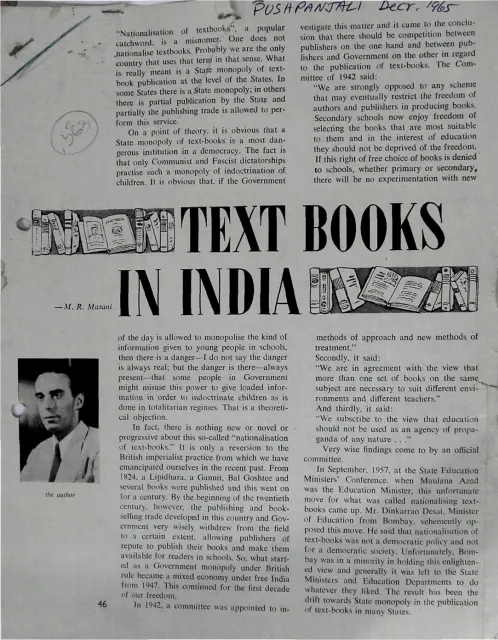
M. R. Masani, M.P., opens by insisting that the so-called ‘nationalisation of text-books’ is a misnomer — what is really happening at the State level is a monopoly of publication. He treats this both as a theoretical danger (only Communist and Fascist dictatorships indoctrinate children through a textbook monopoly) and as a historical regression: from 1824 onwards under the British, official series like the Lipidhara, Gannit and Bal Goshtee dominated, but by the early twentieth century the Government wisely withdrew in favour of reputable private publishers, and a mixed economy in textbooks prevailed in independent India until State governments began re-monopolising the field. Masani musters the official record against the policy — the 1942 Committee, the Mudaliar Committee, the warning by Bombay’s Minister of Education Dinkarrao Desai at the 1957 Education Ministers’ Conference, and an unanswered 1957 letter Masani himself wrote to Deputy Minister Dr. K. L. Shrimali — to show that the drift to State monopoly proceeded against expert advice.
The second half of the essay is a documentary indictment of how that monopoly has worked in practice. State-published textbooks are poor in quality, sold at inflated prices that disguise taxation, and chronically unavailable on time. Masani quotes a 1959 judgment of Justice Balakrishna Ayyar of the Madras High Court on a wretched abridgement of Quentin Durward and a Madras Mail editorial on a similarly mangled Oliver Twist published in Andhra; he then turns to a Press Trust of India report estimating Rs. 10 crores of losses to State governments from counterfeiting and details the Bihar case (drawing on the Bihar Teachers’ Association’s Jali Pustak Virodhi Visheshank), where shortfalls in the Free India Readers and arithmetic books cost the exchequer roughly Rs. 35 lakhs a year. Three structural reasons drive the piracy, he argues — extortionate State margins, late and erratic supply, and stingy trade discounts — and the only real remedy is to end the monopoly itself and let private publishers fight the counterfeiters under competition.
- ‘Nationalisation of text-books’ is a misnomer for what is really a State-level monopoly of publication, and is a reversion to a discarded British imperial practice rather than a progressive reform.
- Only Communist and Fascist dictatorships practise such monopolies; the danger of political indoctrination of children is intrinsic, not contingent.
- Successive official committees (the 1942 Committee, the Mudaliar Committee) and Bombay’s Minister Dinkarrao Desai at the 1957 Education Ministers’ Conference explicitly warned against the policy, and their advice was ignored.
- Madras High Court (Justice Balakrishna Ayyar, 12 January 1959) and Madras Mail commentary on shoddy State-issued abridgements of Quentin Durward and Oliver Twist document the resulting decline in quality.
- A Press Trust of India report puts losses from piracy of State-published books at about Rs. 10 crores across seven States, with Bihar alone losing around Rs. 35 lakhs a year on Free India Readers and arithmetic books.
- Three structural causes drive the piracy: high State margins, late and erratic supply, and trade discounts of only 10 per cent against the 15 per cent offered by private publishers.
- The real remedy is to end the State monopoly and let competition keep both quality high and counterfeiters in check; legal remedies such as amending section 432 IPC can at best supplement, not replace, this.
TEXT-BOOKS IN INDIA
By M. R. MASANI, M.P.
S. S. Patke, writing as ex-President of the Maharashtra State Federation of Headmasters’ Associations, takes the July 1964 collapse of the Maharashtra Government’s Standards IV and V geography textbooks — withdrawn at a cost of more than Rs. 7 lakhs — as the occasion to attack the State’s broader 1960 decision to phase in Government-produced texts in English from Standard V to Standard X. He limits himself, as ‘an active worker in the field of education’, to the educational implications, and notes both the Government’s refusal to reconsider the policy in spite of the scandal and its decision to push it through without legislative sanction, against the considered advice of educationists.
In the rendered pages, Patke amplifies the case by citing authority after authority against the policy: the Secondary Education Commission (the Mudaliar Commission, 1952-53), which urged that the Text Book Committee should approve a number of suitable books rather than prescribe one; an International Team study that endorsed State support for educational research but not State production of textbooks; the XXXII All-India Educational Conference (Madras, December 1957), whose resolution was repeated at Chandigarh (1958) and Trivandrum (1962); and statements by Dr. A. L. Mudaliar (Madras, 22 November 1961), former Union Education Minister Dr. K. L. Shrimali, and Acharya Vinoba Bhave, who warned that ‘Government-controlled education is bound to become formal and rigid’ and turns teachers into employees. The essay continues beyond this chunk; the rendered pages break off as Patke begins to invoke Sir C. P. Ramaswami Aiyer.
- The July 1964 Maharashtra geography-textbook fiasco for Standards IV and V cost the public exchequer more than Rs. 7 lakhs, yet has not made the Government reconsider its 1960 decision to extend State production stage-by-stage from English Std. V to Std. X.
- The Maharashtra Government pushed through this major policy departure without taking the sanction of the Legislature and in defiance of expert educational advice.
- The Secondary Education (Mudaliar) Commission recommended multiple approved textbooks per subject, not a single prescribed text, and explicitly framed this as protecting ‘the scope of free enterprise in the publication of books.’
- An International Team study on textbooks held that State Governments should organise research to support better textbook production but should not themselves take up production.
- The XXXII All-India Educational Conference (Madras, 1957) passed — and repeated at Chandigarh (1958) and Trivandrum (1962) — a resolution against State monopoly publishing of textbooks for schools.
- Patke marshals statements by Dr. A. L. Mudaliar, former Education Minister Dr. K. L. Shrimali and Acharya Vinoba Bhave to argue that publication should be left as far as possible to voluntary organisations and private societies.
Generated by the v1.5 extraction pipeline. Awaiting editorial review.
Metadata and summary are AI-extracted from the source PDF and reviewed for editorial accuracy. The original work is available via the Read PDF tab above (where present); paragraph-level citation inside the PDF is deferred to a future engagement.
People in this work
Related across the archive
 Primary workTEXT BOOKS IN INDIA
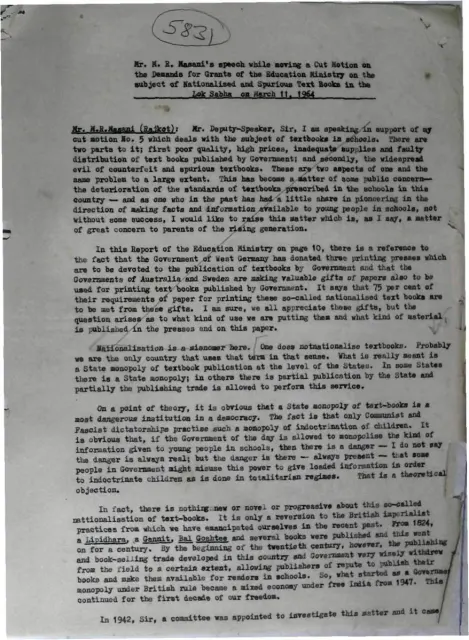 Primary workMr. K. R. Masani's speech while moving a Cut Motion on the Demands for Grants of the Education Ministry on the subject of Nationalised and Spurious Text Books in the Lok Sabha on March 11, 1964
 ExcerptEconomic Reforms In India: Where Are We And Where Do We Go?
 ExcerptEconomics of Freedom