pamphlet
FREE ENTERPRISE WILL SURVIVE AS LONG AS MAN SURVIVES
By A. D. Shroff
FORUM OF FREE ENTERPRISE, "Sohrab House", 235, Dr. Dadabhai Naoroji Road, BOMBAY 1. · Bombay · 1958
2 pages
Summary
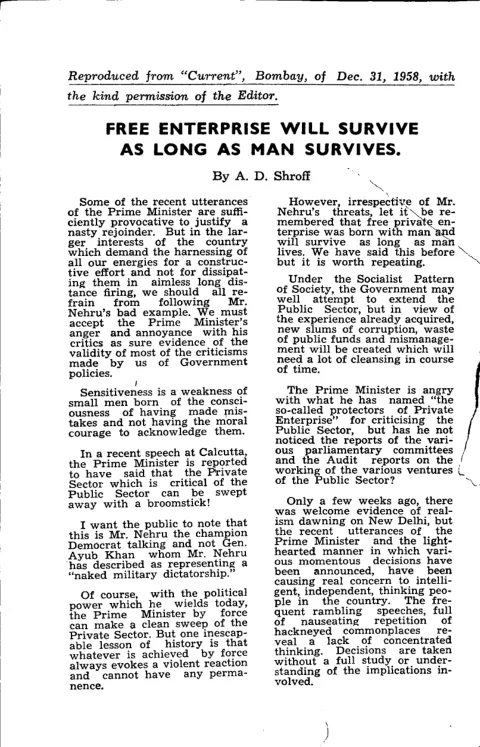
A. D. Shroff replies to a recent batch of speeches by Prime Minister Jawaharlal Nehru that attacked the private sector, in particular a Calcutta address in which Nehru reportedly said critics in the Private Sector ‘can be swept away with a broomstick.’ Shroff treats this as evidence of irritation rather than argument: Nehru, he writes, has the political power to wield such a broom but cannot have any permanent effect, and the very sensitiveness on display is ‘a weakness of small men born of the consciousness of having made mistakes and not having the moral courage to acknowledge them.’ He pointedly contrasts the ‘champion Democrat’ with General Ayub Khan, whom Nehru has himself described as representing a ‘naked military dictatorship’, to suggest the Prime Minister’s intolerance of dissent sits uneasily with his democratic claims.
The second half turns to substance. Shroff concedes that the food problem requires constructive attention and that the State could play some role in correcting maldistribution, but argues that the decision to monopolise wholesale food-grain trading will displace hundreds of thousands of small merchants who have done this work for generations, will not increase output, and will end in a State Trading Corporation that — like the cement, manganese ore and tinplate monopolies before it — simply inserts an unnecessary and avoidable intermediary, taking ‘no record so far’ but a great deal of profiteering with it. He estimates the existing food trade at about Rs. 500 crores. Against Nehru’s contention that private enterprise and democracy can be separated, the Forum of Free Enterprise insists the opposite: every diminution of private enterprise erodes the democratic way of life, and every citizen has a right to choose his avocation that State trading curtails. Shroff closes with confidence that informed opinion, once mobilised, will be heard ‘sooner or later.‘
Key points
-
Frames the piece as a ‘nasty rejoinder’ to Nehru’s recent attacks on private enterprise, especially his Calcutta line that critics ‘can be swept away with a broomstick.’
-
Reads Nehru’s sensitiveness as small-man weakness and as inconsistent with his own labelling of Ayub Khan’s regime a ‘naked military dictatorship.’
-
Argues that Government can clean its own Public Sector — already showing inefficiency, corruption and mismanagement — without abolishing private enterprise.
-
Accepts a limited State role in correcting maldistribution of food grains but rejects wholesale State trading on grounds it displaces hundreds of thousands of small merchants and adds no productive capacity.
-
Cites earlier State Trading Corporation interventions in cement, manganese ore and tinplate as precedents for profiteering and unnecessary intermediation.
-
Estimates the displaced private food-grains trade at about Rs. 500 crores.
-
Rejects Nehru’s separation of private enterprise from democracy, insisting their fates are linked.
-
Positions the Forum of Free Enterprise as a vehicle for mobilising ‘voiceless illiterate voters’ and intelligent public opinion against State trading.
Metadata and summary are AI-extracted from the source PDF and reviewed for editorial accuracy. The original work is available via the Read PDF tab above (where present); paragraph-level citation inside the PDF is deferred to a future engagement.