pamphlet
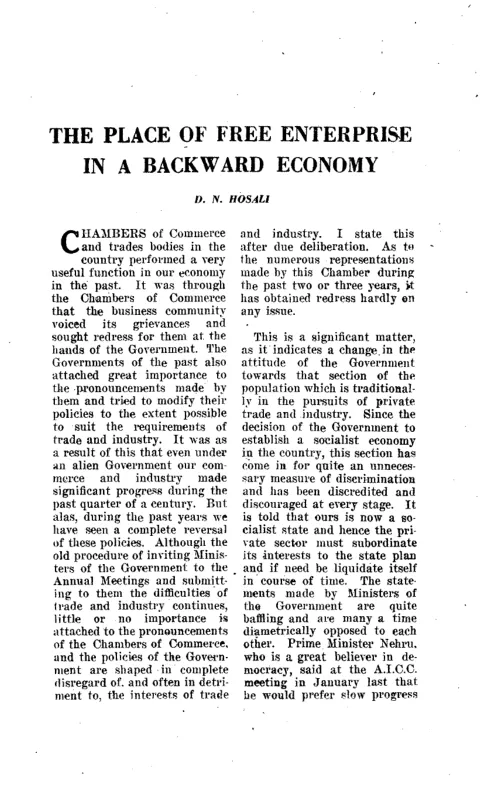
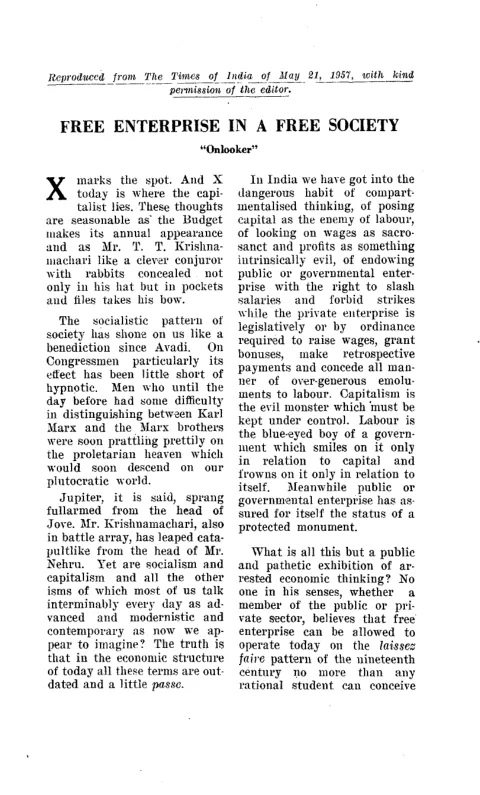
FREE ENTERPRISE IN A FREE SOCIETY
By Onlooker
FORUM OF FREE ENTERPRISE, "Sohrab House", 235, Dr. Dadabhai Naoroji Road, BOMBAY 1. · Bombay · 1957
4 pages
Summary
Reprinted from The Times of India of 21 May 1957 by the newly formed Forum of Free Enterprise, this short polemic by the pseudonymous “Onlooker” attacks what it calls India’s ‘compartmentalised thinking’ on the economy — the habit of treating capital as inherently sinister, labour as sacrosanct and public enterprise as virtuous by definition. Prompted by Finance Minister T. T. Krishnamachari’s budget and the broader ‘socialistic pattern of society’ line emanating from Nehru’s government, the essay argues that Indian leaders are fighting capitalism in the discredited idiom of the nineteenth century, oblivious to how capitalism has actually evolved.
The core argument runs in three movements. First, Onlooker observes that the contemporary Indian state legislatively coerces private enterprise into wage rises, bonuses and retroactive payments while shielding governmental enterprise as a ‘protected monument’. Second, drawing on Switzerland, the United States and Canada, the author insists that Marx’s prediction of an impoverished proletariat has been falsified — modern capitalism spreads ownership and rewards more widely, not less. The countries that actually destroyed capitalism, the essay notes, ended up as Communist (Russia, China) or Fascist (Italy, Germany, parts of South America) tyrannies; freedom in the economic and political spheres stand or fall together.
The piece closes by stipulating that ‘the intelligent capitalist has never quarrelled with reasonable government regulations.’ Citing President Eisenhower’s enumeration of US economic instruments (Federal Reserve, debt management, mortgage insurance, agricultural supports, tax structure, public works) and a line from Luigi Einaudi, former President of the Italian Republic, Onlooker argues that the goal of policy must be not the abolition of regulation but the framing of regulations ‘within which the citizen can act freely’. The conclusion — that ‘free enterprise, as free labour, can only exist under a free government’ — sets the early ideological keynote for the Forum of Free Enterprise.
Key points
-
Frames T. T. Krishnamachari’s budget and the Nehru government’s ‘socialistic pattern of society’ as the trigger for a wider attack on anti-capitalist rhetoric in Indian public life.
-
Argues that Indian political discourse continues to define capitalism in nineteenth-century terms that even Khrushchev’s Soviet Union has begun to abandon.
-
Documents an asymmetry in Indian policy: private enterprise is legislatively compelled to raise wages and pay bonuses while public enterprise is shielded as a ‘protected monument’.
-
Refutes the Marxist immiseration thesis by pointing to Switzerland, the United States and Canada, where the proletariat shares increasingly in both ownership and rewards.
-
Insists that the destruction of capitalism historically yields totalitarianism — either Communist (Russia, China) or Fascist (Italy, Germany, parts of South America) — so reform, not abolition, is the right path.
-
Distinguishes the ‘intelligent capitalist’, who accepts reasonable regulation, from a doctrinaire laissez-faire position, citing Eisenhower’s enumeration of US economic instruments and Luigi Einaudi on the purpose of regulation.
-
Concludes that economic and political freedom are inseparable, warning ‘wiseacres on the extreme right and extreme left’ that ignoring this link imperils freedom in both spheres.
Metadata and summary are AI-extracted from the source PDF and reviewed for editorial accuracy. The original work is available via the Read PDF tab above (where present); paragraph-level citation inside the PDF is deferred to a future engagement.