speech
Economic Progress Demands Attention to Private Enterprise and Scientific Management
By Dr. KK Das
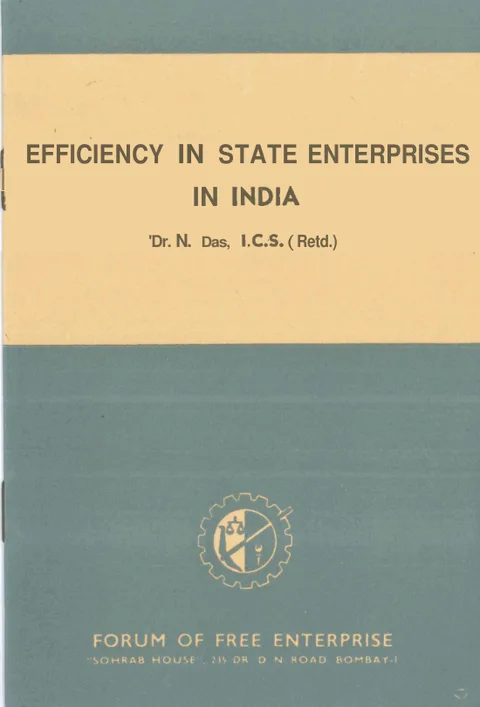
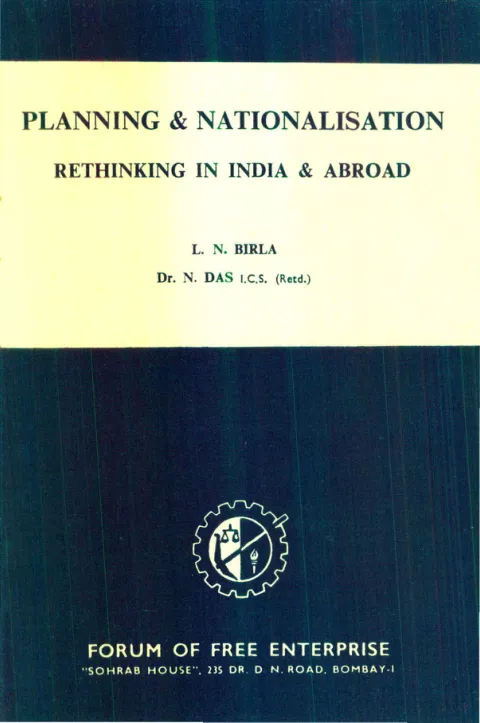
Published by M. R. Pai for Forum of Free Enterprise, "Sohrab House", 235 Dr. Dadabhai Naoroji Road, Bombay 1, and printed by P. A. Raman at Inland Printers, 55 Gamdevi Road, Bombay 7. · Bombay · 1961
6 pages
Summary
This Forum of Free Enterprise leaflet reprints an excerpt from Dr. K. K. Das’s presidential address to the Fourteenth All-India Commerce Conference at Jabalpur (May 1961). Das, Professor of Commerce at Andhra University, argues that a doctrinaire pursuit of the “socialist pattern of society” has fragmented India’s economic effort: the Industrial Policy Statement of 1948 was tolerable, but the 1956 revision and its schedule of activities reserved for state initiative have produced an unpredictable, shifting boundary between public and private enterprise — “somewhat after the manner of the Indo-Chinese border” — that betrays a concealed presumption against private enterprise and a refusal to release private initiative for the economic task before the country.
Das marshals data to show that private enterprise has more than carried its weight while the public sector has lagged: targets in the Second Five-Year Plan were not only met but exceeded by private industry, which also made up for the shortfall in public-sector investment, while the Central Government and state companies (37 and 40 in number respectively) operate at an average pre-tax return of only 2.77% against the 7% tax-free earnings usually expected of private enterprise. He quotes Gandhi on the danger of expanding state power, and notes that, having failed with coal, the government is now turning back to private enterprise to make up the deficit.
What Das recommends is a re-orientation of governmental attitude rather than a wholesale retreat. The state should help and aid private enterprise; it should act as a ready entrepreneur only where private capital genuinely cannot or will not step in; public and private undertakings should compete on equal terms and be measured by comparable performance; and the policy of “witch-hunting” pronouncements and threats against private enterprise must end. He invokes Adolf Berle on the managerial revolution and Chester Bernard on the firm as a human organisation to argue that ownership-versus-management is now a sharper question than ownership-versus-ownership.
The closing pages press the case that India’s binding constraint is no longer capital but managerial manpower. Das points to the dearth of trained managers — including in the public sector, which has had to draw on the Industrial Management Pool and government departments — and calls for a comprehensive, purposive, properly manned programme of management education that integrates commerce and management training. He closes with a 1956 quotation from Prime Minister Nehru on industrial development making larger demands on the country’s technical and managerial personnel, underlining the last two words.
Key points
-
Das frames the 1948 Industrial Policy Statement as workable but the 1956 socialist-pattern revision and its schedule of reserved activities as a doctrinaire intrusion that has fragmented national economic effort.
-
He likens the unpredictable, shifting public–private boundary to the Indo-Chinese border, arguing that governmental freedom has been exercised against private enterprise rather than for the economic task before the country.
-
Citing investment figures (Rs. 1,638 crores in the First Plan, Rs. 3,650 crores in the Second, Rs. 6,200 crores estimated for the Third) and noting that 37 Central and 40 state companies are now in operation, he documents a stupendous growth of public-sector entrepreneurial activity since Independence.
-
He shows that private enterprise has more than met its Second Plan targets — even making up for shortfalls in the Public Sector — while the average pre-tax profit of public enterprises is only 2.77% against the 7% tax-free earnings normally expected of private enterprise.
-
He quotes Gandhi on the danger of state power destroying individuality, and notes that having failed with coal the government is now turning back to private enterprise to make up the deficit.
-
Das proposes a four-part re-orientation: the state should aid private enterprise; act as a ready entrepreneur only where private capital cannot; compete on equal terms with comparable performance estimates; and end “witch-hunting” pronouncements against business.
-
He invokes Adolf Berle on the managerial revolution and Chester Bernard on the firm as a human organisation, arguing that ownership-versus-management has displaced ownership-versus-ownership as the central question of modern industrialism.
-
He closes by identifying managerial manpower as the binding constraint on industrialisation and calling for a comprehensive, integrated programme of commerce and management education, anchored by a 1956 Nehru quote on the country’s need for technical and managerial personnel.
Metadata and summary are AI-extracted from the source PDF and reviewed for editorial accuracy. The original work is available via the Read PDF tab above (where present); paragraph-level citation inside the PDF is deferred to a future engagement.