speech
EFFICIENCY IN STATE ENTERPRISES IN INDIA
By N. Das
Published by M. R. Pai for Forum of Free Enterprise, "Sohrab House", 235 Dr. Dadabhai Naoroji Road, Bombay 1, and Printed by B. G. Dhawale at Karnatak Printing Press, Chira Bazar, Bombay 2 · Bombay · 1963
11 pages
Summary
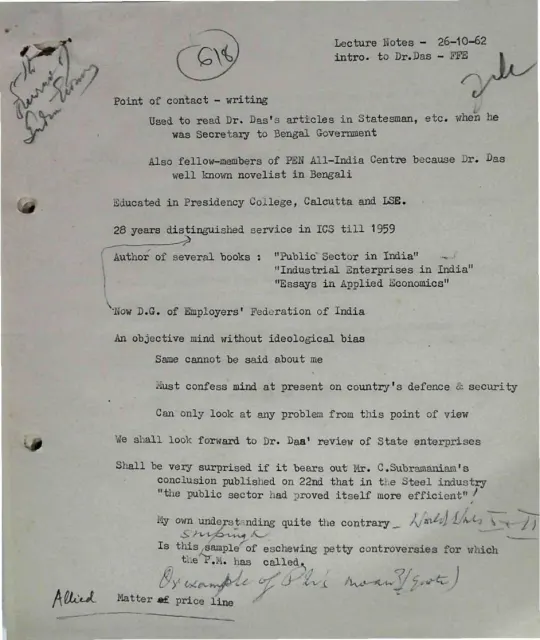
Dr. N. Das, a retired ICS officer and Director-General of the Employers’ Federation of India, delivered this lecture to the Forum of Free Enterprise in Bombay on 26 October 1962. He traces the meteoric rise of India’s public sector since the 1948 Industrial Policy Statement: from Rs. 179 crores in the First Plan, to Rs. 974 crores in the Second Plan, to Rs. 2,147 crores earmarked in the Third Plan—roughly 97 per cent of total Central Government industrial investment by 1960-61. The booklet asks a single, sharp question: with this scale of state investment, is the country getting commensurate value?
The diagnostic core of the lecture is comparative profitability. Das cites the Finance Ministry’s First Annual Report on the Working of Industrial and Commercial Undertakings of the Central Government, which showed that of 23 running concerns only nine declared dividends in 1960-61, averaging just 4.2 per cent on paid-up capital, while six showed losses and three earned under 3.3 per cent. A June 1961 study by the Indian Institute of Public Opinion went further: in physical-output terms the Public Sector’s return on capital employed was less than one-fourth that of comparable private firms, and in financial-return terms 2.7 per cent against the Private Sector’s 9.7 per cent—an almost identical proportional gap from two different angles.
Das attributes this underperformance to a stack of causes: inexperienced ICS recruits parachuted into senior managerial posts (he calls them “pro-consuls”), excessive Government regulation that consumes management time, delays of authority and supply (citing the German experts’ complaint at Rourkela), labour indiscipline and absenteeism (the Heavy Electricals strike at Bhopal, the Rourkela unrest), poor cost accounting and capacity utilisation, and a politically dictated low-price policy that prevents surplus generation. He invokes Galbraith on how officials on boards destroy enterprise autonomy, the World Bank Mission’s verdict that the Government had not helped strengthen the Public Sector, and Paul Appleby on the difficulty of measuring public-enterprise efficiency at all.
The conclusion is deliberately measured rather than ideological. Das does not call for halting the expansion of state enterprises; he calls for parity of treatment with private undertakings so that genuine competition can discipline both. Reduce costs, lift efficiency, end monopoly-style protection, and the Public Sector can be made to earn its considerable place in the economy rather than become, as he puts it, a “costly” business in more senses than one.
Key points
-
Frames the Public Sector’s growth in budget terms: Rs. 179 crores in the First Plan, Rs. 974 crores in the Second, Rs. 2,147 crores planned in the Third—around 97% of Central Government industrial investment by 1960-61.
-
Uses the Finance Ministry’s First Annual Report to show only 9 of 23 Central undertakings declared dividends in 1960-61, averaging 4.2% on paid-up capital, with 6 units running losses.
-
Cites the Indian Institute of Public Opinion’s June 1961 study: Public Sector return on capital was 2.7% versus the Private Sector’s 9.7% over 1958-59.
-
Identifies inexperienced ICS officers in senior managerial posts as a structural drag, with Galbraith quoted on boards becoming “a link in the Civil Service hierarchy”.
-
Catalogues operational failures: Rourkela’s purchasing bottlenecks flagged by the German Commission under Solveen; Bhopal Heavy Electricals strike; high absenteeism flagged in the Solveen Report.
-
Blames excessive Government regulation and the time “negotiating their way through Government regulations” consumes from public enterprise managements, echoing the World Bank Mission.
-
Argues that politically dictated low pricing of public-sector output suppresses surpluses, with Hindustan Machine Tools cutting prices 10-20 per cent and Hindustan Antibiotics offering 15% discounts as illustrations.
-
Does not oppose Public Sector expansion but demands equality of treatment between public and private sectors to generate healthy competition.
Metadata and summary are AI-extracted from the source PDF and reviewed for editorial accuracy. The original work is available via the Read PDF tab above (where present); paragraph-level citation inside the PDF is deferred to a future engagement.