pamphlet
PROFITS IN A PLANNED ECONOMY
By M.A. Master
FORUM OF FREE ENTERPRISE, "SOHRAB HOUSE", 235 DR. D. N. ROAD, BOMBAY-1 · Bombay · 1965
9 pages
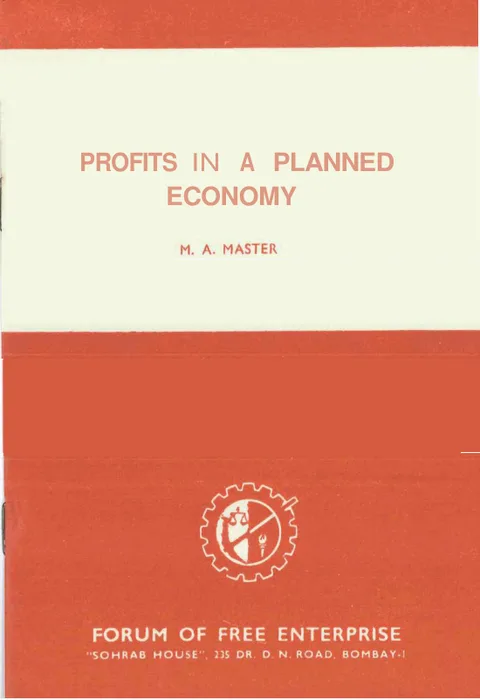
PROFITS IN A PLANNED ECONOMY
By M. A. MASTER
Summary
M. A. Master’s pamphlet, published by the Forum of Free Enterprise in February 1965, mounts a case for the legitimacy and necessity of profits within India’s planned economy. Master opens by observing that profit-making is recognised everywhere — even in Communist states — as essential to the stability and growth of national economies, and that the post-independence equation of profit with un-patriotism distorted the early years of Indian planning. He traces how the planners’ faith in “no-profit, no-loss” working of public enterprises began to crack during the Second Plan when resources fell short, prompting the Congress Planning Sub-Committee under U. N. Dhebar (September 1959) and successive Union Finance Ministers — Morarji Desai and T. T. Krishnamachari — to insist that public enterprises must earn profits to finance investment in railways, irrigation, fertiliser plants and steel.
The core of the pamphlet is an empirical accounting of how the Public Sector has actually performed. Master marshals figures from the Audit Report (Commercial) 1963, the Annual Report on Working of Industrial and Commercial Undertakings, and Reserve Bank data to show that ventures expected to recoup capital — fertiliser distribution, the State Trading Corporation, Hindustan Steel, Hindustan Antibiotics, Hindustan Machine Tools, Hindustan Aircraft Factory and others — have generated either low returns (16–51%) or outright deficits, with Rs. 14,000 crores of Third Plan outlay yielding only Rs. 6,500 crores of fresh resources, deficit-financed for the rest.
Master then turns the argument against the Government’s own logic. He argues that the same Laws of Economics that compel public enterprises to earn an “adequate return” on capital employed apply with equal force to the Private Sector, which — unlike the State — must service interest, repay loans, replace assets and pay dividends out of profits already taxed at 65–70%. He criticises the Bonus Bill, the “retention price” mechanism for steel, and the asymmetric application of the “partners-in-prosperity” principle, warning that crippling taxation and a hostile investment climate (citing the Reserve Bank’s own observation that “the investment climate is not there”) jeopardise capital formation just when fresh taxation of Rs. 2,500–3,000 crores is being contemplated in the Fourth Plan. The pamphlet closes with an appendix excerpt from Wilhelm Roepke on the indispensability of the profit motive and a sidebar quotation from A. D. Shroff defending free enterprise.
Key points
-
Argues that profits are universally necessary for trade, industry and services — even in Communist economies — and that India’s post-independence equation of profit-making with un-patriotism distorted economic policy.
-
Reconstructs the policy reversal between the Second and Third Plans: U. N. Dhebar’s 1959 Planning Sub-Committee, Morarji Desai’s 1962-63 budget speech and T. T. Krishnamachari’s reaffirmation that public undertakings must earn an adequate return on capital.
-
Documents empirically that key public enterprises — fertiliser distribution, the State Trading Corporation, Hindustan Steel, Hindustan Antibiotics, Hindustan Machine Tools, Hindustan Aircraft Factory — produced low returns or losses despite their pricing power.
-
Shows that of Rs. 14,000 crores of Third Plan outlay, only Rs. 6,500 crores will come from fresh resources while the rest is deficit-financed, weakening the planners’ claim that public enterprise can substitute for private capital formation.
-
Insists that the Private Sector must earn enough profit to service interest, repay loans, replace assets and pay dividends after 65-70% effective taxation — a constraint the Public Sector does not face.
-
Criticises the asymmetric application of the Bonus Bill’s “partners in prosperity” principle, which excludes Government undertakings, and the use of “retention prices” to subsidise public-sector amortisation.
-
Warns, citing the Reserve Bank’s own Central Board, that India’s hostile tax regime, unreliable equity market and weak investment climate threaten capital formation just as the Fourth Plan contemplates Rs. 2,500–3,000 crores of additional taxation.
-
Closes with Wilhelm Roepke’s argument that the profit principle is the only known criterion for selecting managers and directing production, and that no equivalent has yet been found.
Generated by the v1.5 extraction pipeline. Awaiting editorial review.
Metadata and summary are AI-extracted from the source PDF and reviewed for editorial accuracy. The original work is available via the Read PDF tab above (where present); paragraph-level citation inside the PDF is deferred to a future engagement.