pamphlet · position paper
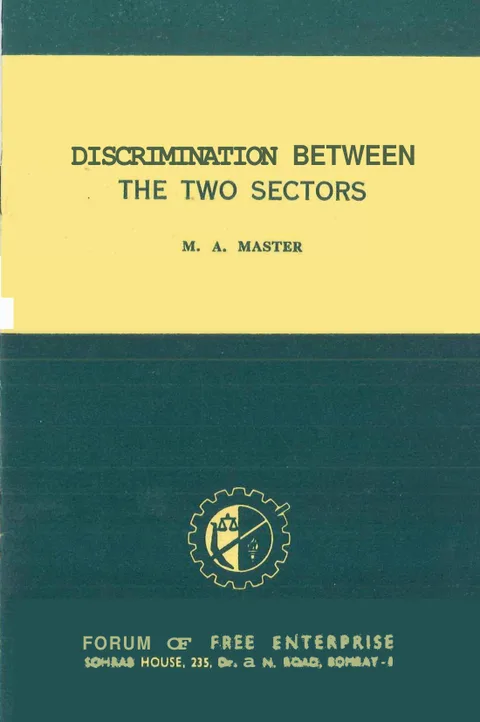
Discrimination Between the Two Sectors
By M.A. Master
Published by M. R. PAI for the Forum of Free Enterprise, "Sohrab House", 235, Dr. Dadabhai Naoroji Road. Bombay 1, and printed by H. NARAYAN RAO at H. R. MOHAN & CO., (PRESS), 9-B, Cawasjee Patel Street. Bombay 1. · Bombay · 1966
10 pages
Summary
M. A. Master’s pamphlet, issued by the Forum of Free Enterprise on 10 January 1966, is a sustained polemic against the official position that public and private sectors should be folded into a single ‘National Sector’ for the purposes of planning discourse. Master argues that the realities of finance, taxation, foreign exchange, pricing policy and corporate law all show that the two sectors have been treated on radically unequal terms — with the Public Sector enjoying privileges denied to the Private Sector. He marshals figures from the first three Plans to show that of Rs. 14,060 crores of total outlay on the Public Sector, roughly 46 per cent came from sources (additional taxation and deficit financing) that carry no obligation to declare dividends or repay capital, while the Private Sector must service every rupee it raises through equity or borrowing.
The core of the argument is a sector-by-sector inventory of discrimination. Foreign aid and World Bank credits, grants of Rs. 480 crores under PL 480, tax concessions on Defence Deposit Certificates and Annuity Deposits, foreign exchange for plant and equipment, ‘Committed Expenditure’ guarantees in the Plans, and reimbursement of operating losses (as in the case of the Government Shipping Corporation) all flow exclusively or overwhelmingly to public undertakings. Master cites Finance Ministers Morarji R. Desai (1962-63) and T. T. Krishnamachari (1964-65) to show that even the Government now concedes that public-sector units must earn ‘adequate’ profits and build reserves for future expansion — yet, he notes, the Tariff Commission’s recommendation that the Tata Iron & Steel Company and the Indian Iron & Steel Company be allowed a retention price of Rs. 8 per tonne to amortise their loans was rejected, and the same companies were squeezed for Rs. 5 crores in cash under threat of nationalisation.
The pamphlet closes with a warning that the State’s accumulating share in private undertakings via the Life Insurance Corporation and the Unit Trust (a total holding of about 40 per cent on his estimate) could allow it to ‘nationalise industries by the backdoor’ through controlling shareholdings — an outcome he frames as contrary to a worldwide trend in which socialist and communist countries are themselves expanding scope for private initiative. The author’s plea is for ‘equal and fair treatment to both Private and Public Sectors’ and for economic realism over dogma.
Key points
-
Reframes the official ‘one National Sector’ formula as a cover for systematic privileging of the Public Sector at the expense of the Private Sector.
-
Quantifies the asymmetry: of Rs. 14,060 crores total Public Sector outlay across the first three Plans, Rs. 6,523.28 crores (about 46%) came from additional taxation, deficit financing and grants — sources that carry no debt-service obligation.
-
Catalogues the financing channels closed to the Private Sector: World Bank and foreign-government loans, Ford Foundation and TCA grants, PL 480 funds, ‘Committed Expenditure’ provisions, and loss reimbursement (e.g. Government Shipping Corporation).
-
Documents tax discrimination via Defence Deposit Certificates, Annuity Deposits and Unit Trust investment, all of which channel private savings to the Government on concessional terms unavailable to the Private Sector.
-
Uses speeches of Finance Ministers Morarji R. Desai and T. T. Krishnamachari to show the Government concedes the Public Sector must earn ‘adequate returns’, yet denies the Private Sector parallel treatment (the Tata Iron & Steel / Indian Iron & Steel retention-price case).
-
Highlights the Companies Act asymmetry — bonus, balance-sheet and Managing Director appointment obligations bind the Private Sector but not the Public Sector.
-
Warns that LIC and Unit Trust holdings (about 40% of certain private undertakings) give the Government a ‘powerful grip’ that could enable de facto nationalisation through the backdoor.
-
Frames the argument against a wider international trend: nationalisation on ideological grounds is being abandoned even in socialist and communist countries in favour of greater scope for individual initiative.
Metadata and summary are AI-extracted from the source PDF and reviewed for editorial accuracy. The original work is available via the Read PDF tab above (where present); paragraph-level citation inside the PDF is deferred to a future engagement.