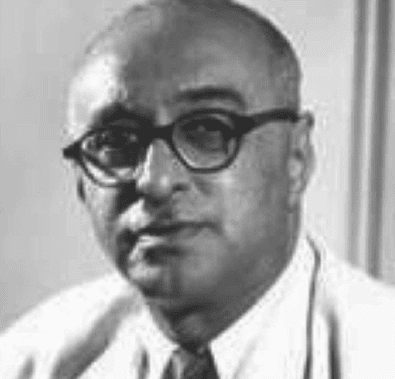
speech
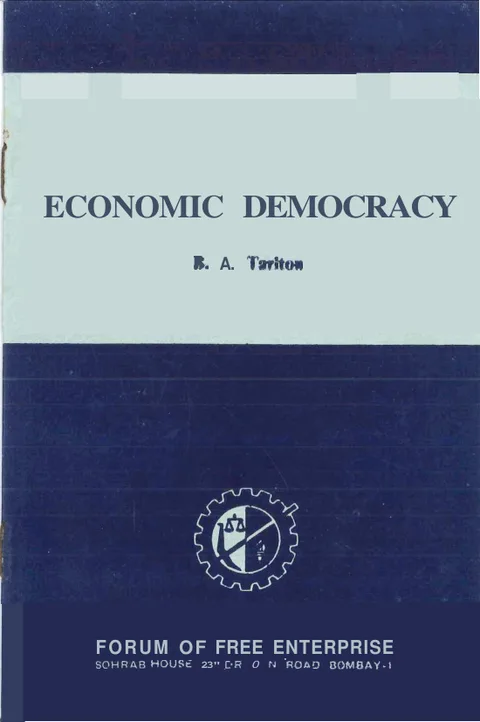
Economic Democracy
Published by M. R. Pai for the Forum of Free Enterprise, 235, Dr. Dadabhai Naoroji Road, Bombay-1, and Printed by Michael Andrades at the Bombay Chronicle Press, Horniman Circle, Bombay-1. · Bombay · 1969
12 pages
Summary
B. A. Tarlton’s 18-page lecture, delivered under the auspices of the Forum of Free Enterprise’s Calcutta centre in 1968 and published as a booklet in February 1969, opens with a balance-sheet of disillusionment. Fifteen years after independence the politicians’ promised “sunlit plateaus of prosperity” remain out of reach, centralised planning has failed to lift average living standards, and India has slid from being a net international creditor of over Rs. 700 crores in 1956 to a net debtor of over Rs. 5,000 crores in 1968. From this prelude Tarlton mounts a sustained case for rethinking what “economic democracy” should mean for India.
He distinguishes a “classical” concept of democracy — rule by a particular person, class, or even a majority — from a “liberal” concept in which political authority is vested equally in every citizen, anchored by full adult suffrage, periodic elections, an independent judiciary and a free press. Lincoln’s formulation, “government of the people by the people for the people,” is offered as the model, and Nehru’s preferred extension of this idea into the economic sphere — socialist planning and public-sector expansion — is rejected as both ideologically incoherent and economically destructive. He marshals data on the runaway growth of government undertakings (from 6% to 43% of paid-up corporate capital between the Second and Third Plans) and on the loss-making Indian Railways and ordnance factories to argue that state ownership has “absorbed huge domestic resources” while consistently underperforming.
Tarlton then weighs alternatives. The Yugoslav model of workers’ self-management is conceded as a serious attempt at economic democracy but is judged inadequate because it remains imprisoned within socialist organisation and severs the producer from consumer signals. The correct model, he insists, is consumer sovereignty inside a competitive market: producers must “queue up” before the buyer just as candidates queue up before the voter. Drawing on Adam Smith’s argument from self-interest, Mahatma Gandhi’s distrust of concentrated power, J. F. Kennedy’s defence of the dispersed free market, and the visible take-off of Hong Kong, Japan, Taiwan, South Korea, Malaysia and Thailand against the centrally directed economies of India, Burma and Indonesia, he makes both a principled and an empirical case that free enterprise simultaneously disperses power and raises living standards.
The closing pages turn polemical. The Indian businessman, Tarlton complains, has been “daubed with so much ideological tar” — exploiter, profiteer, parasite, gambler — that he is tempted to retreat into compromise and “back-door” relief from administrators. Tarlton calls instead for a positive, public defence: the entrepreneur is “the main architect of economic democracy,” and the businessman’s task is not to plead for protection but to demand the basic freedoms — to decide, invest, produce, hire and be honestly taxed — that allow him to create wealth and employment as a civic contribution to a democratic society.
Key points
-
Centralised planning is presented as a measurable failure: India moved from net international creditor of Rs. 700 crores (1956) to net debtor of over Rs. 5,000 crores (1968), with stagnant living standards and rising unemployment.
-
Tarlton distinguishes a ‘classical’ democracy (rule by a particular class or majority) from a ‘liberal’ democracy (political authority vested equally in every citizen), and treats the liberal concept as the only one suited to India.
-
He attacks the size and inefficiency of the Indian public sector — government share of paid-up corporate capital grew from 6% to 43% across the Second and Third Plans, with sub-1% returns against planned 11–12%.
-
The Yugoslav self-management experiment is acknowledged as the closest socialist approach to economic democracy but is dismissed because it remains divorced from consumer signals.
-
Economic democracy, in Tarlton’s reframing, is consumer sovereignty inside a competitive market — producers must compete for the consumer’s vote just as politicians compete for the citizen’s.
-
He marshals comparative evidence: East Asian free-enterprise economies (Hong Kong, Japan, Taiwan, South Korea, Malaysia, Thailand) have outpaced the centrally directed economies of India, Burma and Indonesia.
-
The entrepreneur is framed as the ‘main architect of economic democracy,’ and the booklet closes with a call for businessmen to mount a positive, public defence of free enterprise rather than retreat into back-door lobbying.
Metadata and summary are AI-extracted from the source PDF and reviewed for editorial accuracy. The original work is available via the Read PDF tab above (where present); paragraph-level citation inside the PDF is deferred to a future engagement.