edited volume · anthology
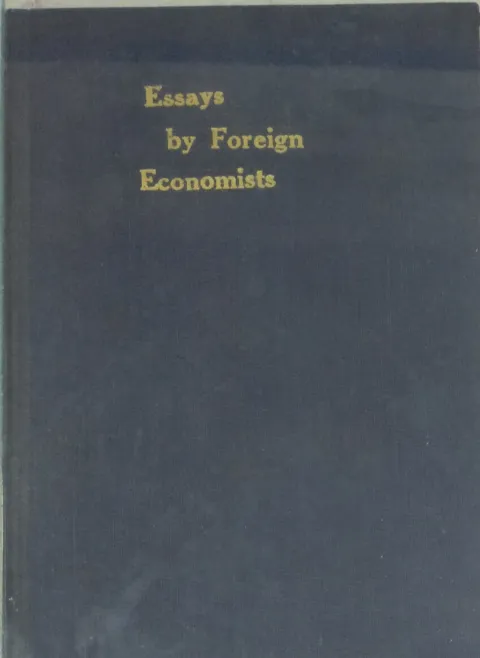
Essays by Foreign Economists
By Milton Friedman, B. A. Tarlton, W. H. Hutt, Eugene R. Black Sr.
FORUM OF FREE ENTERPRISE, "Sohrab House", 235, Dr. Dadabhai Naoroji Road, Bombay-1. Published by M. R. Pai for the Forum of Free Enterprise, 235, Dr. Dadabhai Naoroji Road, Bombay-1 and printed by S. J. Patel, at Onlooker Press, (Prop. Hind Kitabs Ltd.), Sassoon Dock, Colaba, Bombay-5. · Bombay · 1971
210 pages
Summary
Essays by Foreign Economists is a compilation published in August 1971 by the Forum of Free Enterprise, Bombay (M. R. Pai, publisher), gathering twelve booklets the Forum had previously issued; the volume is explicitly marked ‘not for sale’ and circulated only to Forum members. In the rendered pages, the table of contents lists pieces by Milton Friedman, B. A. Tarlton, F. A. Hayek, G. Carl Wiegand, W. H. Hutt, Colin Clark (two essays), P. T. Bauer (three essays), Dudley Dillard, and Eugene Black, addressing the case for free enterprise, the failings of central planning, the conditions for economic growth, foreign aid, the economic thinking of Keynes, and the place of India’s private sector. The chunk contains the full text of Friedman’s opening essay ‘Myths That Keep People Hungry’ (reprinted from Harper’s Magazine, April 1967), which sets the polemical frame for the volume by contrasting countries where private markets organise economic life with those subject to detailed central planning, and the opening pages of B. A. Tarlton’s 1968 Calcutta lecture ‘Economic Democracy’.
Key points
-
Milton Friedman’s essay “Myths That Keep People Hungry,” reprinted from Harper’s Magazine, argues that wherever private markets organise economic life people gain material progress and freedom, unlike under detailed state control.
-
The essay contrasts West Germany, Israel, Singapore, Malaya and post-Meiji Japan as cases of market-led progress against East Germany, Egypt, Indonesia, post-Independence India, Yugoslavia and Russia.
-
A statistical anchor is that in the Soviet Union only three percent of cultivated land held in private plots nonetheless produced one-third of total agricultural output.
-
Examples of waste under Indian controls include the ban on new car production, which forced buyers to pay around $1,500 for a 1950 Buick, and bureaucratic cotton “procurement” replacing market exchange.
-
B. A. Tarlton’s 1968 Calcutta lecture “Economic Democracy” tracks India’s shift from a net international creditor of over Rs. 700 crores in 1956 to a net debtor of over Rs. 5,000 crores by 1968.
-
Tarlton observes that the Planning Commission had been reduced to advisory functions and the Fourth Plan shelved for three years, reading these as signs of disillusion after two decades of planning.
-
Tarlton distinguishes a “classical” conception of democracy as rule by the common people from a “liberal” conception resting on equal political authority for every citizen, using the distinction to interrogate India’s economic policy.
-
Beyond Friedman and Tarlton, the volume gathers Forum of Free Enterprise booklets by F. A. Hayek, G. Carl Wiegand, W. H. Hutt, Colin Clark, P. T. Bauer, Dudley Dillard and Eugene Black on planning, growth, foreign aid and Keynesian thought.
Essays
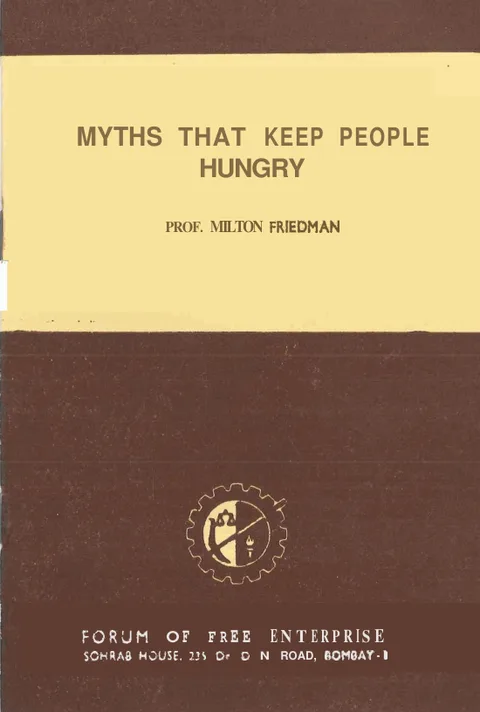
Myths that keep People Hungry
By Prof. Milton Friedman
Drawing on a year-long journey with his wife through Eastern Europe, the Middle East and the Far East, Friedman lays out, in the rendered pages, the central contention that wherever private markets organise economic activity ordinary people enjoy material progress and personal freedom, and wherever the state controls economic life in detail the ordinary citizen becomes ‘an instrument to be used for the state’s purpose’. He walks the reader through a chain of comparisons — West and East Germany, Israel and Egypt, Singapore and Indonesia, Malaya and India, Yugoslavia and Russia — to argue that the difference in outcomes reflects the difference in economic organisation rather than resources or culture.
The heart of the essay in the rendered pages is a sustained contrast between Japan after the 1868 Meiji restoration, which Friedman reads as a broadly free-market case that absorbed foreign techniques without depending on foreign aid, and India after 1948, which he reads as a case of Fabian socialism and detailed central planning that has frustrated initiative and impoverished the ordinary villager. He closes the essay with a warning that the climate of opinion hostile to markets — transmitted from the affluent West to the less-developed nations — may doom mankind ‘to a renewed era of universal tyranny and misery’.
- In the rendered pages Friedman organises the essay around a personal observation: wherever he found individual freedom and rising material welfare he also found private markets, and wherever central planning prevailed the ordinary man was ‘in political fetters’ and had a low standard of living.
- He cites West Germany, Israel, Singapore, Malaya and post-Meiji Japan as cases of market-led progress, and contrasts them with East Germany, Egypt, Indonesia, post-Independence India, Yugoslavia and Russia.
- A statistical anchor for the essay is that in the Soviet Union only 3 per cent of cultivated land is in private plots whose produce may be marketed privately, yet this 3 per cent produces one-third of total agricultural output.
- Friedman reads Japan after 1868 and India after 1948 as a controlled experiment: both faced major political change and rigid class relations, but Japan followed a broadly free-market policy modelled on Britain while India followed Fabian-socialist central planning, with sharply divergent results.
- Examples of waste under Indian controls include the prohibition of new car production, which forced wealthy buyers to pay around $1,500 for a 1950 Buick, and the substitution of bureaucratic ‘procurement’ for market exchange in cotton.
- He closes by warning that the prevailing climate of opinion hostile to market arrangements, transmitted from the affluent West to less-developed nations, may consign mankind to ‘a renewed era of universal tyranny and misery’.
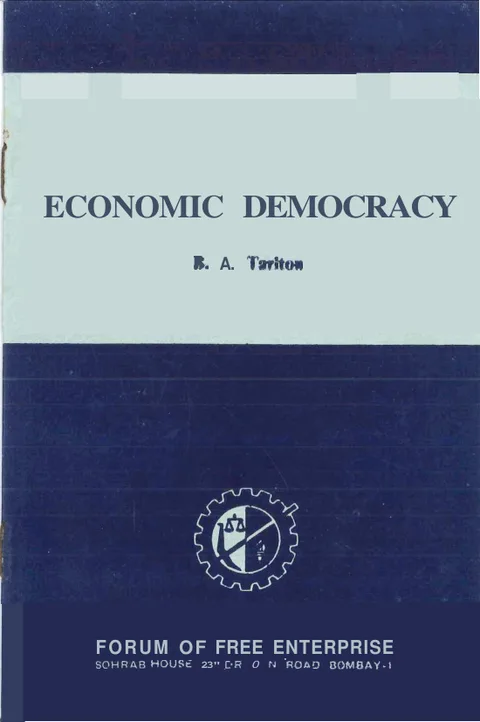
Economic Democracy
By B. A. Tarlton
Tarlton, an economist with the Associated Chambers of Commerce and Industries in Calcutta, opens his 1968 lecture by taking stock of India’s mood after two decades of planning. In the rendered pages he notes that the ‘sunlit plateaus of prosperity’ once promised by the politicians have given way to disillusion: average living standards have not significantly improved, unemployment and the foreign trade deficit have risen, and India, a net international creditor of over Rs. 700 crores at the start of the Second Five Year Plan in 1956, had become a net international debtor of over Rs. 5,000 crores by 1968. The Planning Commission, he observes, has been cut down in size and confined to advisory functions, and the Fourth Plan shelved for three years.
In the rendered pages he then begins to interrogate the title concept, distinguishing a ‘classical’ conception of democracy — rule by the ‘demos’ or common people, traceable to Plato and Aristotle and compatible with class dictatorship — from a ‘liberal’ conception that has emerged only over the past two or three hundred years and rests on equal political authority for every citizen and a principle of self-rule. The chunk ends mid-argument, with Tarlton starting to lay out the implications of this distinction for India’s economic policy.
- Tarlton frames the lecture against India’s prevailing ‘mood of doubt and pessimism’ after two decades of central planning.
- He marshals headline numbers in the rendered pages: India shifted from a net international creditor of over Rs. 700 crores in 1956 to a net debtor of over Rs. 5,000 crores by 1968 at the post-devaluation level.
- He notes that the Planning Commission has been cut down in size and confined to advisory functions, while the Fourth Plan has been shelved for three years.
- Using the Cotton Control Order as an example, he argues that government ‘procurement’ is in substance compulsory requisitioning at fixed prices.
- He distinguishes a ‘classical’ conception of democracy as rule by the ‘common people’ (traceable to Plato and Aristotle, compatible with the dictatorship of the proletariat in modern China and the Soviet Union) from a ‘liberal’ conception of self-rule by equal citizens that has emerged only in the past two or three hundred years.
Metadata and summary are AI-extracted from the source PDF and reviewed for editorial accuracy. The original work is available via the Read PDF tab above (where present); paragraph-level citation inside the PDF is deferred to a future engagement.