pamphlet
CONSUMER SOVEREIGNTY LEADS TO RAPID ECONOMIC DEVELOPMENT
By B. R. Shenoy
Published by M. R. PAI, for Forum of Free Enterprise, "Sohrab House", 235 Dr. Dadabhai Naoroji Road, Bombay 1, and Printed by B. C. DHAWALE at KARNATAK PRINTING PRESS, Chira Bazar, Bombay 2. · Bombay · 1962
4 pages
Summary
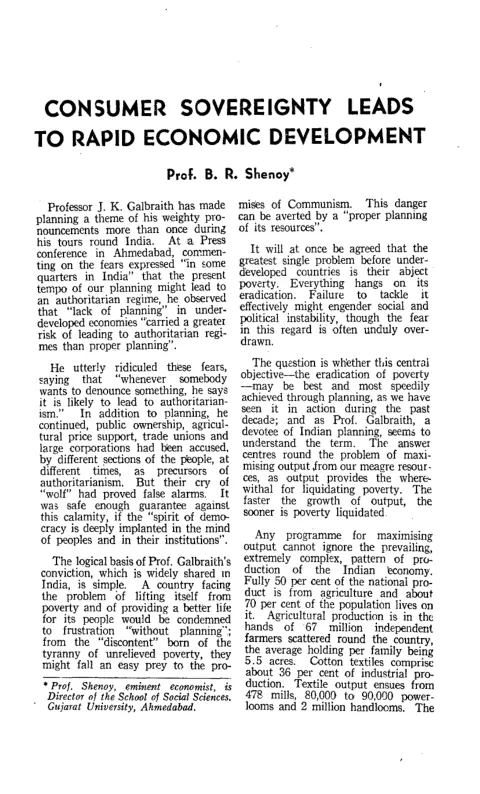
B. R. Shenoy’s July 1962 Forum of Free Enterprise leaflet is a direct riposte to J. K. Galbraith, whose pronouncements during his tours of India had cast doubt on those who criticised central planning. Reporting from a Press conference in Ahmedabad, Shenoy notes Galbraith’s claim that ‘the present tempo of our planning might lead to an authoritarian regime’ yet his simultaneous insistence that ‘whenever somebody wants to denounce something, he says it is likely to lead to authoritarianism.’ Shenoy turns the warning back on its author: it is the architecture of centralised resource allocation, not the rhetoric of its critics, that incubates the authoritarian habit.
The substantive argument is a critique of the Third Plan’s investment pattern. With 65 per cent of investment resources sunk into the Public Sector and 57 per cent of that into ‘heavy industries, mammoth river valley projects and costly social overheads,’ the productive base for consumer goods, agriculture, textiles and trade is starved of capital. The arithmetic, Shenoy argues, is unsparing: agricultural production is in the hands of 67 million independent farmers cultivating an average 5.5 acres each, and textile output emerges from 478 mills, 80,000 to 90,000 powerlooms and 2 million handlooms — yet planning channels capital away from these sectors. The consequence has been an Indian national income rising at roughly 3.5 per cent a year over the preceding decade against the 8–10 per cent the basic-needs strategy would yield, with food and cloth consumption stagnant or in decline.
Against this, Shenoy offers what he calls ‘planning for the free market under the aegis of consumer sovereignty’ — pointing to the West German miracle, the EEC, Israel, Japan, Hong Kong, Spain and the Philippines as cases where market-led planning has produced ‘blinding economic and social dividends.’ He warns that this lesson has not reached New Delhi or Indian universities, where the imported authority of Galbraith, Millikan, Rostow, Ward, Balogh, Bettelheim, Lange and Robinson still props up the dirigiste consensus. The pamphlet closes with the prayer, ‘Good Lord, protect me from my friends; against mine enemies I can defend myself’ — a barb aimed at well-meaning Western advisers whose counsel, Shenoy holds, is more dangerous to Indian liberty than any avowed adversary.
Key points
-
Rebuts J. K. Galbraith’s argument — made during his India tours and a Press conference in Ahmedabad — that critics of planning court an authoritarian regime; Shenoy turns the charge around, arguing that centralised planning itself ‘carries the very risks of authoritarianism’ Galbraith claims to fear.
-
Identifies abject poverty as the central problem of underdeveloped countries and frames the policy question as whether eradicating it is best achieved through state planning or through the free market.
-
Documents that the Public Sector will absorb 65 per cent of Third Plan investment resources and that 57 per cent of plan outlay is going into heavy industry, river valley projects and social overheads — at the expense of agriculture, textiles and consumer-goods industries that produce for mass needs.
-
Quantifies the productive base being neglected: 67 million farmers averaging 5.5 acres each, 478 textile mills, 80,000–90,000 powerlooms and 2 million handlooms — all in independent hands and starved of capital by the plan’s allocation choices.
-
Argues that re-directing investment toward consumer-good sectors and letting individual production units plan via the market would yield 8–10 per cent annual income growth alongside rising food and cloth output — versus the actual 3.5 per cent national-income growth and stagnant or declining mass consumption of the past decade.
-
Cites West Germany’s post-war miracle, the EEC, Israel, Japan, Hong Kong, Spain, the Philippines and the United Kingdom’s eagerness to join the EEC as evidence that ‘planning for the free market’ under consumer sovereignty has produced superior economic and social outcomes.
-
Names the imported intellectual authority sustaining Indian dirigisme — Galbraith, Millikan, Rostow, Ward, and left-wing figures Balogh, Bettleheim, Lange and Robinson — as ‘illicit beneficiaries of planning’ whose expositions stand in the way of Indians appreciating free-market potentialities.
-
Closes with the prayer ‘Good Lord, protect me from my friends; against mine enemies I can defend myself,’ positioning sympathetic Western planning advocates as a graver threat to Indian liberty than declared adversaries.
Metadata and summary are AI-extracted from the source PDF and reviewed for editorial accuracy. The original work is available via the Read PDF tab above (where present); paragraph-level citation inside the PDF is deferred to a future engagement.