edited volume · proceedings
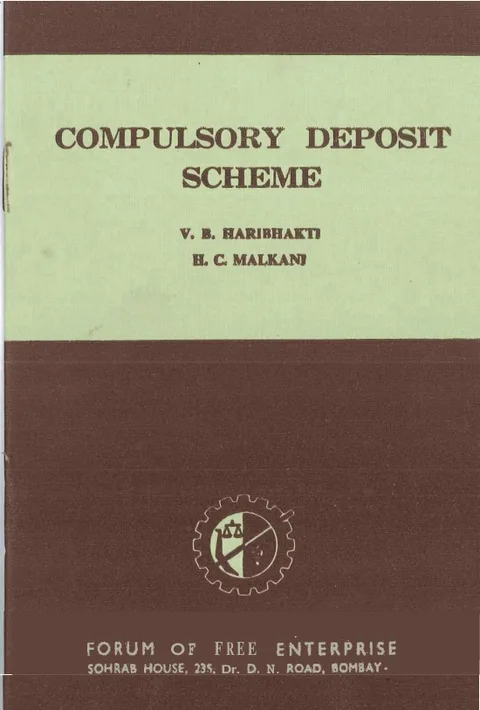
Compulsory Deposit Scheme
FORUM OF FREE ENTERPRISE, SOHRAB HOUSE, 235, Dr. D. N. ROAD, BOMBAY · Bombay · 1963
15 pages
Summary
This Forum of Free Enterprise pamphlet collects two talks delivered in Bombay on 23 July 1963 attacking the Compulsory Deposit Scheme (C.D.S.) announced by the Finance Minister in the 28 February 1963 Budget Speech. V. B. Haribhakti, a chartered accountant, dissects the statute clause-by-clause to argue that the scheme is gigantic, ill-considered, and impossible to administer fairly on lower-income earners. H. C. Malkani, Principal of Bombay’s College of Commerce and Economics, takes up the question of feasibility — comparing C.D.S. to Keynes-inspired British deferred-pay precedents, weighing it against ordinary taxation, and concluding that the implementation machinery is nowhere near ready for the colossal task. Both pieces share the Forum’s classical-liberal framing — captured in the cover-leaf epigraphs from Eugene Black and A. D. Shroff — that compulsory saving on the poor is a contradiction in terms and that government overspending, not private consumption, is the real fiscal problem.
Key points
-
Chartered accountant V. B. Haribhakti opens by calling the Compulsory Deposit Scheme a ‘Frankenstein’ born of only four paragraphs of the sixty-nine-paragraph 1963 Budget Speech and drafted in haste.
-
Haribhakti works through the statute’s five categories of compulsory depositors, its Rs. 12-crore revenue target, and definitional gaps between the C.D.S. Act and the Income-tax Act around ‘salary’ and ‘person’.
-
He cites India’s per-capita income of Rs. 292.50 against Rs. 11,118 in the United States, plus a survey showing 85% of urban households had nil or negative savings, to argue compulsion cannot work below Rs. 3,000 income.
-
H. C. Malkani, Principal of Bombay’s College of Commerce and Economics, recalls Lord Keynes’s wartime British precedent for compulsory saving but concludes the scheme’s implementation machinery is not ready for so large a task.
-
Malkani notes the Third Plan required an 11.5% saving rate but achieved only about 8.5%, treating this shortfall as the scheme’s real motivation without endorsing it as the remedy.
-
He points to NCAER findings that employees earning Rs. 1,500 to 3,000 monthly have almost no net savings, and to the eight lakh accounts the scheme would require in Bombay City alone.
-
Both contributors, framed by cover-leaf epigraphs from Eugene Black and A. D. Shroff, conclude that compulsory saving imposed on the poor is a contradiction and that curbing government overspending is the real fiscal remedy.
Essays
COMPULSORY DEPOSIT SCHEME
By V. B. Haribhakti
Haribhakti opens by calling the C.D.S. ‘a novel idea in the Indian Fiscal System’ but also a ‘Frankenstein’ that emerged from only four paragraphs (57–60) of the 69-paragraph Budget Speech, and was drafted hastily. He works through the five statutory categories of compulsory depositors, the Rs. 12-crore revenue target, the definitions of ‘salary’ and ‘employee’ under Section 2(b) and Section 3(e), the 240-day employment condition, the 3% deposit rate (10.8% for the 1963-64 partial year), the depositing banks, Form ‘A’/‘B’/‘C’/‘D’/‘E’ procedures, the 4% interest, the five-year repayment cycle, and the cumbersome penalty mechanism on employers who fail to deduct. He shows that the scheme penalises bona fide salaried staff while leaving the genuinely better-off (urban property holders, Section-11 trust employees, casual labour) effectively outside its grasp. The essay closes with per-capita-income data (Rs. 292.50 for India in 1961-62 versus Rs. 11,118 for the United States) and survey evidence that 85% of urban households ‘dis-saved’ to argue that the scheme for incomes below Rs. 3,000 must simply be scrapped, and that the real avenue for resource mobilisation is curbing colossal Government expenditure.
- The C.D.S. was buried in four paragraphs of a 69-paragraph Budget Speech and reflects a recent pattern of hasty Indian legislation.
- The scheme’s two stated objects — restraining demand and inculcating the saving habit — are doubtful for income-tax payers earning Rs. 125 to Rs. 250 a month.
- Definitional inconsistencies between the C.D.S. Act and the Income-tax Act (especially around ‘salary’ and ‘person’) create implementation traps that may render the scheme illegal for many employees.
- Employers face severe penalties and a quasi-banking burden of opening, maintaining, and repaying Compulsory Deposit Accounts in duplicate or triplicate.
- Forms ‘A’, ‘B’, ‘C’, ‘D’, and ‘E’ and deposit machinery across the Reserve Bank, SBI, eight scheduled banks, and post offices add administrative load without clear benefit.
- Indian per-capita income (Rs. 292.50) is a fraction of the U.S. figure (Rs. 11,118), so the saving capacity for compulsion to act on simply isn’t there.
- A 1960 Monthly Abstract of Statistics survey showed 85% of urban households had ‘nil’ or negative saving — for them ‘compulsory saving’ is a directive to ‘compulsorily borrow’.
C.D.S. IS DIFFICULT TO IMPLEMENT
By H. C. Malkani
Malkani’s contribution, ‘C.D.S. is Difficult to Implement’, accepts that the Finance Minister’s objects — supplementing taxation and inculcating austerity — are legitimate given that the Third Plan’s required 11.5% saving rate has slipped against a stagnant 8.5% achievement, but rejects the chosen instrument. He recalls that Lord Keynes used compulsory saving with success in wartime Britain, and notes that compulsory deposits at 4% interest are preferable to taxation in form but suffer the same demand-inflationary limits and require deficit financing. Walking through each category C.D.S. is meant to capture — land-revenue payers above Rs. 5/-, income-tax payers, salaried staff between Rs. 1,500 and Rs. 3,000, shopkeepers above Rs. 15,000 turnover, urban immovable-property holders, and professionals outside income-tax — he shows that State Government arrears, NCAER ‘nil savings’ findings on the Rs. 1,500–3,000 group, the eight-lakh-account burden in Bombay City alone, and the un-perfected collection machinery together make the scheme practically unworkable. His verdict: objects laudable, implementation a very difficult task.
- Common people, especially the middle classes, are worried because the scheme bites a population with low per-capita income, rising prices, and almost no capacity to save.
- Compulsory deposits are preferable to taxation only because they are ‘earning assets’ at 4% — but they share taxation’s inflationary and deficit-financing limits.
- The Third Plan needed a 11.5% saving rate but achieved only ~8.5%, with growth slipping to 2.2–2.4% against a 7% target — the gap motivates C.D.S. but does not justify it.
- Land-revenue payers above Rs. 5/- are the largest affected class, but State Governments — including Madras — are already grumbling about collecting on the Centre’s behalf.
- NCAER evidence reportedly shows that persons earning Rs. 1,500–3,000 ‘have on an average hardly, any net savings’, and increased indirect taxes have already reduced their capacity to save.
- Implementation arithmetic — 8.28 lakh income-tax payers plus ~355 lakh non-farm households in the Rs. 1,500–3,000 range, and 8 lakh accounts in Bombay City alone — makes the scheme a colossal administrative task.
Metadata and summary are AI-extracted from the source PDF and reviewed for editorial accuracy. The original work is available via the Read PDF tab above (where present); paragraph-level citation inside the PDF is deferred to a future engagement.