
speech
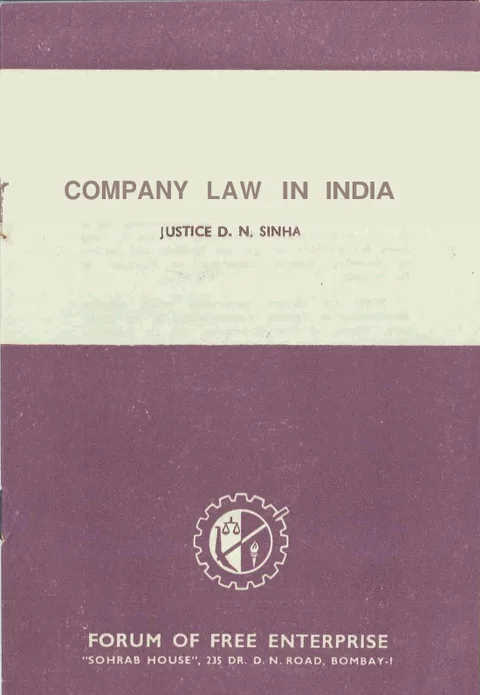
COMPANY LAW IN INDIA
Forum of Free Enterprise, "Sohrab House", 235 Dr. D. N. Road, Bombay-1 · Bombay · 1964
8 pages
Summary
Justice D. N. Sinha’s address—delivered on 30 June 1964 to the Association of Company Secretaries & Executives in Calcutta and issued as a Forum of Free Enterprise booklet in December 1964—traces the chequered history of Indian company law from the 1850 Act onward, through the Acts of 1857, 1860, 1866, 1882, 1913, and 1936, down to the 1956 Companies Act and its many amendments (notably the 218 changes culminating in section 388B). Sinha frames company legislation as an inheritance of English law, born of seventeenth-century chartered enterprises and the South Sea Bubble, and crystallised by the nineteenth-century invention of limited liability—what he calls a “stroke of genius” without which modern industrial prosperity could not have been built.
The core argument is that the object of company law is twofold: to enable persons to band together for trade, business, and industry most effectively, and to ensure that this private power is consistent with political, social, and economic necessity. Drawing on Justice Douglas of the United States Supreme Court and on Lord Cranworth’s classic dictum in Oakes v. Turques (1867), Sinha insists that corporations carry an element of public interest and that directors owe duties to labour, suppliers, consumers, and the wider community as well as to shareholders. He worries that Indian legislation, though constantly amended, has failed to achieve its purpose: it has become bulky, complex, and incomprehensible, defeating the very economic prosperity it aims to serve.
The second half turns to taxation and to legislative craftsmanship. Sinha argues that India’s tax regime—income tax, the Wealth Tax Act, the Gift Tax Act, the Estate Duty Act, the Compulsory Deposit and Annuity Deposit schemes—has become so prolix, technical, and unstable that ordinary taxpayers cannot understand their own liabilities, while “big business” devotes its energy to legitimate tax-avoidance schemes that thwart the spirit of the law. Citing Alexander Hamilton in The Federalist on the danger of laws “so voluminous that they cannot be read”, he calls for ideal legislation that pinpoints the disease and prescribes a simple cure, drafted by men specifically trained in the art. He ends with a plea for serious legal research in India to clear away technicalities and protect the honest taxpayer, commending the West Bengal State Unit of the Indian Law Institute for beginning that work.
Key points
-
Reconstructs the statutory history of Indian company law from the 1850 Act, through the 1857, 1860, 1866, 1882, 1913, and 1936 enactments, to the 1956 Companies Act and its 218 amendments culminating in section 388B.
-
Locates the origin of company legislation in seventeenth-century English chartered enterprises and the South Sea Bubble, and identifies limited liability—introduced after 1850—as the decisive innovation behind modern industrial prosperity.
-
Defines the object of company legislation as enabling collective enterprise while ensuring it serves political, social, and economic necessity, invoking Lord Cranworth in Oakes v. Turques (1867) and Justice Douglas of the U.S. Supreme Court on the public-interest dimension of corporations.
-
Argues that Indian company law has become so frequently amended, technical, and complex that it now obstructs rather than fosters the commercial community it was intended to serve.
-
Critiques India’s tax regime—Income Tax, Wealth Tax, Gift Tax, Estate Duty, Compulsory Deposit, and Annuity Deposit Schemes—for being incomprehensible to the ordinary taxpayer and for driving ‘big business’ into elaborate but lawful avoidance schemes.
-
Notes that roughly 99% of Indians fall outside the income-tax net and that the burden on the honest middle-class taxpayer is rising even as revenue is leaking, citing Alexander Hamilton in The Federalist on the dangers of voluminous, ever-changing laws.
-
Calls for simpler, comprehensible legislation drafted by trained specialists, and for serious legal research—commending the West Bengal State Unit of the Indian Law Institute for taking up the task.
Metadata and summary are AI-extracted from the source PDF and reviewed for editorial accuracy. The original work is available via the Read PDF tab above (where present); paragraph-level citation inside the PDF is deferred to a future engagement.
People in this work
Related across the archive
 ExcerptCrushing Burden of Taxation - Nani Palkhivala
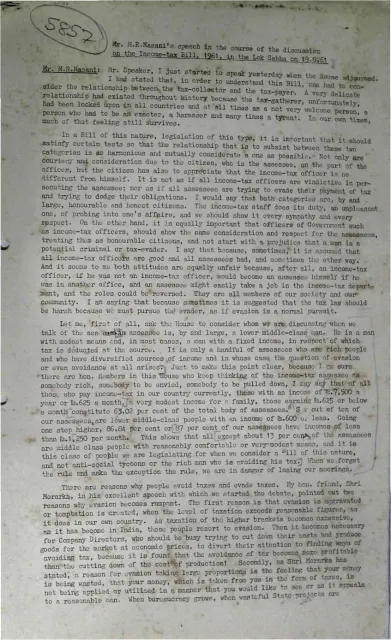 Primary workMr. M.R.Masani's speech in the course of the discussion on the Income-tax Bill, 1961, in the Lok Sabha on 19.8.61
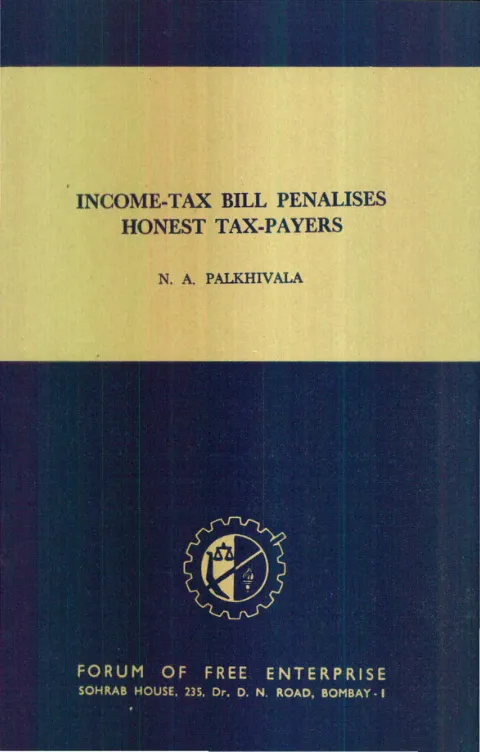 Primary workINCOME-TAX BILL PENALISES HONEST TAX-PAYERS
 Primary workCrushing Burden of Taxation
 ExcerptJamshed Antia's Views On Sales Tax