speech · memorial lecture
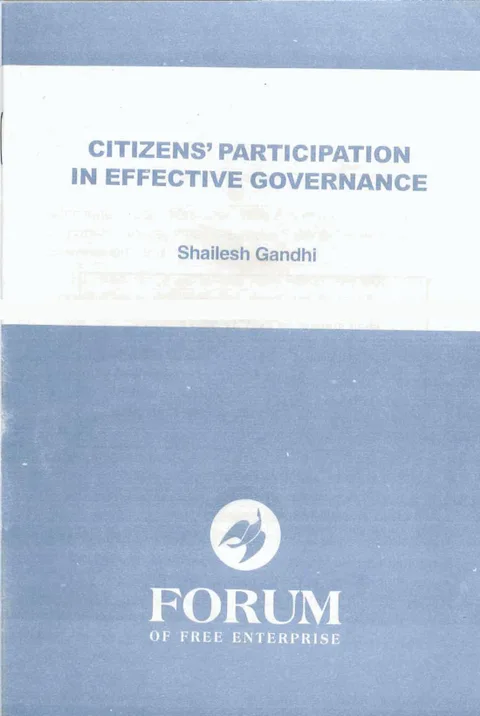
CITIZENS' PARTICIPATION IN EFFECTIVE GOVERNANCE
Published by S. S. Bhandare for the Forum of Free Enterprise, Peninsula House, 2nd Floor, 235, Dr. D. N. Road, Mumbai 400001, and Printed by S. V. Limaye at India Printing Works, India Printing House, 42 G. D. Ambekar Marg, Wadala, Mumbai 400 031. · Mumbai · 2010
13 pages
No. 21 in Bhogilal Leherchand Memorial Lecture
Summary
Citizens’ Participation in Effective Governance is the text of the 21st Bhogilal Leherchand Memorial Lecture, delivered by then-Central Information Commissioner Shailesh Gandhi in Mumbai on 9 December 2009 and published in January 2010 by the Forum of Free Enterprise. Gandhi opens by reminding readers that the Constituent Assembly, elected by under two per cent of the population, nevertheless framed a Constitution that conceived of India as a vibrant democracy of equal citizens. The promise, he argues, has been hollowed out: India settled for an ‘elective democracy’ that observes the forms of elections while losing the substance of citizen sovereignty, with the result that ordinary people meet the State with suspicion, derision and anger.
The bulk of the lecture is a granular indictment of administrative failure built from Gandhi’s own files as Information Commissioner. He recounts a child sodomised by a policeman whose case has crawled through two inquiries in two years, lays out the data on Mumbai’s cognizable-crime registration (which fell from 32,000 to 40,000 even as the city’s population rose by 50 per cent), and describes how 4,532 mobile towers in Delhi were erected with only 2,015 of them having the requisite permissions, with the State subsequently issuing an ordinance to shield such ‘unauthorised developments’ from action. He treats the IIT-issued stability certificates for towers, the Salwa Judum experiment in privatising policing, the abdication of the State in school and health provision, the 26/11 attacks, and the Liberhan Commission as different faces of one disease: a governance structure structurally incapable of delivery in any reasonable time.
Gandhi’s diagnosis is procedural and human-resources oriented rather than ideological. Files tied with string, paper-pushing systems designed by colonial administrators who distrusted Indian officers, an HR regime in which promotions are by seniority and good performance is not even recorded, an ageing IAS cadre, and a downsizing drive that has hollowed out staff while contractors flout labour law together produce an ‘outmoded, demotivated, low-productivity’ machine staffed at roughly one-twentieth the per-capita ratio of the United States. Quoting at length from the Maharashtra Government Servants Regulation of Transfers Act, 2005, he shows how laws on the books are routinely ignored — 144 IPS transfers in 13 months, every one of them violating the three-year tenure rule — until citizens use the Right to Information and sustained public pressure to force compliance.
The closing pages set out his theory of change. Citizens, he insists, are the sovereigns who delegated power to the State in return for the rule of law; they cannot outsource the repair of governance to a political class they correctly mistrust. The Administrative Reforms Committee’s recommendations should be debated and acted on, management professionals should redesign workflows and training, and ordinary citizens should engage their elected representatives ‘at regular intervals’ rather than only at the ballot box. Better governance, he concludes, is not a difficult goal but a boring one — and one that will not arrive without ‘citizens’ sustained pressure’.
Key points
-
Frames democracy as resting on individual citizen sovereignty rather than mere periodic elections — India has an ‘elective’ democracy without the participatory substance the Constituent Assembly intended.
-
Uses RTI-derived case files (a child sodomised by a policeman; non-registration of cognizable crimes in Mumbai; 4,532 mobile towers in Delhi with only 2,015 having permissions) to show systemic non-delivery and active State protection of well-connected lawbreakers.
-
Treats 26/11 as a governance failure rather than an isolated terror event — evidence that the Indian State is structurally incapable of timely action.
-
Diagnoses the bureaucracy as a colonial machine the Republic never overhauled: paper-bound file procedures, seniority-based promotion, no recognition of good performance, arbitrary transfers as punishment, and an ageing IAS cadre worsened by indiscriminate downsizing.
-
Argues the State cannot privatise its core functions (policing, schooling, health) without alienating citizens — the Salwa Judum and the closure of Bombay Municipal Corporation schools are read as abdication.
-
Quotes the Maharashtra Government Servants Regulation of Transfers Act, 2005 to demonstrate that even well-drafted Indian laws lie inert until citizens force enforcement through RTI and public pressure.
-
Lays responsibility on citizens rather than the political class: a ‘sustained campaign’ lasting a few years could shift the administrative structure, but only if citizens act as sovereigns rather than spectators who curse politicians.
Metadata and summary are AI-extracted from the source PDF and reviewed for editorial accuracy. The original work is available via the Read PDF tab above (where present); paragraph-level citation inside the PDF is deferred to a future engagement.