edited volume
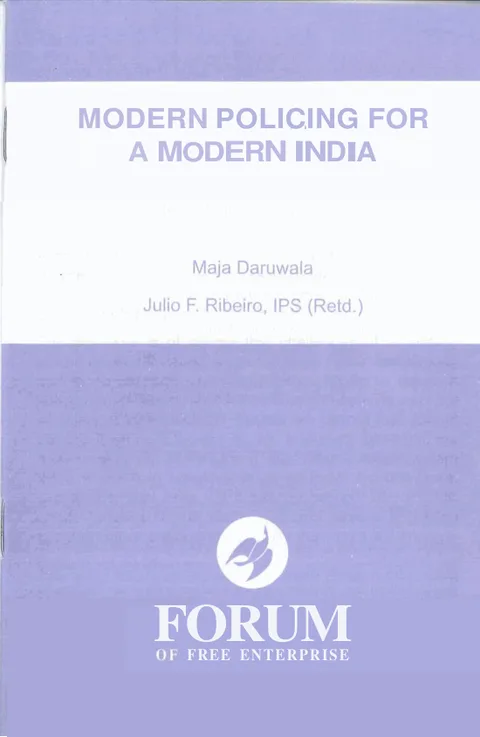
Modern Policing for a Modern India
Published by S. S. Bhandare for the Forum of Free Enterprise, Peninsula House, 2nd Floor, 235, Dr. D. N. Road, Munrbai 400001, and Printed by S. V. Lirnaye at India Printing Works, India Printing House, 42 G. D. Ambekar Marg, Wadala, Mumbai 400 031. · Mumbai · 2009
15 pages
Summary
This Forum of Free Enterprise booklet collects two addresses delivered together in Mumbai on 30 January 2009 — by Maja Daruwala, Executive Director of the Commonwealth Human Rights Initiative (CHRI), and by Julio F. Ribeiro, IPS (Retd.), former Police Commissioner of Mumbai and former Director-General of Police, Punjab. Both speakers diagnose Indian policing as a colonial-era institution that has decayed into a politicised, unaccountable instrument and argue that the Supreme Court’s September 2006 directions — fixed tenures, a State Security Commission, a Police Establishment Board, Police Complaints Authorities, and separation of investigation from law-and-order — provide a workable template for reform that the Centre and the states are actively subverting. Daruwala lays out the institutional architecture and CHRI’s monitoring of state-level compliance; Ribeiro, speaking after her, frames police reform as the citizen’s agenda after 26/11, calling on the middle class that voted to also organise around good leadership, operational independence and the elimination of the politician-bureaucrat-police ‘partnership’ he sees corroding the service.
Key points
-
Maja Daruwala, Executive Director of the Commonwealth Human Rights Initiative, cites National Human Rights Commission and Transparency International data showing 60 to 80 per cent of public complaints are filed against the police.
-
The address argues the colonial-era 1861 Police Act model is incompatible with a Constitution under which citizens and police are equal subjects of law, prioritising intelligence-gathering over service.
-
It goes on to detail the Supreme Court’s September 2006 directions in the Prakash Singh case: a State Security Commission, fixed tenure for the police chief, a Police Establishment Board, and Police Complaints Authorities.
-
Daruwala documents widespread state non-compliance, singling out Maharashtra’s State Security Council under Justice Shri Krishna, with more than sixty members but no real enforcement power, as an ornamental response.
-
Daruwala closes by urging Mumbai residents to move beyond demanding more police weapons and equipment and instead insist on structural change to make the police responsive to public needs and rights.
-
Julio Ribeiro, former Police Commissioner of Mumbai and former Director-General of Police, Punjab, treats the 26 November 2008 attacks as a watershed that forced the middle class to care about police reform for the first time.
-
He defines operational independence concretely as freedom from political interference in postings, transfers, and punishments from Deputy Superintendent down to constable, naming this the key to breaking a corrupt politician-bureaucrat-police “partnership.”
-
Ribeiro calls for separating the investigation arm of the police from the law-and-order arm so that investigations proceed under the Bombay Police Act and the rule of law rather than political control.
-
The address closes by endorsing the National Police Commission scheme devised under Dharma Vira and recalling Ribeiro’s own public interest litigation that secured the reversal of reinstatements of dismissed officers.
Essays
Modern Policing for a Modern India
By Mrs. Maja Daruwala
Maja Daruwala opens with the claim that a vibrant democracy belongs to the people and therefore requires accessible justice, and narrows her focus from the wider justice system to police reform on the grounds that fixing one large area will create knock-on pressure on the rest. She walks through CHRI’s diagnosis: the public perceives the police as inefficient, untrustworthy and corrupt; National Human Rights Commission data show 60–80% of complaints are filed against police; political interference has broken the chain of command; and service conditions, recruitment, training and internal management are all in disrepair. The essay then turns to the constitutional argument that policing in a democracy must be re-grounded — the police are upholders of the law, not mere enforcers of executive will, and must protect liberties and create an environment for free citizens, not just quell rebelliousness as under colonial rule.
Daruwala devotes the second half to the Supreme Court’s September 2006 directions in the Prakash Singh PIL: fixed tenure and merit-based selection for the police chief through a State Security Commission that includes the opposition; a Police Establishment Board to handle transfers and promotions transparently; and Police Complaints Authorities at state and district levels staffed by civilians independent of serving or retired police officers. She catalogues how states have responded with retrograde legislation that retains the 1861 colonial model, or with sham bodies — Maharashtra has set up a State Security Council under Justice Shri Krishna with over sixty members but no real teeth, and other states have legislated to dilute the Court’s orders. She closes with a call to action: Mumbaikars must move beyond demanding more police arms and equipment and instead insist that underlying structures change to make the police responsive to public needs and rights.
- Frames a stable democracy as one that delivers accessible justice, and chooses police reform as the leverage point inside the criminal justice system.
- Cites NHRC and Transparency International data showing 60–80% of complaints filed are against the police, and notes a recent statute restricting police arrest discretion as evidence of legislative loss of trust.
- Argues that the colonial 1861 Police Act model — hierarchical, militaristic, prioritising intelligence over service — is incompatible with a Constitution under which citizens and police are equal subjects of law.
- Walks through the Supreme Court’s September 2006 directions in the Prakash Singh PIL: State Security Commission, fixed tenure and merit-based selection of the police chief, Police Establishment Board, and state and district Police Complaints Authorities.
- Documents widespread state-level non-compliance: retrograde laws that preserve the 1861 model, Police Complaints Authorities packed with serving or retired police, and ornamental bodies like Maharashtra’s State Security Council under Justice Shri Krishna.
- Closes with a call for organised citizen pressure on government to implement the Court’s scheme, not just to demand more equipment after 26/11.
Modern Policing for a Modern India
By Julio Ribeiro, IPS (Retd.)
Julio Ribeiro picks up where Daruwala leaves off, treating 26 November 2008 as a watershed because, for the first time, the middle class — which usually relies on its own pipelines to bureaucrats and politicians — was forced to care about policing. He argues that most of what Mumbaikars discussed after the attacks was equipment and weapons rather than reform, and insists that the only durable response operates on three fronts: police reform, organising as voters to elect lawmakers who will not pass laws meant to be broken, and disaster-readiness at the neighbourhood level. He calls citizens to lend their signatures and presence to ministers, because ministers only respond when they sense that votes are at stake.
Ribeiro’s core demand is twofold: choose good leaders, and give them operational independence. He defines operational independence concretely as no political interference in postings, transfers and punishments from Deputy Superintendent down to constable, and argues that the current ‘partnership’ between corrupt politicians, corrupt bureaucrats and corrupt officers is what the citizenry must break. He also calls for separating the investigation arm from the law-and-order arm so that investigations are conducted under the Bombay Police Act and the rule of law rather than under political control, and recalls his own PIL securing the reversal of reinstatements of dismissed officers. He closes by endorsing the National Police Commission scheme — under Dharma Vira — of a Security Commission with the leader of opposition, a transparent process for selecting the police chief with fixed tenure, and a Police Establishment Board, framing all this as professional accountability to law, people and elected representatives.
- Reads 26/11 as a watershed because the middle class, normally insulated by personal pipelines, was forced to engage with policing failure.
- Argues the citizens’ agenda has three legs: police reforms, organised voting in municipalities, Assemblies and the Lok Sabha to avoid laws that invite breaking, and neighbourhood-level disaster preparedness.
- Demands good leadership at the top of the police and concrete operational independence — defined as no political interference in postings, transfers or punishments from Deputy Superintendent down to constable.
- Names a ‘partnership’ between corrupt politicians, corrupt bureaucrats and corrupt police officers as the structural problem, and recalls a PIL in which he successfully challenged the reinstatement of dismissed officers.
- Calls for separation of the investigation arm from the law-and-order arm so that investigations operate under the Bombay Police Act and the rule of law, not under political control.
- Endorses the National Police Commission framework — Security Commission with the leader of opposition, transparent selection and fixed tenure for the chief, and a Police Establishment Board — as the route to a force accountable to law, people and elected representatives.
Metadata and summary are AI-extracted from the source PDF and reviewed for editorial accuracy. The original work is available via the Read PDF tab above (where present); paragraph-level citation inside the PDF is deferred to a future engagement.