speech
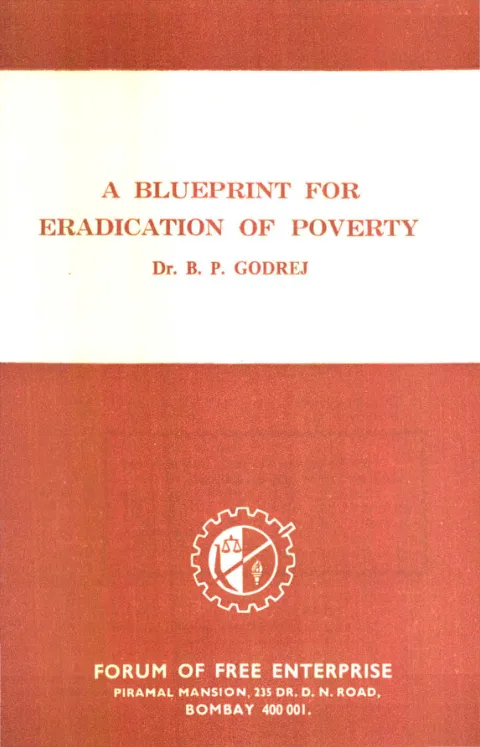
A Blueprint for Eradication of Poverty
By BP Godrej
Published by M. R. PAI for the Forum of Free Enterprise, "Piramal Mansion", 235 Dr. Dadabhai Naoroji Road, Bombay-1. and printed by B. D. Nadirshaw at Bombay Chronicle Press, Sayed Abdulla Brelvi Road, Fort, Bombay-1. · Bombay · 1980
20 pages
Summary
Delivered as a public lecture under the auspices of the Forum of Free Enterprise in Bombay on 16 September 1980 and published as a pamphlet in December of that year, Dr. B. P. Godrej’s address opens by naming poverty and unemployment as India’s greatest crises. Drawing on official surveys and press reports, he establishes that more than 356 million Indians lived below the poverty line in 1978—defined as the caloric threshold below which a worker cannot perform a full day’s labour—and that malnutrition was measurably depressing the cognitive development of the rural poor.
The first half of the lecture dissects the causes of this failure. Godrej argues that the ideological adoption of a dominant public sector, without regard for India’s actual conditions, had produced a nationalised economy that could not deliver energy, transport, or industrial goods efficiently. The government sector absorbed Rs. 15,000 crores of investment yet chronically underperformed; monopolistic bank employees exploited their captive position; and the Monopolies and Restrictive Trade Practices Act starved legitimate private enterprise of licences and room to grow. Confiscatory personal and corporate tax rates drove capital underground, rewarding evasion rather than production. Agriculture, neglected in favour of state industry, lagged at half world-average yields despite India’s unique endowment of arable land.
The second half, under the heading ‘THE SOLUTION’, offers a programme anchored in free-market democratic capitalism. Godrej’s first priority is population control by persuasion, backed by a dedicated well-funded ministry staffed by serious administrators rather than publicity-conscious figures. His second priority is a sound economic policy capable of delivering at least three per cent per annum real per-capita growth—something he judges unachievable without surgery on the present system: liberalisation of the private sector, conversion of government units to joint-stock enterprises with professional chief executives, rationalisation of tax rates to end evasion, and an ambitious national water-management scheme that could simultaneously address unemployment and food security. He draws on the post-war trajectories of Germany and Japan to argue that democratic capitalism—not aid or reparations—is the reliable engine of mass welfare, and cites international data showing that development assistance sent from Germany to the Third World returns one-and-a-half times its value to Germany itself. The lecture closes with a humanist coda: the ultimate desideratum is not poverty eradication as a statistic but the happiness of all people, and every child deserves freedom, bread, and enlightenment—in that order.
Key points
-
Over 356 million Indians (50% of the population) lived below the poverty line in 1978, defined by a caloric floor that adult male labourers were failing to meet.
-
The state-dominated industrial policy produced a public sector absorbing Rs. 15,000 crores in investment while chronically underdelivering on energy, transport, and consumer goods.
-
Confiscatory personal and corporate tax rates—the highest among developed countries—drove massive evasion of taxes and accumulation of unaccounted money, harming honest taxpayers.
-
Agricultural neglect left India’s per-hectare yields at roughly half the world average despite the country having a uniquely large share of arable land.
-
The lecture’s solution calls for a minimum 3% real per-capita annual growth, achievable only through free-market reform, tax rationalisation, professional management of public assets, and a national water-management scheme.
-
Germany and Japan are cited as proof that democratic capitalism, not socialist planning, is the reliable post-war route to prosperity; the Soviet path produced neither quality consumer goods nor adequate agricultural output.
-
The lecture ends with a three-fold aspiration for every child: Freedom, Bread, and Enlightenment—with freedom ranked first because a tyrant can deny bread to those who lack it.
Metadata and summary are AI-extracted from the source PDF and reviewed for editorial accuracy. The original work is available via the Read PDF tab above (where present); paragraph-level citation inside the PDF is deferred to a future engagement.